- Blogs
- Company Formation
- Company Formation in Dubai 2026: Incorporation Costs & Steps
Nov 12, 2026
Company Formation in Dubai 2026: Incorporation Costs & Steps

Share this article
- How Does Business Formation in Dubai Work in 2026?
- Pros & Cons of Setting Up a Business in Dubai
- How to Open a Company in Dubai: 10 Steps (2026)
- Company Incorporation in Dubai vs Company Formation: What's the Difference?
- Dubai Company Setup Cost: Full 2026 Breakdown
- How Long Does Company Formation in Dubai Take?
- 5 Mistakes That Slow Down Your Dubai Business Setup
- Frequently Asked Questions About Company Formation In Dubai / UAE
- Ready to Start Your Company in Dubai?
By Adil Rashid Lone, SEO Manager at Peko · Published 15 April 2026 · Last verified 12 November 2026.
How Does Business Formation in Dubai Work in 2026?
Business formation in Dubai means licensing a new company with the Department of Economy and Tourism (DET) for the mainland, or with a free zone authority such as DMCC, Meydan or Dubai South. It takes about 2 to 6 weeks end to end, starts at AED 12,500 a year for a no-visa free zone licence, and allows 100% foreign ownership for most activities.
TL;DR - Company Formation in Dubai
Setting up a company in Dubai involves 10 steps: choosing a jurisdiction (mainland or free zone), selecting a business activity and license type, reserving a trade name, getting initial government approval, preparing documents, securing office space, obtaining a trade license, applying for a visa, opening a corporate bank account, and setting up operations. Company incorporation in Dubai and company formation in Dubai describe the same process; incorporation is the legal act of bringing the entity into existence, and formation is the broader journey that includes licensing, visas, and banking. Whichever term you searched for, the ten steps below are the process you follow.
Key facts at a glance:
- Jurisdictions: Mainland (via DET - unrestricted UAE trading) or Free Zone (30+ zones, lower cost, international focus)
- License types: Commercial, Professional, Industrial, Tourism
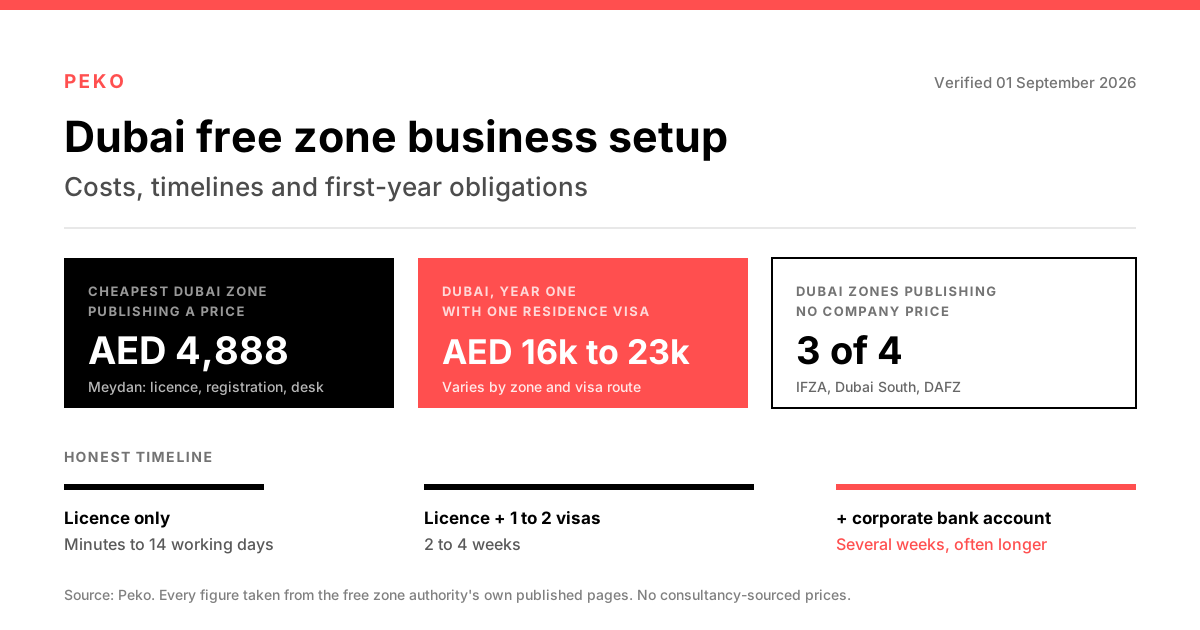
- Cost Free Zone 1 Year : From AED 12,500 (no visa, Meydan or Dubai South) to AED 35,484 (DMCC, one visa).
- Cost Mainland 1 Year : From about AED 14,000 for a lean setup before visas; typically AED 50,000–75,000 with a dedicated office and one visa.
- Timeline: 2–6 weeks end-to-end; trade licence in 4–5 working days in practice (14 working days published ceiling, u.ae)
- Ownership: 100% foreign ownership for most mainland activities since 2021; 100% in free zones
- Tax: No personal income tax on salaries. Corporate tax is 0% on profits up to AED 375,000 and 9% above. Qualifying free zone companies pay 0% on qualifying income and 9% on everything else
- Visas: Residence visas typically run two years; licence plus 1–2 visas typically takes 2–3 weeks
- Corporate tax registration: Every new company, within three months of incorporation
Source: Sources: DET / Invest in Dubai, Federal Tax Authority, u.ae, and the zones' own price pages (checked 11 November 2026)

Thinking about how to start a business in Dubai? You’re not alone. Dubai issued 58,337 new business licences across its mainland and free zones in the first half of 2026 alone (Gulf News, 3 September 2026). The reason is simple: Dubai has become one of the most business-friendly cities on the planet.
Zero personal income tax. No capital gains tax. 100% foreign ownership for most activities, and a trade licence that typically takes days, not months. The UAE is no longer a zero-tax jurisdiction for companies, though: corporate tax and VAT both apply, so the administrative side matters from day one.
Whether you’re a foreign entrepreneur, a freelancer formalising your work, or an established company expanding into the Gulf this guide covers every step of the Dubai company formation process: costs, documents, timelines, and common mistakes.
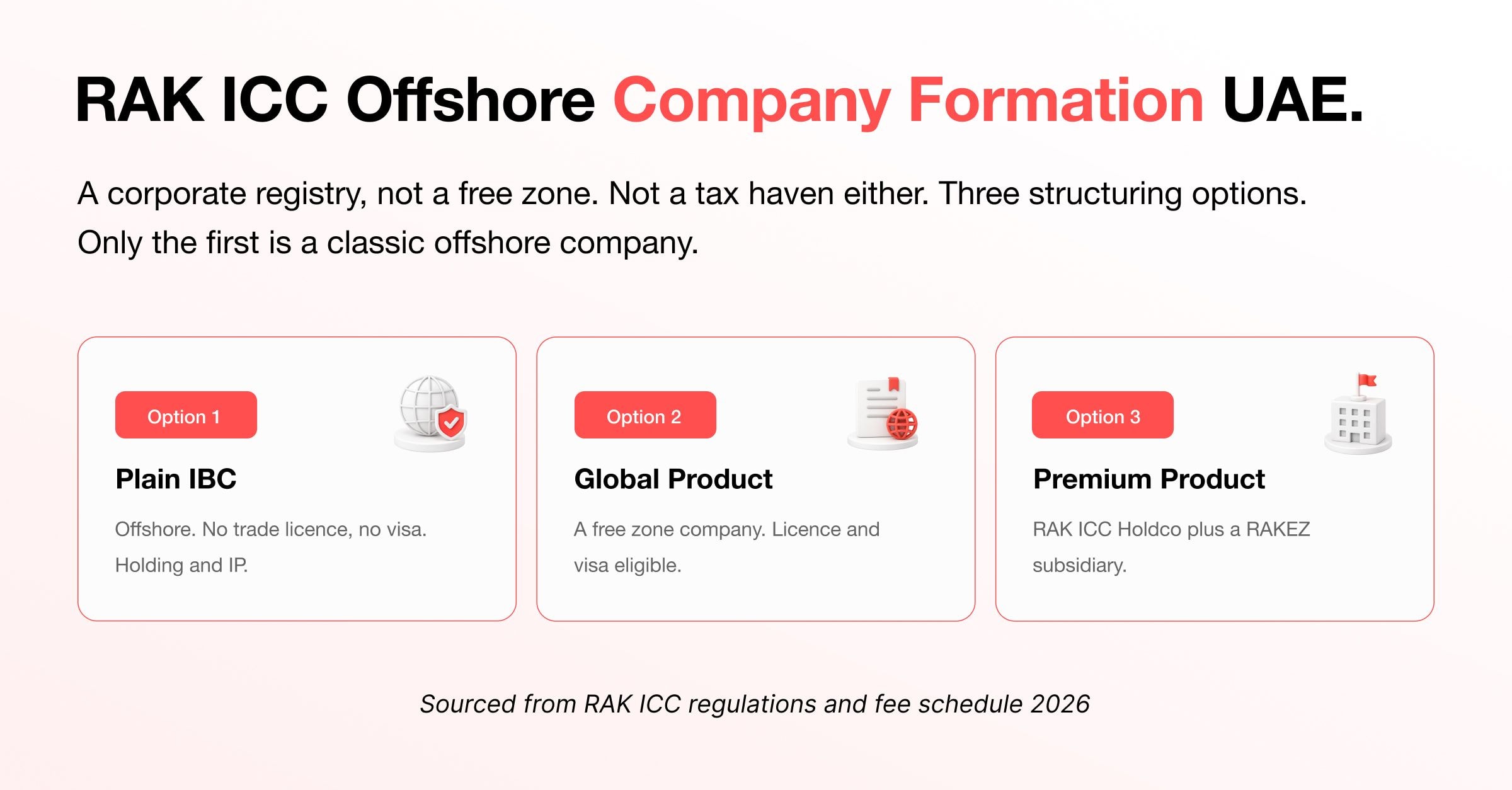
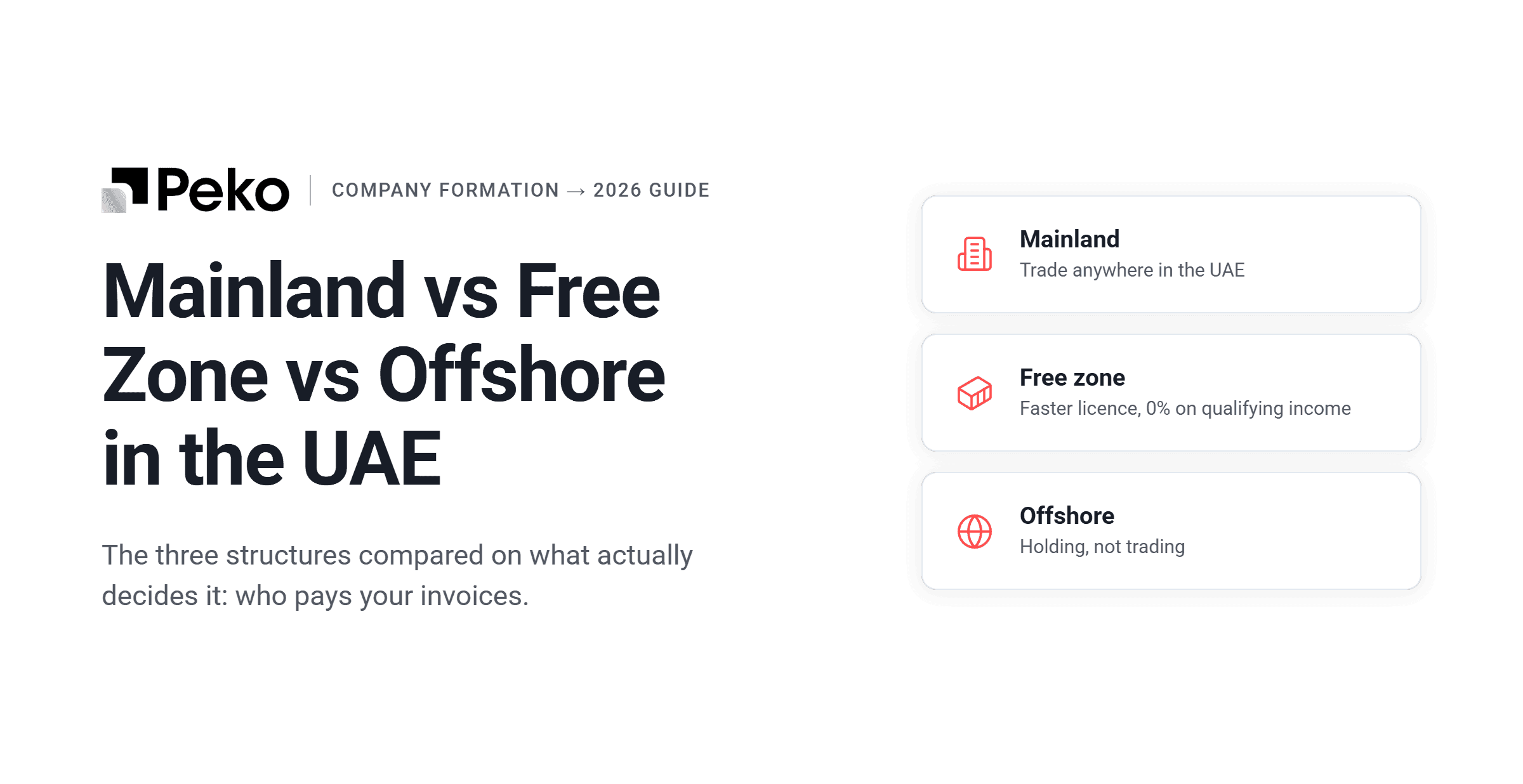
Setting up in another emirate? The steps are the same in outline, but each emirate has its own economic department and free zones. Compare them in our mainland vs free zone vs offshore UAE guide, or see Setting up in another emirate? The steps are the same in outline, but each emirate has its own economic department and free zones. Compare them in our mainland vs free zone vs offshore UAE guide, or see RAK ICC for an offshore holding company. Mainland vs Free Zone vs Offshore & Offshore Company RAK ICC Guide
Pros & Cons of Setting Up a Business in Dubai
The main advantages of setting up a business in Dubai are 0% personal income tax, 100% foreign ownership for most activities and a trade licence in days. The trade-offs are 9% corporate tax above AED 375,000, strict bank due diligence, a physical office for mainland companies, and licence fees that renew every year.
Before jumping into steps and costs, here’s an honest look at the advantages and the realities of business setup in Dubai:
How to Open a Company in Dubai: 10 Steps (2026)
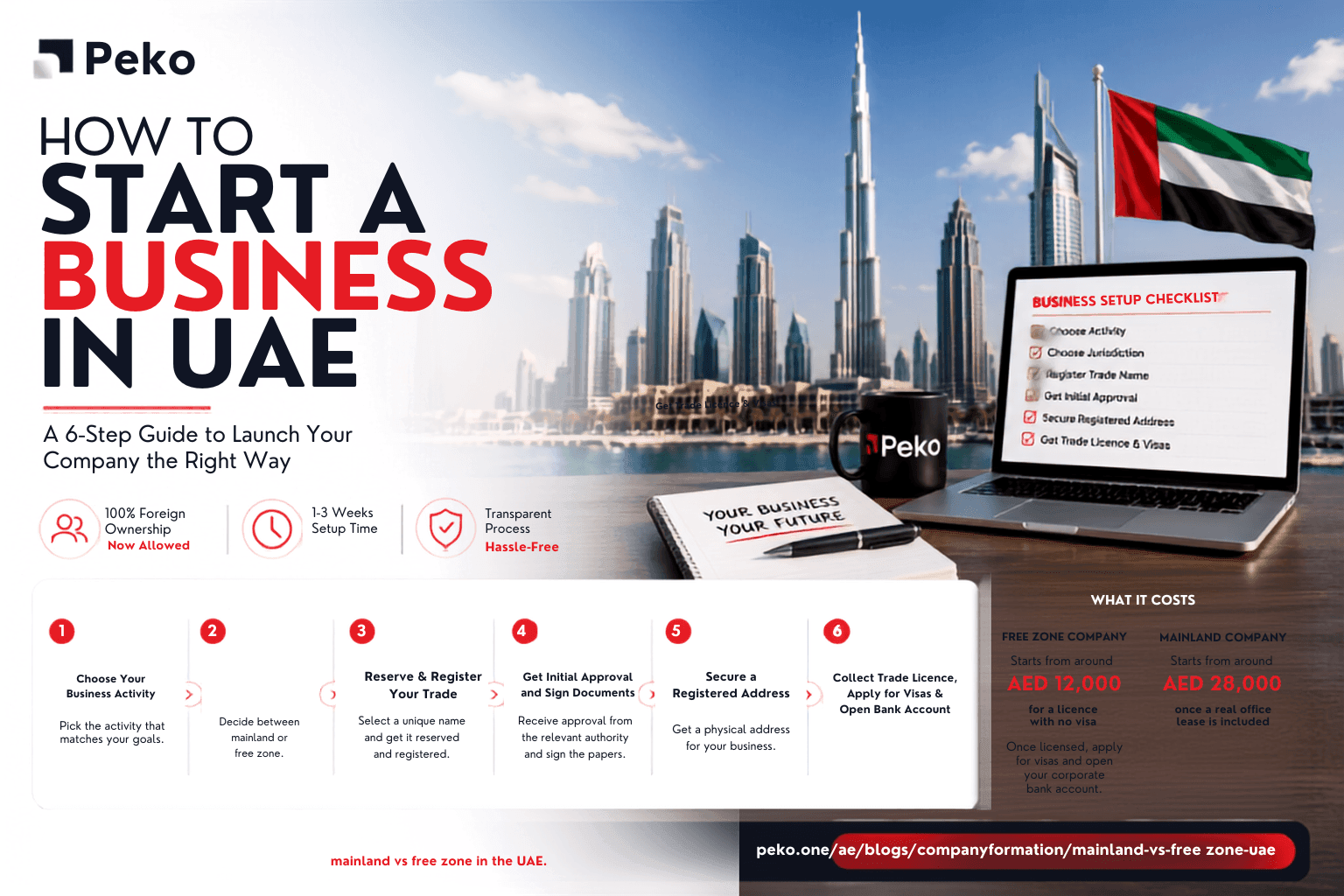
Opening a company in Dubai takes 10 steps: choose mainland or free zone, pick your activity, reserve a trade name, get initial approval, prepare documents, secure an address and collect your trade licence. Then get your establishment card and visa, open a corporate bank account and register for corporate tax. Steps 1 to 7 get you licensed; steps 8 to 10 make you operational.
Step 1: Choose Your Business Jurisdiction
This is the single most important decision in your Dubai business setup. Your jurisdiction determines who you can sell to, what taxes you pay, and how much your first year costs.
Mainland
Registered with the Department of Economy & Tourism (DET), the official UAE government authority for mainland businesses (dubaidet.gov.ae). Mainland companies can trade anywhere in the UAE, bid on government contracts, and operate without restrictions on customers.
Free Zone
Registered with one of Dubai's free zone authorities (DMCC, DAFZA, IFZA, JAFZA, Meydan, Dubai South and others). Qualifying Free Zone Persons pay 0% corporate tax on qualifying income only. To sell directly to mainland customers, a free zone company needs a DET branch licence or activity permit, with its free zone's approval.
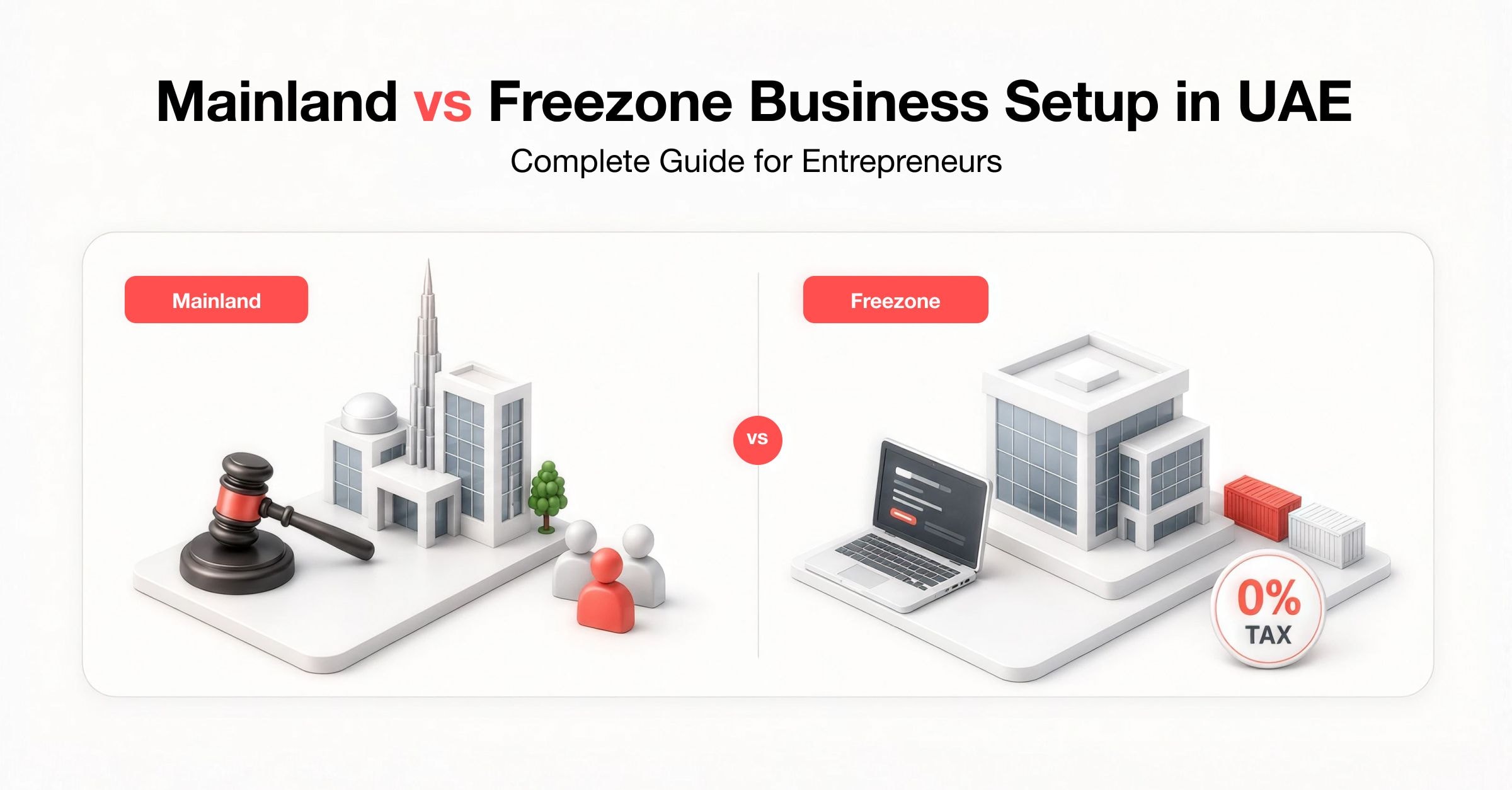
Not sure which to choose? Read our complete Mainland vs Free Zone business setup guide for 2026 for a full side-by-side analysis.
Step 2: Pick Your Business Activity & License Type
Every company in Dubai needs a trade license, and your Dubai business license type must match your actual business activity. Getting this wrong is one of the costliest mistakes, it can delay your setup and cause banks to reject your account application.
• Commercial License : buying, selling, importing, or distributing goods
• Professional License : service businesses: consulting, IT, marketing, healthcare, legal
• Industrial License : manufacturing and production businesses
• Tourism License : travel agencies and hospitality businesses
Step 3: Reserve Your Trade Name
Submit up to three name options to DET or your free zone authority; approval usually takes one to two working days. DET publishes the current reservation fee on Invest in Dubai, and most free zones include it in their package.
UAE naming rules to know:
• Must not include offensive or religious language
• Must not copy or closely mimic a well-known brand name
• Must not use a country name or government term without prior approval
• Abbreviations of your name are not permitted unless using your full legal name
Step 4: Get Initial Approval
Initial approval is the government’s confirmation that your chosen business activity is permitted and you can proceed. For mainland companies, this comes from DET. For free zone companies, it comes from your chosen free zone authority (DMCC, DAFZA, etc.).
This step typically takes 1–3 business days. Initial approval does not mean you can start trading, it’s the green light to proceed with the full application.
Step 5: Prepare Your Documents
A power of attorney is not required for registration and licensing. Documentation delays are the number one reason company formation takes longer than expected. Have all of these ready before you begin:
• Passport copies (minimum 6 months validity) for all shareholders and directors
• UAE entry stamp or visa copy proving legal entry into the country
• Emirates ID for any shareholders who are UAE residents
• Memorandum of Association (MOA) drafted and notarised before license submission
• Tenancy contract / Ejari (proof of registered office space, mandatory for mainland)
• Business plan required for some regulated activities and usually requested by banks
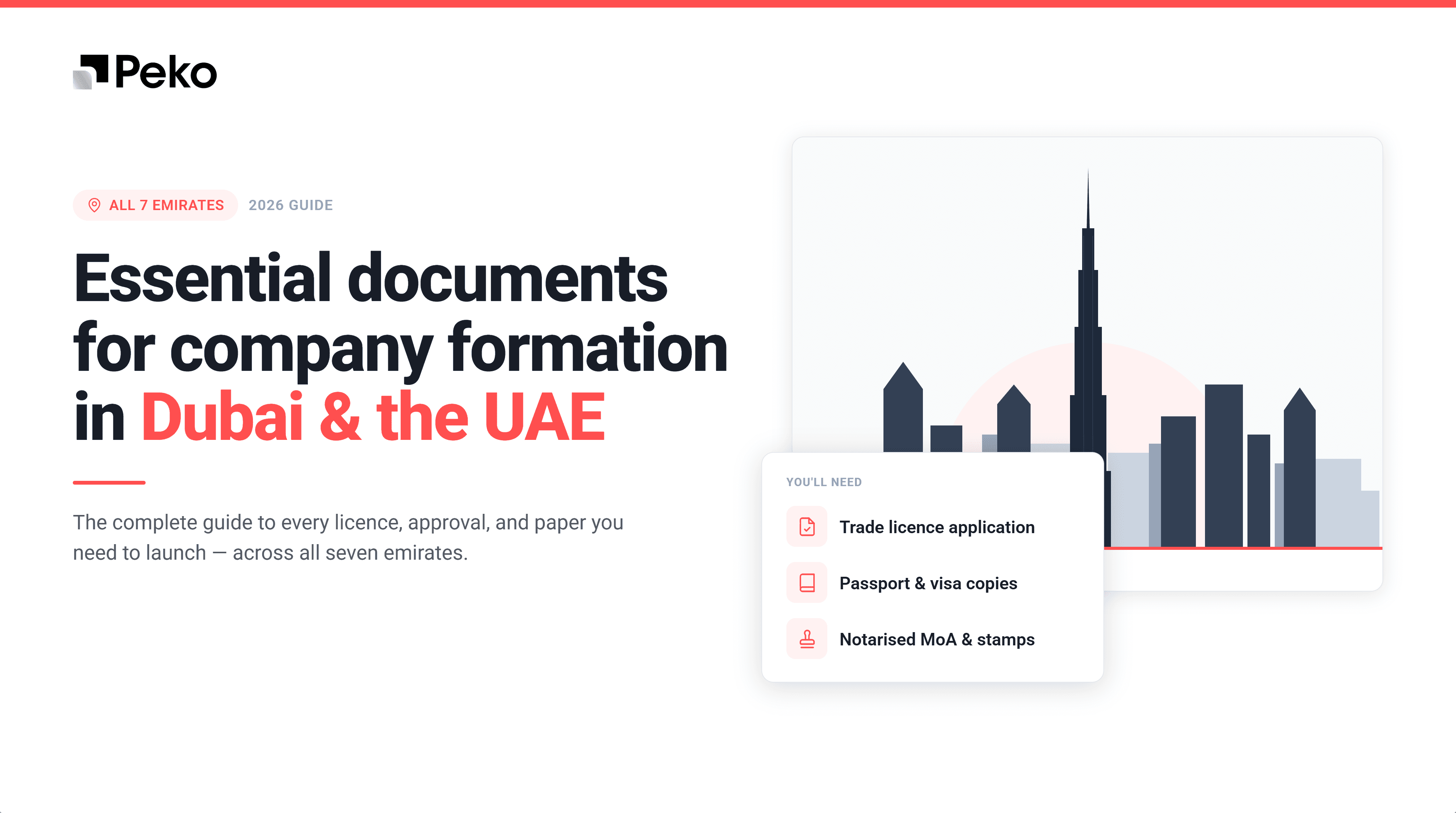
See the full documents required for company formation in Dubai and the UAE a complete checklist organised by business type and jurisdiction.
Step 6: Secure Your Office Space
• Mainland: Physical office registered with Ejari. / Flexi-desks are usually included in the licence package, with dedicated desks and offices as paid upgrades.
• Free Zone: Flexible options including virtual offices, flexi-desks, and shared work-spaces. Virtual packages start from AED 5,000 per year.
Step 7: Obtain Your Trade License
The UAE government portal sets a ceiling of 14 working days. With complete documents, licences usually arrive in 4 to 5 working days.
Step 8: Get Your Establishment Card and Investor Visa
After licensing, register the company with immigration (the establishment card and e-channel registration), then apply for your investor or partner visa. You must be in the UAE for the medical test and Emirates ID biometrics.
• Cost: typically AED 3,000–7,000 per person for the visa, medical test, and Emirates ID (Peko estimate). Each zone prices the establishment card and e-channel separately.
• Timeline: a licence plus one or two visas typically takes 2 to 3 weeks.
• Validity: residence visas typically run for two years, depending on zone and visa type. • Insurance: Dubai law requires employers to insure employees and sponsors to insure dependants (Dubai Law No. 11 of 2013).
Step 9: Open Your Corporate Bank Account
Honest warning: this is the most challenging step in 2026. UAE banks have significantly tightened their compliance requirements, and many first-time applicants face rejection.
There is a faster route. The Dubai Media Office reported in November 2025 that the Dubai Unified Licence cut average business account opening from 65 days to 5 at its seven integrated banks: Emirates NBD, Emirates Islamic, Mashreq, Commercial Bank of Dubai, First Abu Dhabi Bank, Emirates Development Bank and Ruya Bank. Start the application the same week your licence is issued.
What banks look for:
• A solid, detailed business plan explaining your revenue model and expected transactions
• Source of funds documentation for all shareholders
• Evidence of business activity (contracts, invoices, client letters if available)
• Clean shareholder background (banks run full KYC and AML compliance checks)
Step 10: Set Up Your Business Operations
Your license is live, now you need the right systems to operate legally and efficiently from day one:
• Accounting: UAE corporate tax law requires proper financial records from the first day you trade. Automated accounting software keeps you audit-ready without the manual workload.
• Corporate Tax Registration: Every new company must register with the Federal Tax Authority within three months of incorporation, whatever its expected profit (FTA Decision No. 3 of 2024). Late registration carries an AED 10,000 penalty. Our guide to corporate tax registration in the UAE answers the 25 most common questions.
• WPS Payroll: Hiring employees? All UAE salaries must be paid through the Wage Protection System. Keep “All UAE salaries must be paid through the Wage Protection System.Read how the WPS salary transfer process works before your first payroll run.
• Full Business Automation: From expense management to invoicing to bill payments, connecting these systems saves hours every week. Our UAE business operations and financial automation guide for 2026 covers the full setup sequence.
. VAT: registration is mandatory once taxable supplies exceed AED 375,000 over 12 months, and voluntary from AED 187,500.
. Climate law: Federal Decree-Law No. 11 of 2024 makes emissions measurement and reporting a legal duty for in-scope entities, with fines from AED 50,000 to AED 2,000,000. The decree sets no threshold itself. The Ministry of Climate Change and Environment decides which entities must report, and its guidance was still pending at the time of writing, so check whether your activity is in scope.
Company Incorporation in Dubai vs Company Formation: What's the Difference?
In practice they mean the same thing. Company incorporation in Dubai is the moment your entity legally exists, when DET or your free zone authority issues the trade licence. Company formation is the wider journey that also covers visas, the establishment card and banking. UAE authorities do not run a separate incorporation filing like the UK's Companies House.
Dubai company incorporation is what founders, lawyers and offshore advisors call the moment your entity legally exists: the point at which DET or your free zone authority issues your trade license. Company formation is the term Dubai's own authorities use, and it covers the whole sequence from trade name reservation to your first corporate bank account.
Three phrases you will see used interchangeably, and what each actually refers to:
- Company incorporation in Dubai — the legal creation of the entity: MOA notarisation, trade license issuance, and the Certificate of Incorporation for corporate shareholders and offshore structures.
- Company formation in Dubai — the full end-to-end process, including initial approval, office space, visas and banking.
- Business setup in Dubai (also written business incorporation in Dubai) — the commercial framing: everything above, plus accounting, payroll and corporate tax registration once you are trading.
One practical reason this matters. When you compare quotes from business setup consultants, an "incorporation-only" package usually stops at the trade license. Visas, Ejari and bank account coordination are billed on top, which can more than double the headline figure. Peko Start quotes the full picture up front.
Mainland and free zone incorporation also differ mechanically — different constitutional documents, different office proof, different amendment costs. Full comparison in our mainland vs free zone guide.
Dubai Company Setup Cost: Full 2026 Breakdown
A Dubai free zone company costs from AED 12,500 a year with no visa at Meydan or Dubai South, AED 16,500 with one visa at Dubai South and AED 35,484 for DMCC's one-visa package. A lean mainland setup starts from about AED 14,000; with a dedicated office and one investor visa, expect AED 50,000 to 75,000 in year one.
Dubai company setup cost is one of the most-searched questions around business formation, and most guides only show you the license fee. You will see the same question asked as Dubai company incorporation cost; the figures are identical, and the table below is the complete picture rather than the license line alone.
Here’s the complete picture:
Establishment card and e-channel |
| priced separately by each zone |
| Note: The mainland starting price is Peko Start’s practice figure (November 2026). Your final cost depends on business activity, legal structure, office/Ejari requirements and visa allocation. |
Published free zone prices checked 11 November 2026 on the zones' own pages (Dubai South Business Hub, updated 20 October 2026; DMCC; Meydan). Zones run promotions with no stated expiry, so confirm the live rate before you budget.
Hidden Costs Most Guides Don’t Mention
• Medical tests: Required for all visa applicants - AED 300–700 per person
• Emirates ID fee: AED 370 per person, renewable every 3 years
• Corporate bank account setup: Some banks require a minimum balance; check each bank's tariff before you apply.
• Accounting + payroll software: Factor in operational software from day one to avoid compliance penalties
• Health insurance: Dubai law requires employers to insure employees and sponsors to insure dependants (Law No. 11 of 2013). Setup quotes rarely include it.
Note: Medical test and Emirates ID are charged per person and usually billed outside the licence package.
How Long Does Company Formation in Dubai Take?
Company formation in Dubai takes about 2 to 6 weeks end to end. The trade licence is the fast part: the UAE government portal sets a ceiling of 14 working days, and with complete documents it usually arrives in 4 to 5 working days. A licence with one or two visas typically takes 2 to 3 weeks, and banking drives the rest.
Incorporation itself, trade name through to trade license, is the fast part, typically 4 to 5 working days in practice. The rest of the timeline is visas and banking, and banking is where almost all of the variance lives.
5 Mistakes That Slow Down Your Dubai Business Setup
The five mistakes that slow down a Dubai business setup most are choosing the wrong jurisdiction, registering a vague business activity, budgeting only for the licence, taking premises too small for your visa needs, and missing the three-month corporate tax registration deadline. Each one costs weeks at the bank or a second round of fees.
• Wrong jurisdiction. Going for a free zone when you need UAE mainland access means paying again to fix it. Always decide based on who your customers are, not just upfront cost.
• Incorrect business activity. Your Dubai business license activity is cross-checked by banks. A mismatch between your license and your actual transactions is grounds for account rejection.
• Under-budgeting. The license fee is one line item. Office, visas, medical tests, bank minimum balance, and professional fees easily double the headline figure. Health insurance for every visa holder is rarely in a setup quote.
• Missing tax registration. Every new company must register for corporate tax within three months of incorporation, whatever its profit. Late registration costs AED 10,000. Federal Tax Authority (FTA)
• Undersized premises. Your visa quota is tied to your office space. If you plan to hire, a flexi-desk will not carry you, and upgrading later means amending the licence.
Frequently Asked Questions About Company Formation In Dubai / UAE
How much does it cost to start a company in Dubai?
From AED 12,500 a year for a free zone licence with no visa and about AED 16,500 with one visa. A lean mainland setup starts from about AED 14,000, rising to AED 50,000 to 75,000 in year one with a dedicated office and one investor visa. Peko Start handles all →
How long does company formation in Dubai take?
About 2 to 6 weeks end to end. The trade licence itself usually arrives in 4 to 5 working days once your documents are complete.
Can a foreigner own 100% of a company in Dubai?
Yes. Since 2021 most mainland commercial and industrial activities allow 100% foreign ownership, and free zone companies are fully foreign-owned; a small number of strategic-impact activities carry conditions.
What is the minimum capital to form a company in Dubai?
There is no fixed statutory minimum for most mainland and free zone companies. Some regulated activities and some free zones set their own, so confirm with your licensing authority before you apply.
Do I need to be in Dubai to register a company?
Not for registration: you can apply online and no power of attorney is needed for licensing. You do need to be in the UAE for the visa medical test and Emirates ID biometrics.
Can a free zone company trade in mainland Dubai?
Yes, with a DET branch licence or activity permit and its free zone's prior approval, under Dubai Executive Council Resolution No. 11 of 2025.
What is the difference between company incorporation and company registration in Dubai?
Registration is a stage inside incorporation: you register your trade name and activity, and the authority incorporates the entity by issuing the trade licence. Both phrases describe the same end goal.
Does a Dubai company give me a UAE residence visa?
Yes. Owning a Dubai mainland or free zone company makes you eligible for an investor or partner visa, which typically runs for two years and lets you sponsor family members, subject to the usual conditions.
Do new Dubai companies pay corporate tax?
Corporate tax is 0% on taxable income up to AED 375,000 and 9% above it, with 0% on qualifying income for Qualifying Free Zone Persons. Every new company must register within three months of incorporation.
Ready to Start Your Company in Dubai?

The Dubai company formation process is one of the most straightforward in the world, when you know what you’re doing. Ten clear steps. Transparent costs. Timelines measured in weeks, not months.
The decisions that matter most come early: which jurisdiction you choose, which business activity you register, and whether you have the right documentation ready from day one. Get those right, and everything else follows naturally.
If you want to create a company in Dubai without managing ten separate authority interactions yourself, Peko Start takes care of the entire incorporation, license, visa, and every operational system you need to run compliantly: accounting, payroll, corporate tax, bill payments, corporate travel and expense management.
Start Your Company in Dubai with Peko License • Visa • Accounting • Payroll • Tax • Cards |
|---|
Related Reads
This guide is general information, not legal or tax advice. Fees and rules change; confirm with DET, your free zone authority and the Federal Tax Authority before you commit. Peko is not a government authority.