- Blogs
- Company Formation
- Mainland vs Free Zone vs Offshore UAE: 2026 Guide
Aug 13, 2026
Mainland vs Free Zone vs Offshore UAE: 2026 Guide
Share this article
- Mainland vs Free Zone vs Offshore in the UAE: How to Choose the Right Business Setup
- What Mainland, Free Zone and Offshore Actually Mean
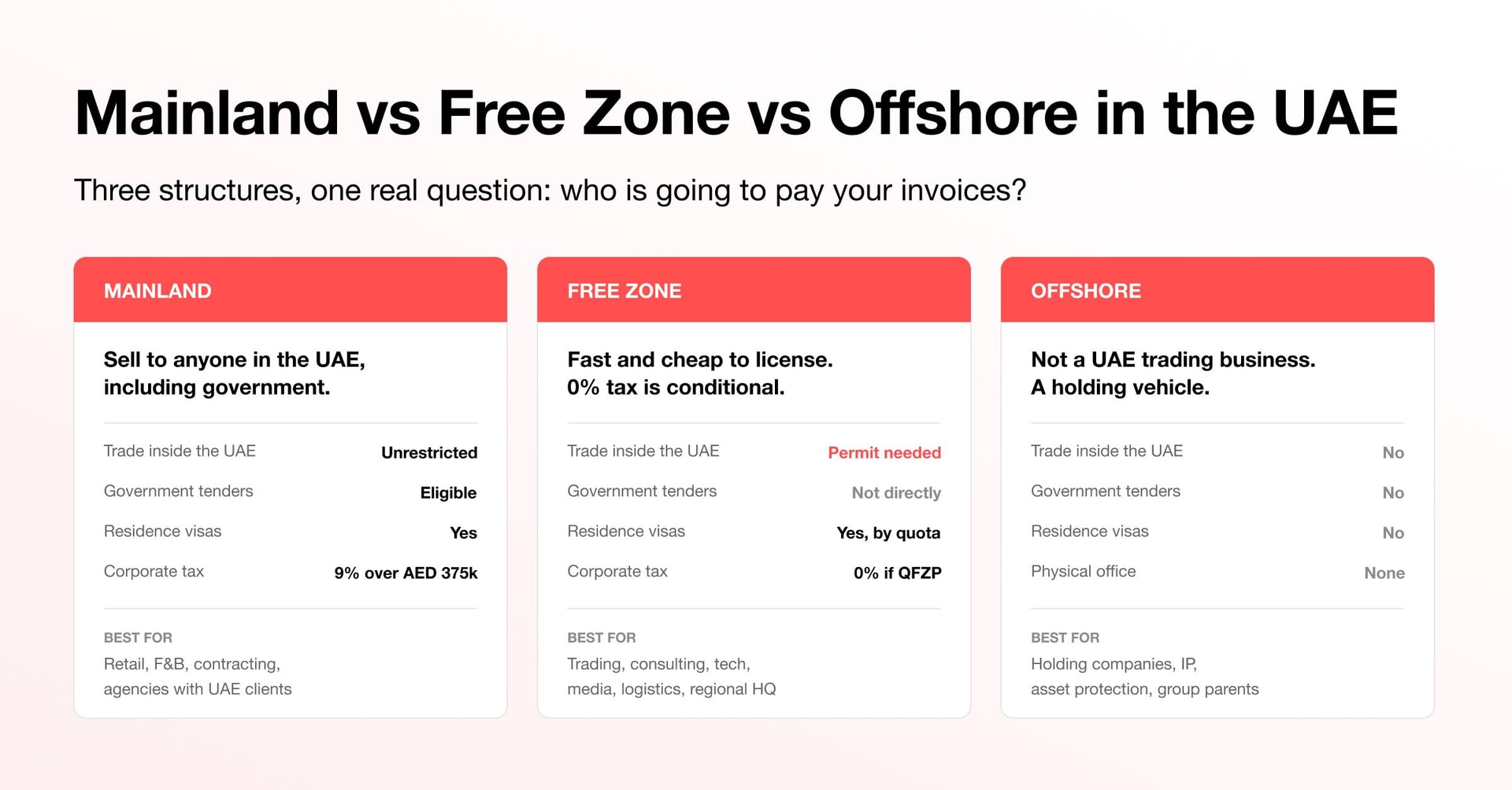
- Mainland vs Free Zone vs Offshore: Side by Side
- The Tax Question Everyone Gets Wrong
- What Changed in 2025 and 2026
- How to Actually Choose: Three Questions
- Which Industries and Business Types This Applies To
- Frequently Asked Questions About the difference between mainland, free zone and offshore company setup in the UAE
- More Questions on UAE Company Setup
- Final Thoughts
Mainland vs Free Zone vs Offshore in the UAE: How to Choose the Right Business Setup
TL;DR:
|
Most comparisons of mainland vs free zone vs offshore in the UAE are written to sell you a package. They present three tidy columns, put a green tick next to whichever option the writer sells, and stop. The real decision is narrower than that, and it turns on one question that has almost nothing to do with tax: who is going to pay your invoices?
Answer that honestly, and the structure usually picks itself.
What Mainland, Free Zone and Offshore Actually Mean
The three structures differ in where you are legally allowed to earn money, not in how "good" they are. Mainland companies are licensed by an emirate's economic department and can sell anywhere in the UAE. Free zone companies are licensed by an independent zone authority and were historically fenced into that zone plus international markets. Offshore companies are registered UAE entities that are barred from carrying on business inside the country.
Mainland
A mainland licence comes from the Department of Economy and Tourism (Dubai), ADDED (Abu Dhabi) or the equivalent authority in the other emirates. You can sell to UAE consumers, sign contracts with government bodies, and open branches across the country without a local partner or distributor in between.
The old 51% Emirati ownership rule is gone for most activities. Federal Decree-Law No. 32 of 2021 on Commercial Companies, building on Federal Decree-Law No. 26 of 2020, permits full foreign ownership of mainland companies, with the Cabinet retaining a list of "strategic impact" activities where restrictions still apply. That list covers areas like defence, banking and insurance, telecoms and commercial agencies (u.ae). Available legal forms include the LLC, general and limited partnerships, and public or private joint stock companies. A Local Service Agent is still needed for certain forms held entirely by non-GCC nationals, typically sole establishments and civil companies, and that agent holds no equity.
Free Zone
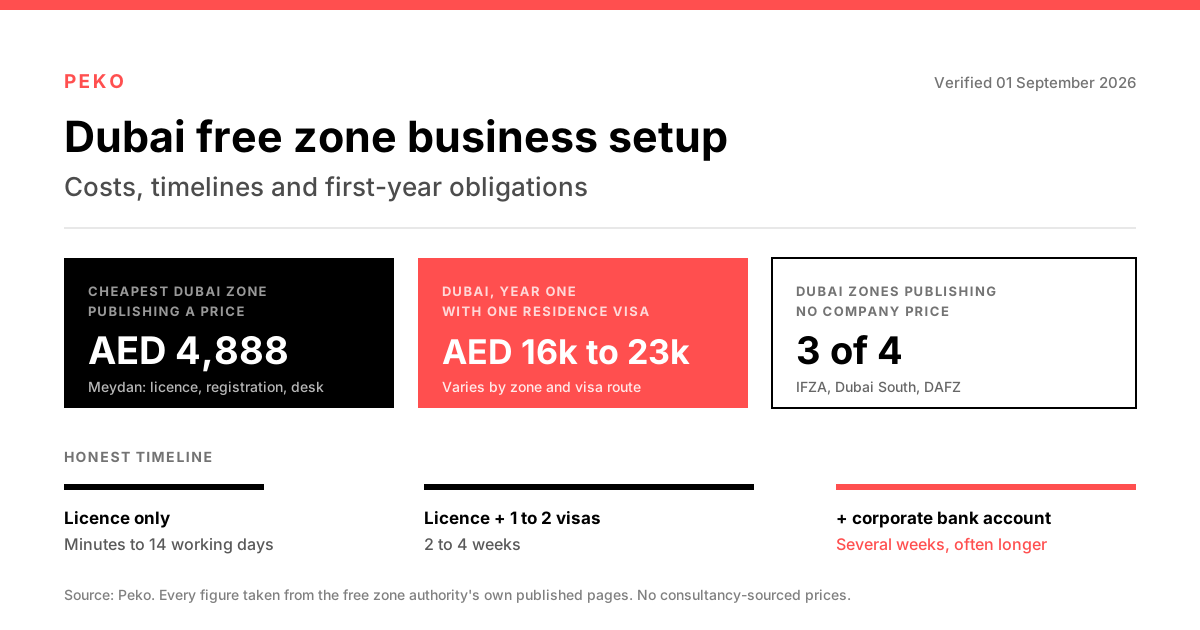
There are more than 40 free zones across the UAE, each with its own registrar, activity list, and pricing. You can incorporate a Free Zone Establishment (single shareholder), a Free Zone Company (multiple shareholders), or register a branch of an existing company. The UAE government portal puts licence issuance at around 14 working days once documents are approved.
What you get is speed, a predictable fee schedule, 100% ownership by default, and an ecosystem built for a particular industry. What you historically gave up was direct access to the domestic market. That constraint has loosened, which we will come back to.
Offshore
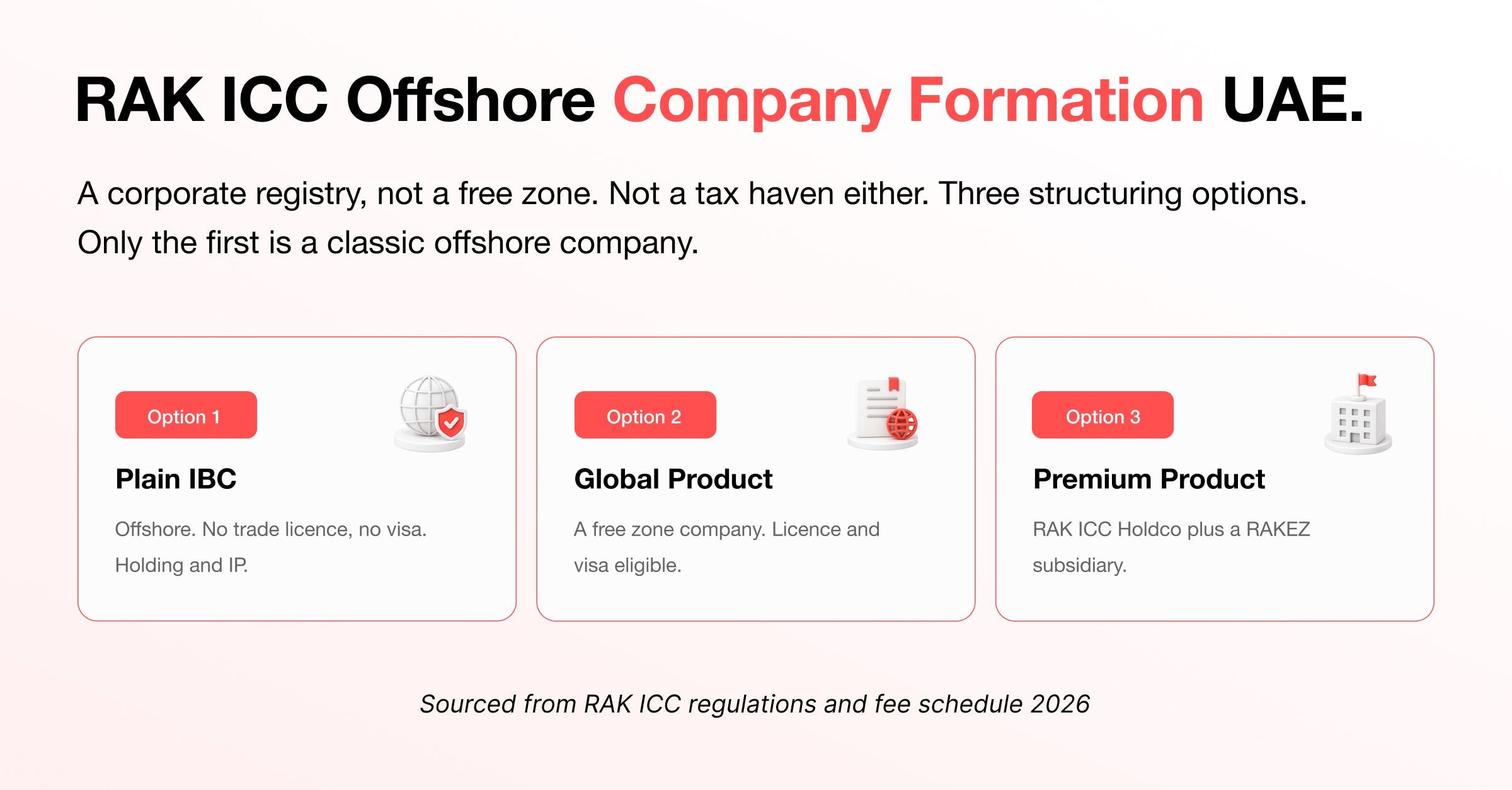
This is the one people misunderstand most. A RAK ICC or JAFZA Offshore company is a UAE-registered entity that cannot trade inside the UAE. RAK ICC's own Business Companies Regulations 2018 are blunt about it: "No company shall carry on business with persons in the Zone unless expressly authorised to do so by RAK ICC" (Regulation 40(5)(a)), and any activity elsewhere in the UAE requires the appropriate licence from the competent authority (Regulation 40(8)).
There is no trade licence for local activity, no office, and no visa quota attached. Tellingly, RAK ICC markets a separate "Global" midshore product precisely because it adds UAE residence visa eligibility and office options that the classic offshore IBC does not carry.
Offshore earns its keep as a holding company, an asset-protection vehicle, or the parent in a multi-entity group. Treat it as an operating business and you will hit a wall at the first bank meeting.
Mainland vs Free Zone vs Offshore: Side by Side
The Tax Question Everyone Gets Wrong
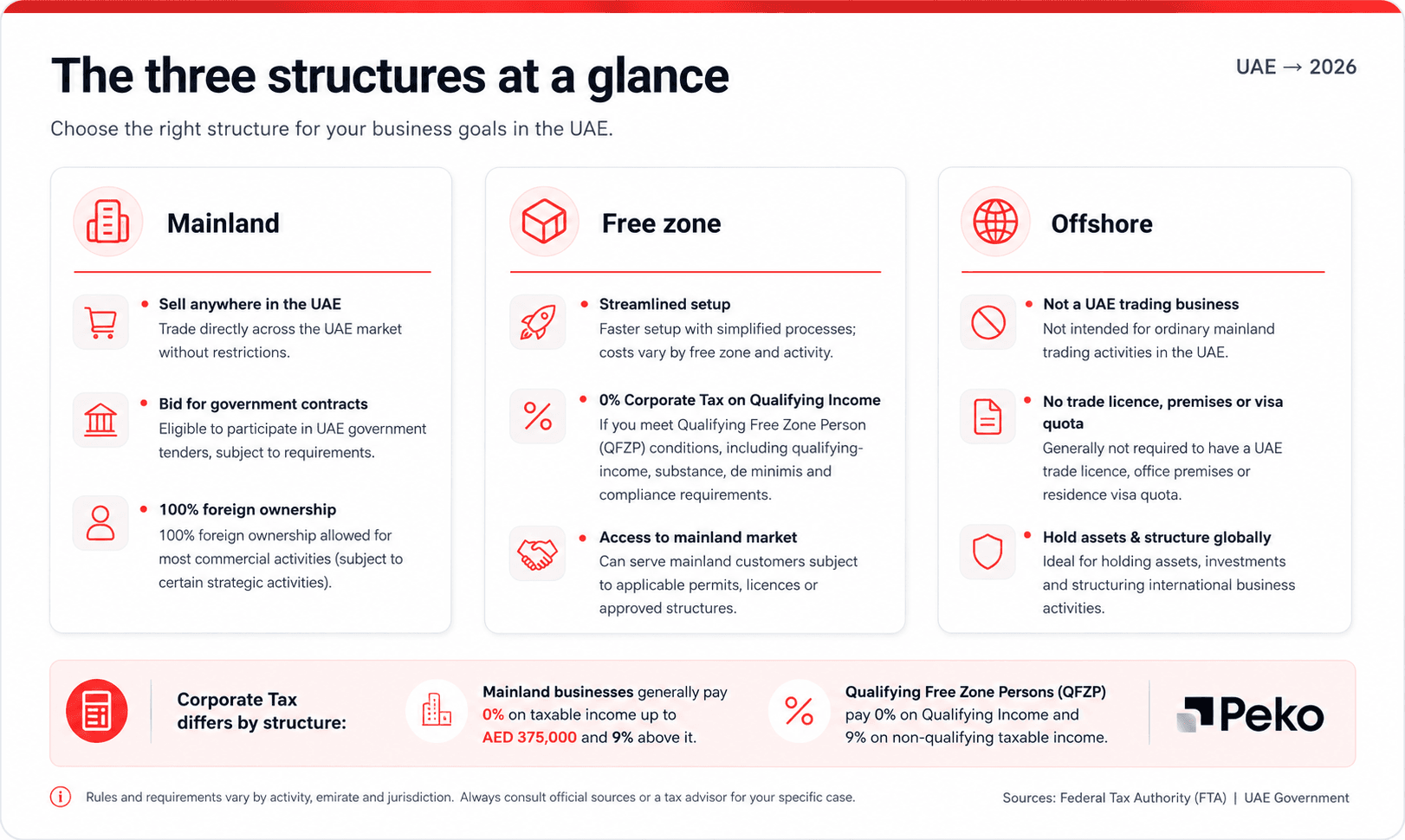
Free zone does not mean tax-free. Every UAE business, mainland or free zone, sits inside the corporate tax regime introduced by Federal Decree-Law No. 47 of 2022, which applies to financial years starting on or after 1 June 2023. Cabinet Decision No. 116 of 2022 sets the rates: 0% on taxable income up to AED 375,000 and 9% above it.
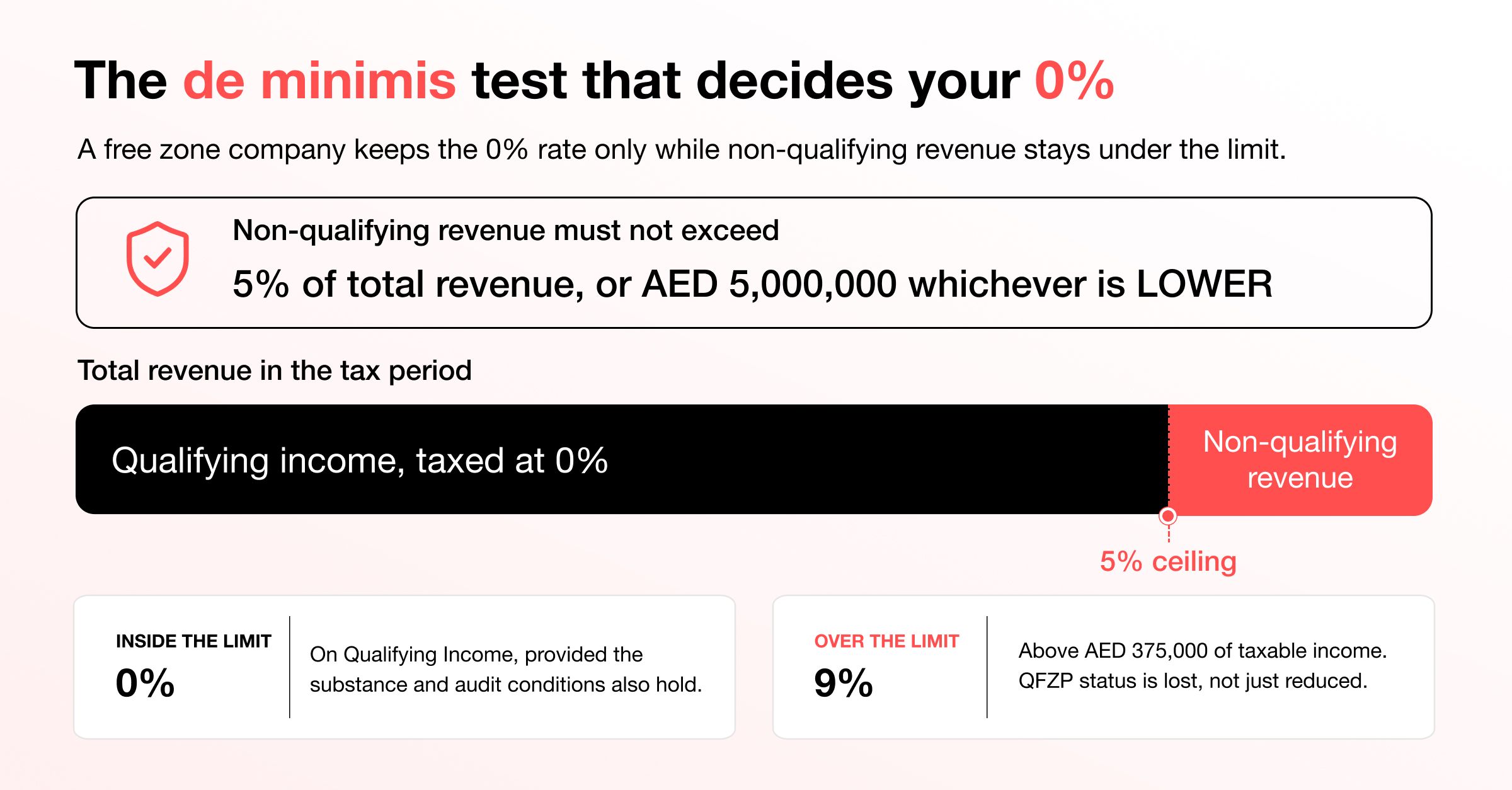
What a free zone offers is a conditional 0% on Qualifying Income, and the conditions are real. Under Cabinet Decision No. 100 of 2023 (which repealed Cabinet Decision No. 55 of 2023), a Qualifying Free Zone Person must carry out its core income-generating activities in the zone with adequate assets, staff, and operating expenditure. It must stay inside the de minimis limit for non-qualifying revenue: no more than 5% of total revenue or AED 5,000,000, whichever is lower.
Here is the part that almost no 2026 guide has caught up with. The list of Qualifying and Excluded Activities is no longer governed by Ministerial Decision No. 265 of 2023. That decision was repealed by Ministerial Decision No. 229 of 2025, issued 28 August 2025, which now carries the current activity list and the de minimis figures. If your advisor is still quoting 265, they are working from a repealed instrument.
Two more dates worth putting in your calendar. Small Business Relief, which lets a resident business with revenue at or below AED 3,000,000 be treated as having no taxable income, only applies to tax periods ending on or before 31 December 2026 under Ministerial Decision No. 73 of 2023. A Qualifying Free Zone Person cannot elect it. And late corporate tax registration carries an AED 10,000 administrative penalty, so registration is not something to leave until the first return is due. If you are working through this now, our corporate tax registration guide answers the 25 questions owners ask most.
VAT sits separately: registration is mandatory once taxable supplies pass AED 375,000 and voluntary from AED 187,500, at a 5% standard rate.
What Changed in 2025 and 2026
The cleanest line between mainland and free zone has blurred, and this is the single biggest update to the comparison.
Dubai's Executive Council Resolution No. (11) of 2025, effective 3 March 2025, lets free zone companies conduct business on the Dubai mainland without setting up a separate mainland entity. Two routes exist: a branch licence valid for one year at AED 10,000, or a temporary permit of up to six months at AED 5,000. Both need prior approval from the free zone authority and the Department of Economy and Tourism, and the company must keep separate financial records for its mainland activity. DIFC entities are outside the scheme, and companies already operating on the mainland were given a year to regularise.
Practically, this means "free zone companies cannot serve UAE clients" is now wrong in Dubai. It is a permit and a bookkeeping obligation, not a wall. It also does not change your corporate tax position: mainland-sourced revenue is generally non-qualifying, so it counts against your 5% / AED 5m de minimis limit.
The other date to plan around is e-invoicing, and it is phased — not a single switch-on. Under Ministerial Decision No. 244 of 2025 (Article 5), businesses with annual revenue of AED 50 million or more must appoint an Accredited Service Provider by 30 October 2026 (extended from the original 31 July 2026) and comply from 1 January 2027. Everyone below AED 50 million, which is most newly incorporated companies, has until 31 March 2027 to appoint an ASP and must comply from 1 July 2027. Government entities also appoint by 31 March 2027 and go live on 1 October 2027. B2C invoicing is out of scope for now.
So if you are incorporating today, your realistic go-live is July 2027 rather than January — but the ASP appointment deadline lands in March, which is closer than it sounds. Whichever structure you choose, your invoicing system needs to be ready for the bracket you fall into. We break the timeline down in our UAE e-invoicing and payment links guide.
How to Actually Choose: Three Questions
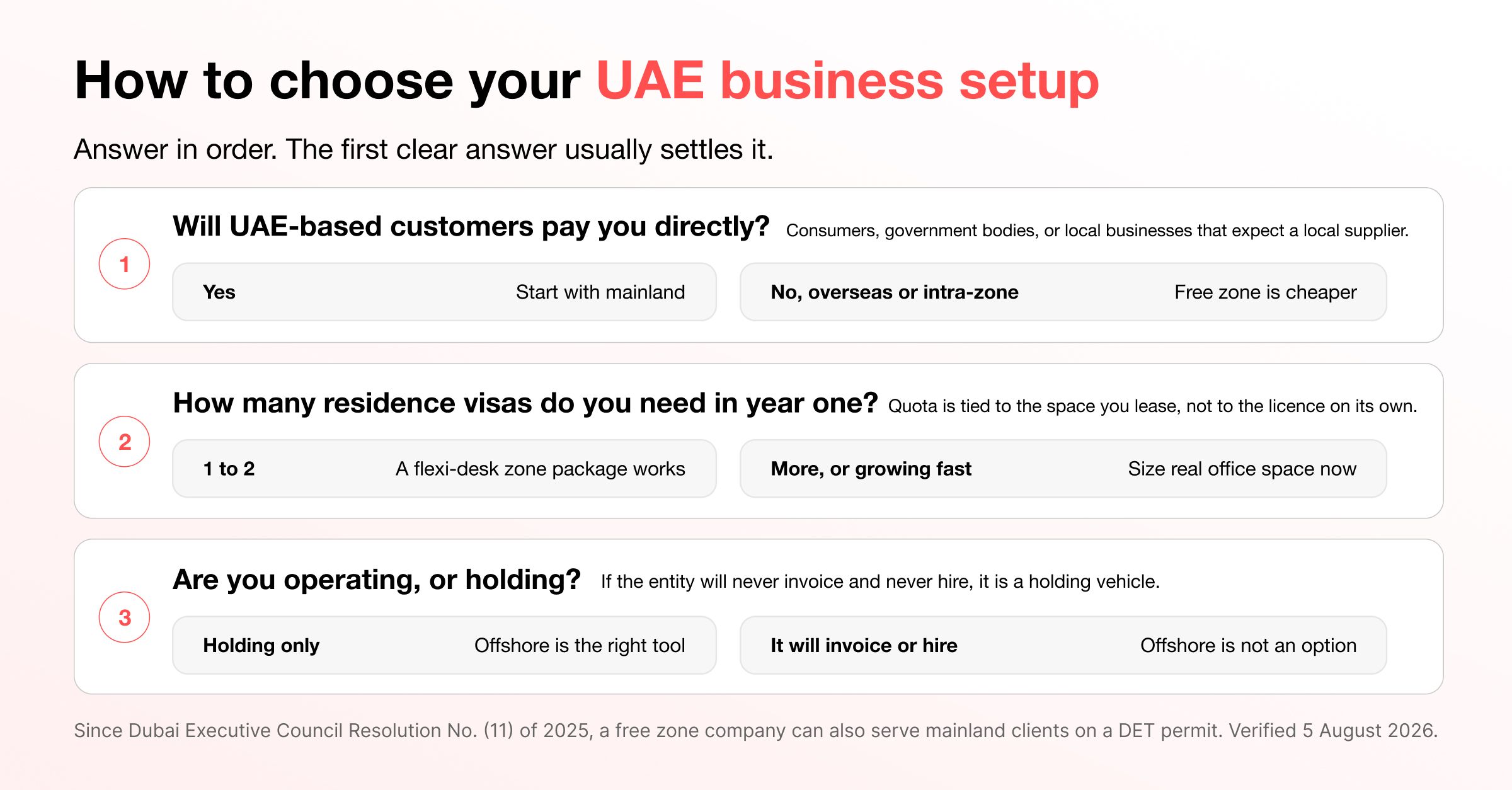
Skip the feature grids. Answer these in order.
1. Will UAE-based customers pay you directly? If yes, and they are consumers, government bodies or businesses that expect a local supplier, start with mainland. If your revenue comes from outside the UAE or from other free zone entities, a free zone is the cheaper and faster path.
2. How many residence visas do you need in year one? Visa quota is tied to the space you lease. A flexi-desk in a low-cost zone might support one or two visas; a mainland office sized properly supports more. Underestimating this is the most common reason companies restructure in year two.
3. Are you operating, or holding? If the entity will never issue an invoice, never hire, and exists to own shares or property, offshore is the right tool. If it will do any of those things, it is not.
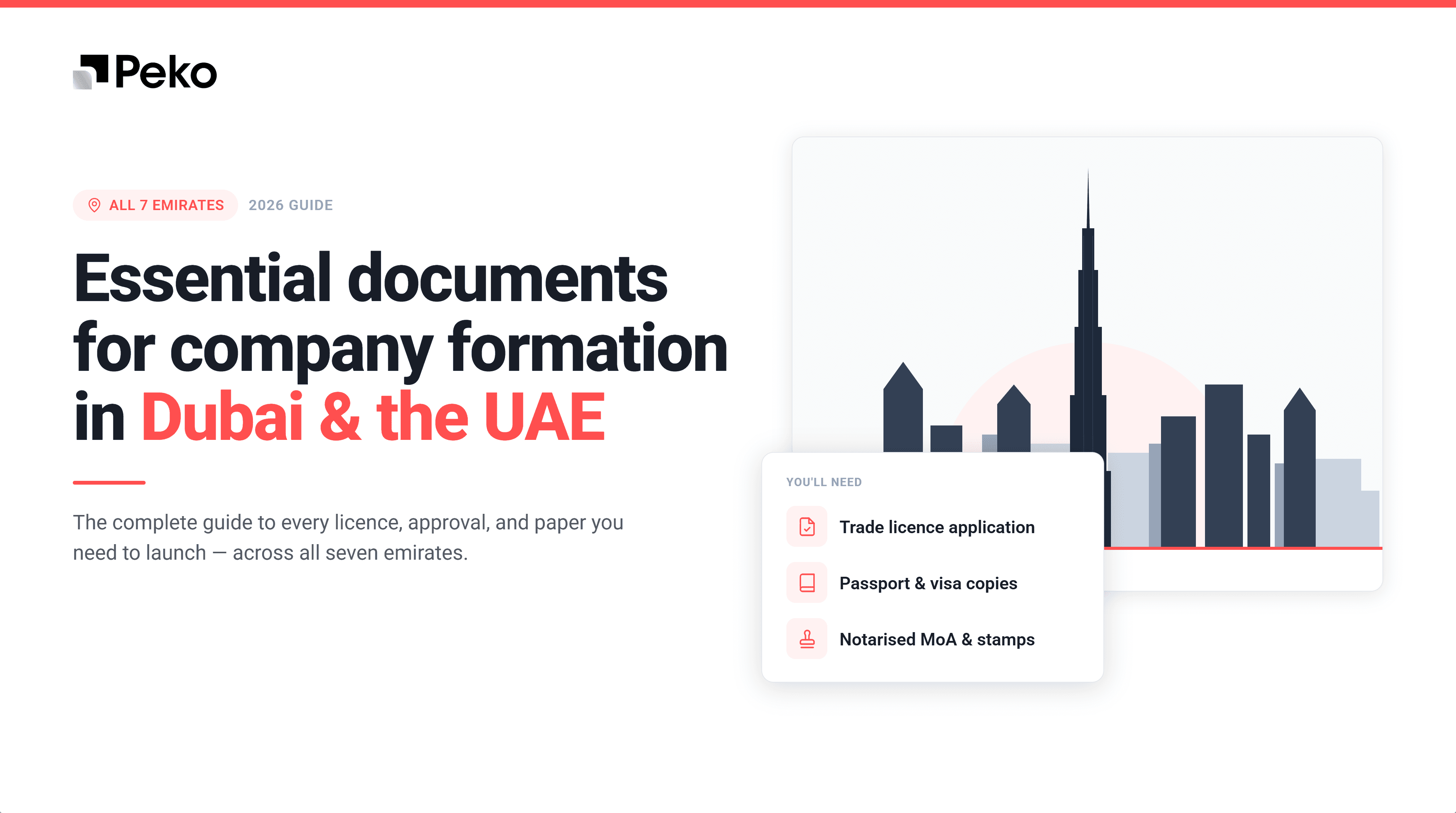
For the deeper two-way breakdown, including visa types, banking and which zones suit which activity, see our full mainland vs free zone comparison for the UAE. When you are ready to move, the documents required for company formation in Dubai and the UAE is the checklist to work from.
Which Industries and Business Types This Applies To
The right structure changes sharply by what you actually do:
- Retail, F&B and fitness studios serving walk-in UAE customers: mainland, almost without exception. You need a physical trade licence tied to a location.
- Construction, contracting and facilities management bidding for government or developer work: mainland, because most tenders require it.
- Consultants, agencies and freelancers with a mix of UAE and overseas clients: free zone for the licence, plus a DET permit in Dubai if local invoicing grows past incidental.
- E-commerce and cross-border trading shipping into the region: free zone, ideally one with customs and warehousing infrastructure such as JAFZA or DAFZA.
- Tech startups and SaaS billing internationally: free zone, with attention to whether your revenue counts as Qualifying Income.
- Media, film and creative production: sector-specific zones like SHAMS or twofour54 usually beat generic options on cost and licensing speed.
- Family offices, holding structures and property investors: offshore for the holding layer, with an operating entity elsewhere if there is any UAE activity.
- Regional headquarters of foreign groups: free zone for the HQ, with a mainland branch or permit where local delivery is needed.
Frequently Asked Questions About the difference between mainland, free zone and offshore company setup in the UAE
What is the main difference between mainland, free zone and offshore company setup in the UAE?
Mainland companies can trade anywhere in the UAE and bid for government contracts. Free zone companies are licensed by a zone authority, are built for international and intra-zone trade, and can qualify for 0% corporate tax on Qualifying Income. Offshore companies cannot carry on business inside the UAE at all and exist for holding, asset protection and international structuring.
Can a free zone company do business on the UAE mainland in 2026?
In Dubai, yes. Executive Council Resolution No. (11) of 2025, effective 3 March 2025, allows free zone companies to operate on the mainland through a one-year branch licence (AED 10,000) or a temporary permit of up to six months (AED 5,000), with approval from both the free zone authority and the Department of Economy and Tourism. Separate financial records are required. Other emirates handle this differently, so check locally.
Is a UAE free zone company really 0% corporate tax?
Only on Qualifying Income, and only if it meets every Qualifying Free Zone Person condition, including adequate substance in the zone and non-qualifying revenue below 5% of total revenue or AED 5,000,000, whichever is lower. Fail those and the company is taxed at the standard 9% above AED 375,000. The current activity list sits in Ministerial Decision No. 229 of 2025, which repealed Ministerial Decision No. 265 of 2023.
Can an offshore company in the UAE get residence visas or an office?
No. A standard offshore company such as a RAK ICC IBC or a JAFZA Offshore company carries no visa quota, no trade licence for UAE activity and no premises. RAK ICC sells a separate midshore "Global" product for founders who need residence visa eligibility and office facilities.
Do I still need a local sponsor for a mainland company in the UAE?
Not for most activities. Full foreign ownership of mainland companies is permitted under Federal Decree-Law No. 32 of 2021, subject to a Cabinet list of "strategic impact" activities where restrictions remain. A Local Service Agent is still required for certain legal forms held entirely by non-GCC nationals, such as sole establishments and civil companies, and that agent holds no shares in the business.
Which UAE business setup is cheapest for a startup?
A low-cost free zone licence with a flexi-desk is usually the cheapest entry point, and several zones package a licence with one or two visas. The saving disappears quickly if your customers are UAE-based, because you will then be paying for a mainland permit or a second entity on top. Cheapest at incorporation and cheapest over three years are rarely the same answer.
More Questions on UAE Company Setup
When does e-invoicing actually apply to a newly incorporated UAE company?
If your annual revenue is below AED 50 million, which covers most new companies, you must appoint an Accredited Service Provider by 31 March 2027 and issue compliant e-invoices from 1 July 2027. The 1 January 2027 date widely quoted online applies only to businesses at or above AED 50 million in revenue, which had to appoint an ASP by 30 October 2026. Government entities go live on 1 October 2027. The phasing is set out in Ministerial Decision No. 244 of 2025.
Does the structure I choose change my e-invoicing deadline?
No. The phasing is based on annual revenue and entity type, not on whether you hold a mainland, free zone or offshore licence. A free zone company above AED 50 million faces the January 2027 date exactly as a mainland company of the same size does. Offshore entities that do not carry on business in the UAE and are not VAT-registered fall outside the scheme in practice, but confirm your own position with the FTA.
Final Thoughts
The honest read is that free zone versus mainland has become a less dramatic decision than it was three years ago, and offshore has become a more specialised one. Dubai's 2025 resolution took the sting out of the biggest free zone limitation, while corporate tax quietly removed the "tax free" shine that made free zones an automatic default. What is left is a practical question about your customers, your headcount, and your appetite for compliance.
Wherever you land, the admin does not stop at the licence. Corporate tax registration, VAT thresholds, WPS payroll if you hire, and e-invoicing readiness - 1 January 2027 if you clear AED 50 million in revenue, 1 July 2027 if you do not, all arrive whether you chose a free zone or a mainland LLC. If you would rather run all of that from one place than stitch together five tools, see how Peko handles it.
Explore Pekos Platform And Choose Your Tools To Start Your UAE Company with Peko →
|
|---|
Note: This article is general information, not legal or tax advice. Rules, fees and activity lists change, and each free zone sets its own terms. Verify your specific position with the Federal Tax Authority, the Ministry of Economy and Tourism, or a licensed advisor before acting.