- Blogs
- WPS Payroll and HR
- UAE WPS Compliance Guide 2026: Avoid AED 50,000 Fines | Peko
May 07, 2026
UAE WPS Compliance Guide 2026: Avoid AED 50,000 Fines | Peko

Share this article
The Master Guide to UAE Wage Protection System (WPS) in 2026
✅ Last verified: 22 July 2026 | Sources: MoHRE, Central Bank of UAE, U.AE (Official UAE Government Portal), Federal Decree-Law No. 33 of 2021, Ministerial Resolution No. 340 of 2026, Cabinet Resolution No. 21 of 2020
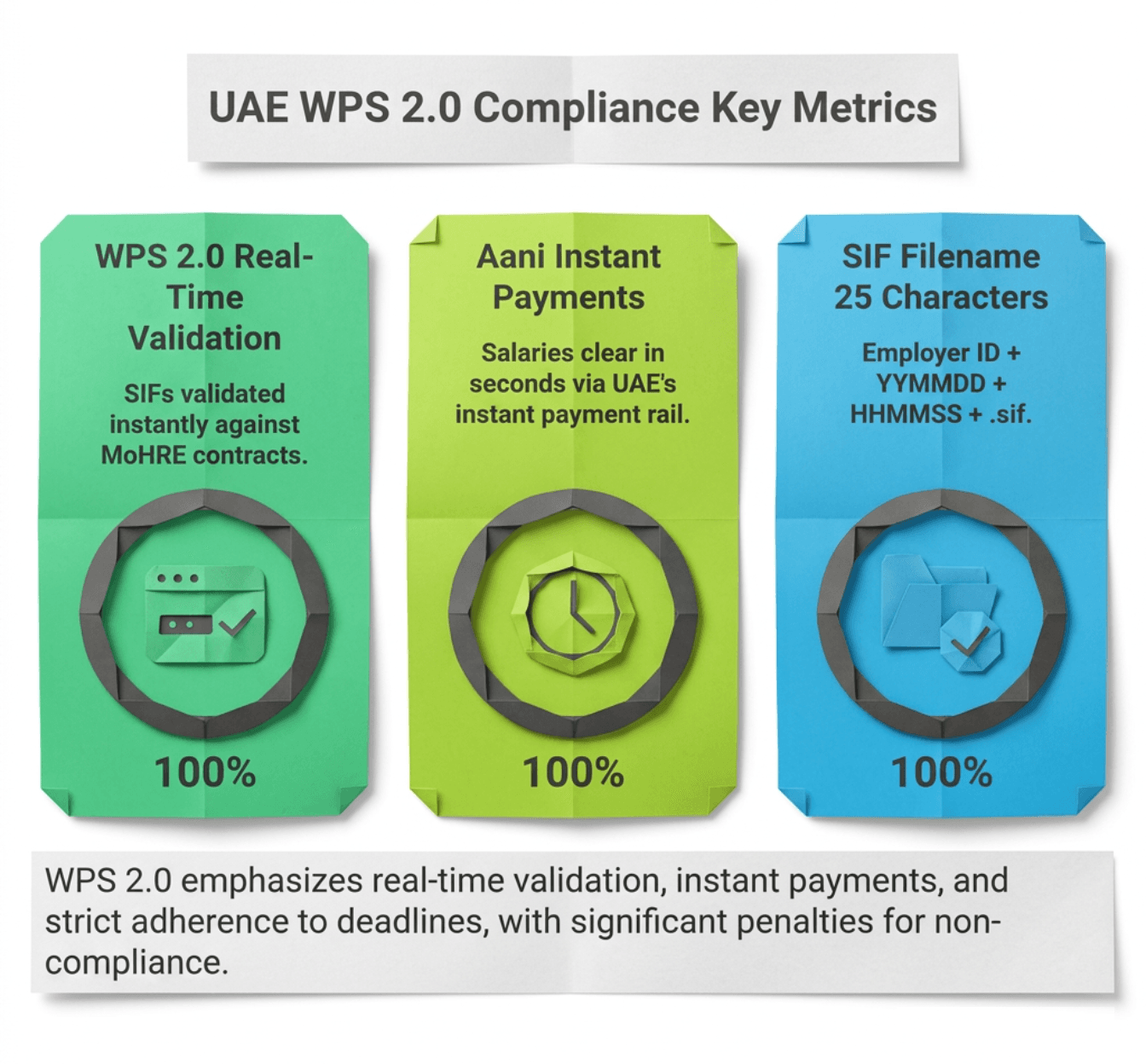
TL;DR: The 60-Second Compliance CheckIn December 2025, the UAE rolled out WPS 2.0, a fully digital, real-time payroll monitoring platform built on direct integration between MoHRE, the Central Bank of the UAE, and Al Etihad Payments. By 2026, payroll compliance has shifted from "monthly batch reporting" to "instant validation." Key Takeaways:
|
1. What Is the UAE Wage Protection System? {#what-is-wps}
The Wage Protection System (WPS) was launched in 2009 by the UAE Ministry of Human Resources and Emiratisation (MoHRE) in partnership with the Central Bank of the UAE. It is a mandatory electronic salary transfer and monitoring system that requires private-sector employers to pay wages through approved banking channels.
The legal foundation rests on three core instruments:
- Federal Decree-Law No. 33 of 2021 (current UAE Labour Law, effective 2 February 2022)
- Ministerial Resolution No. 340 of 2026 (WPS-specific regulations)
- Cabinet Resolution No. 21 of 2020 (employer classification and penalty framework)
According to MoHRE, WPS today covers more than 99% of private-sector employees, with monthly salary transfers exceeding AED 35 billion.
2. WPS 2.0: What Changed in December 2025 {#wps-2}
In December 2025, MoHRE launched a fully upgraded WPS platform in collaboration with the Central Bank and Al Etihad Payments. This is the most significant operational change since WPS was introduced.
The Real-Time Validation Layer
Previously, you would upload your SIF, and the bank would process it on a delayed-batch basis. Errors often surfaced only during periodic audits.
Under WPS 2.0:
- Every SIF is validated instantly against the Unified Labour Contract held in MoHRE's records.
- A wrong IBAN, a Labour ID mismatch, or a one-dirham discrepancy between submitted and contracted basic salary causes the file to be rejected before it reaches the bank.
- AI-assisted validation also scans for unpaid leave without correct deduction codes, outdated contract details, and basic pay that has drifted from MoHRE records.
Aani Instant Payments & Jaywan Integration
WPS 2.0 integrates with Aani, the UAE's instant payment platform, meaning salary transfers can now clear in seconds rather than days. Participating institutions include Al Maryah Community Bank, Al Ansari Exchange, Lulu Exchange, GCC Exchange, and digital wallet providers like Botim.
Expanded Scope
The system now covers domestic workers (drivers, nannies, household staff) in many situations, and international assignees on UAE work permits must demonstrate that their local salary component flows through WPS, regardless of whether part of their compensation originates abroad.
💼 Streamline Your Operations: Managing WPS 2.0's real-time validation manually is high-risk. Peko helps UAE businesses automate compliance, license renewals, and back-office tasks, so you focus on growth, not on file rejection emails.
|
3. The AED 6,000 Emirati Minimum Wage Rule {#emirati-wage}
Effective 1 January 2026, every UAE national employed in the private sector must receive a minimum monthly salary of AED 6,000. This is a structural component of the Nafis programme and Emiratisation policy.
The Critical Dates
What This Means for Your Payroll System
WPS 2.0 automatically validates Emirati salaries against the AED 6,000 threshold as part of Emiratisation quota monitoring. If your master data (contracted salary, IBAN, Emirati flag) is inaccurate, the system will flag it.
📌 Note on Part-Time Emiratis: The AED 6,000 floor is primarily designed for full-time private-sector roles. Pro-rata application to part-time arrangements should be confirmed with MoHRE for your specific case, as guidance continues to evolve. Be especially cautious of "fake Emiratisation" — penalties for fraudulent Emirati hiring can reach AED 100,000 per misrepresented position, and Emiratisation quota failures can cost up to AED 108,000 per missing position annually for companies with 50+ employees.
4. The Penalty Timeline Under Resolution 340 of 2026 {#penalties}
Most WPS guidance still in circulation describes the pre-2026 penalty structure. As of 1 June 2026, MOHRE's Ministerial Resolution No. 340 of 2026 replaced Ministerial Resolution No. 598 of 2022, and the enforcement timeline changed with it.
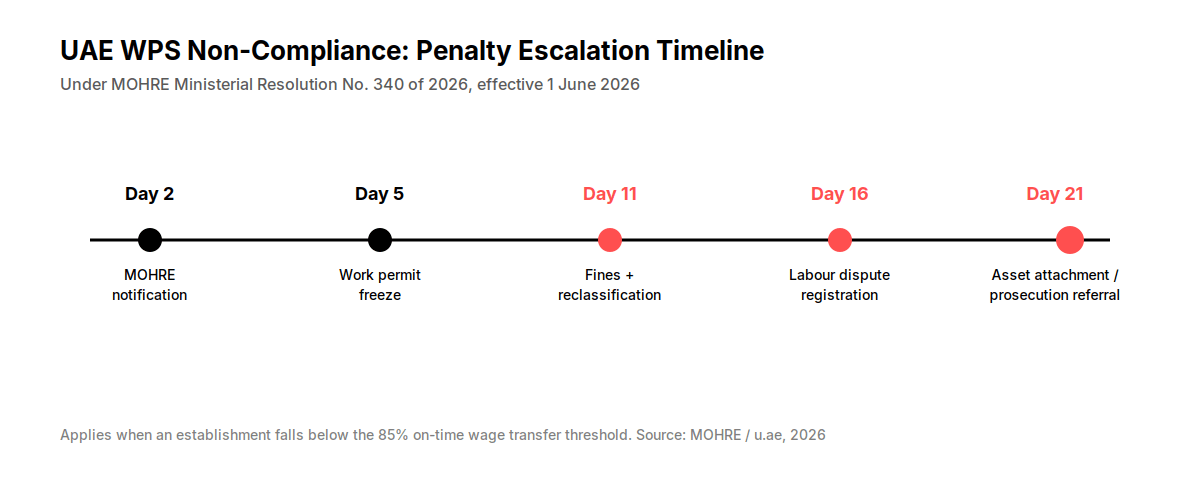
Source: Ministerial Resolution No. (340) of 2026 Concerning the Wage Protection System, as published on u.ae, updated 5 June 2026.
Two things worth being direct about. First, the 85% threshold is the real trigger now, not a flat “days late” count on its own, an establishment paying 85% or more of total wages due on time is considered compliant even if a handful of individual payments lag. Second, this replaces the previous Day 17 permit block and Day 30 escalation figures that circulated under the 2022 framework, if you've seen those numbers elsewhere recently, they're describing the old rule.
What Changed: Resolution 598/2022 vs Resolution 340/2026
False SIF Information
A separate fine of AED 1,000 per employee applies for false information in the SIF, with risk of full trade licence suspension for repeated violations.
5. SIF File Format: The 25-Character Rule {#sif-format}
Most WPS rejections aren't from bad intent, they're from formatting errors. The Salary Information File (SIF) is a structured .sif file with strict naming and content rules.
The Filename Formula
The SIF filename must be exactly 25 characters (plus the .sif extension), built as:
[13-digit MoHRE Employer ID] + [YYMMDD] + [HHMMSS].sif
Example: If your MoHRE Employer ID is 1234567890123 and you generate the file on 7 May 2026 at 11:30:00:
1234567890123260507113000.sif
A single mismatched digit, an off-by-one timestamp, or a date written in the wrong format will cause the file to bounce.
File Internal Structure
Inside the SIF, every file contains:
- One SCR (Salary Control Record): Company-level header with total salary amount and record count.
- One EDR (Employee Detail Record) per employee: Individual employee bank, salary breakdown, and pay-period data.
The SCR acts as a checksum: total amount and record count must match the EDR data exactly. A 1-dirham mismatch between SCR total and the sum of EDR rows = full file rejection.
6. Common SIF Rejection Reasons {#sif-rejections}
These are the issues that cause most WPS 2.0 rejections in 2026:
- Filename mismatch - date or time in the filename doesn't match the SCR data.
- SCR total ≠ sum of EDR rows - most common when adding a new employee but forgetting to update the header.
- IBAN format errors - UAE IBANs are 23 characters starting with "AE"; check digits must validate.
- Expired Labour Card - even if the 14-digit Person ID is valid, an expired permit flags the row as inactive.
- Basic salary mismatch with MoHRE contract - even AED 1 below the contract value triggers rejection under WPS 2.0.
- Missing deduction codes - if you reduce a payment without using the official codes (NOPAY, ABSNT, FINE), the AI flags it as underpayment.
- Date format errors - dates must be YYYY-MM-DD. Excel's default DD/MM/YYYY will reject the entire file.
7. Special Rules for Business Owners {#owner-rules}
If you are an owner-manager and your name is on the company's labour list (i.e., your residency visa is sponsored by your own company), you are subject to the 80% Rule.
- You must take at least 80% of your registered contract salary through WPS.
- Skipping your own salary to "save the company money" during a slow month flags the company as Partially Paid.
- Solution: Always process your own salary through WPS, even if you immediately reinvest it as a director's loan. The transfer is what the system needs to see.
8. WPS 2.0 vs WPS 1.0: A Quick Comparison {#wps-comparison}
9. Frequently Asked Questions {#faqs}
What is the UAE WPS deadline in 2026?
Under Ministerial Resolution No. 340 of 2026, effective 1 June 2026, salaries for the previous month are due on the first day of each Gregorian month. An establishment is compliant if it transfers at least 85% of total wages due by that date. Falling short triggers a graduated timeline starting with alerts on Day 2 and escalating through work permit suspension, fines, and, for larger establishments, labour dispute registration and asset attachment by Day 21.
Can I pay employees in cash if they have no bank account?
No. Under WPS 2.0, salaries must flow through approved banks, exchange houses, or digital wallets linked to the Central Bank's WPS switch. Cash payments do not register in MoHRE's records.
How do I check my company's WPS status in 2026?
Use the MoHRE Smart App or the eNetwasal / Tas'heel portal. Look for the Company Compliance Dashboard. A "Green" status means compliant; "Yellow" or "Red" means specific files or employees are flagged.
Does the AED 6,000 minimum apply to part-time Emiratis?
The rule is designed for full-time private-sector roles. For part-time arrangements, MoHRE expects the hourly rate to reflect a pro-rata version of the floor. Confirm specifics with MoHRE for your situation.
Can I deduct money for disciplinary reasons?
Yes — but only with a documented internal policy and only if you use the correct deduction code (e.g., FINE) in the SIF. Unflagged underpayments are treated as violations.
I'm in a Free Zone (DMCC, DIFC, JAFZA). Do I need to worry?
Yes. JAFZA companies have always required SIF submissions. Most other free zones now sync data with the federal MoHRE database under the unified compliance push of 2026. Free zones such as DMCC are increasingly aligned.
How do I get my company unblocked after a Day 17 freeze?
There is no instant "unblock" button. You must:
- Correct the salary transfer.
- Wait for the bank to relay clearance to the Central Bank.
- Allow 24–48 hours for the MoHRE system to refresh.
What happens if an employee is on unpaid leave?
You must still generate a SIF entry for them, using the official NOPAY reason code. Omitting them or paying zero without a code is treated as a missing payment.
Can employees report WPS violations directly?
Yes. As of 2026, employees can report WPS violations through the MoHRE Smart App with real-time case tracking — making delayed payroll a reputational risk for employers.
Final Word: Compliance Is Now a Competitive Advantage
In the UAE's high-velocity 2026 economy, WPS compliance is no longer a back-office tick-box — it's a public signal of operational reliability. High-quality talent (both expats and Emiratis) increasingly check a company's MoHRE status before signing a contract. A Red Flag on the MoHRE app is the fastest way to lose your next great hire.
WPS 2.0's real-time architecture rewards precision and punishes drift. Treat the 15th of each month as a hard internal deadline (process by the 25th of the previous month for buffer), keep your master data clean, and use the right deduction codes every time.
🚀 Ready to grow without the red tape? From WPS payroll to license renewals and complex compliance, Peko takes the boring stuff off your plate so you can build the future. Start your journey with Peko.one today →
|
About the Author
Adil Rashid Lone - SEO Manager at Peko
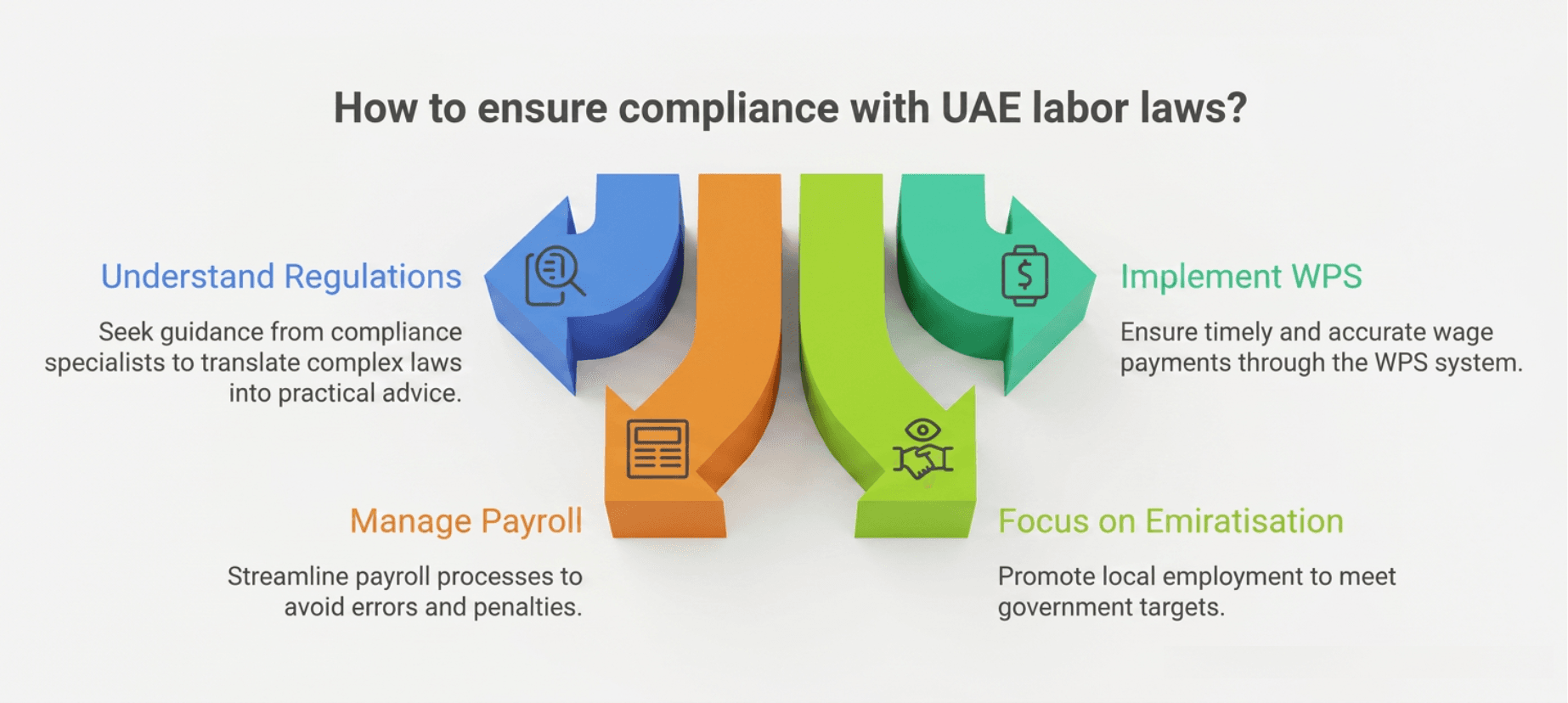
Adil leads SEO and content strategy at Peko, focusing on UAE business compliance, payroll, and Emiratisation topics. He works closely with compliance specialists to translate complex MoHRE regulations into practical guidance for UAE business owners and HR teams. LinkedIn
Follow Peko on X | Follow Peko on LinkedIn
References & Further Reading
- UAE Government Official Portal — Payment of salaries/wages
- MoHRE — WPS Update Announcement, December 2025
- Federal Decree-Law No. 33 of 2021 (UAE Labour Law)
- Cabinet Resolution No. 21 of 2020 (Employer Classification & Penalties)
- Ministerial Resolution No. 598 of 2022 (WPS Regulations)
- Khaleej Times — UAE: Faster, easier salary payments with updated WPS (December 2025)
⚖️ Disclaimer: This guide is for informational purposes and reflects publicly available MoHRE, Central Bank of UAE, and Cabinet Resolution sources as of May 2026. It does not constitute legal advice. Regulations evolve — for binding rulings on your specific business, consult a UAE-licensed labour law advisor or visit the official MoHRE portal.
Last updated: 7 May 2026.