- Blogs
- Company Formation
- RAK ICC Company Formation UAE: Offshore Costs & 2026 Guide
Aug 18, 2026
RAK ICC Company Formation UAE: Offshore Costs & 2026 Guide
Share this article
- What Is RAK ICC? UAE Offshore Company Formation Explained
- Quick Answer: Is RAK ICC Right for You?
- What Is RAK ICC?
- Is RAK ICC an Offshore Company or a Free Zone?
- RAK ICC vs RAKEZ: What's the Difference?
- The Three RAK ICC Structuring Options
- What Can a RAK ICC IBC Do?
- What Can't a RAK ICC IBC Do?
- How Much Does RAK ICC Company Formation Cost in 2026?
- Documents and Requirements
- How Long Does RAK ICC Company Formation Take?
- Corporate Tax for RAK ICC Companies
- Economic Substance Reporting: What Changed
- Can a RAK ICC Company Get a UAE Residence Visa?
- Can a RAK ICC Company Own Property in Dubai?
- RAK ICC Foundations and Succession Planning
- RAK ICC vs Other UAE Offshore Options
- Who Should Use RAK ICC, and Who Shouldn't
- Frequently Asked Questions Regarding RAK ICC Freezone
- Final Thoughts
What Is RAK ICC? UAE Offshore Company Formation Explained
TL;DR:
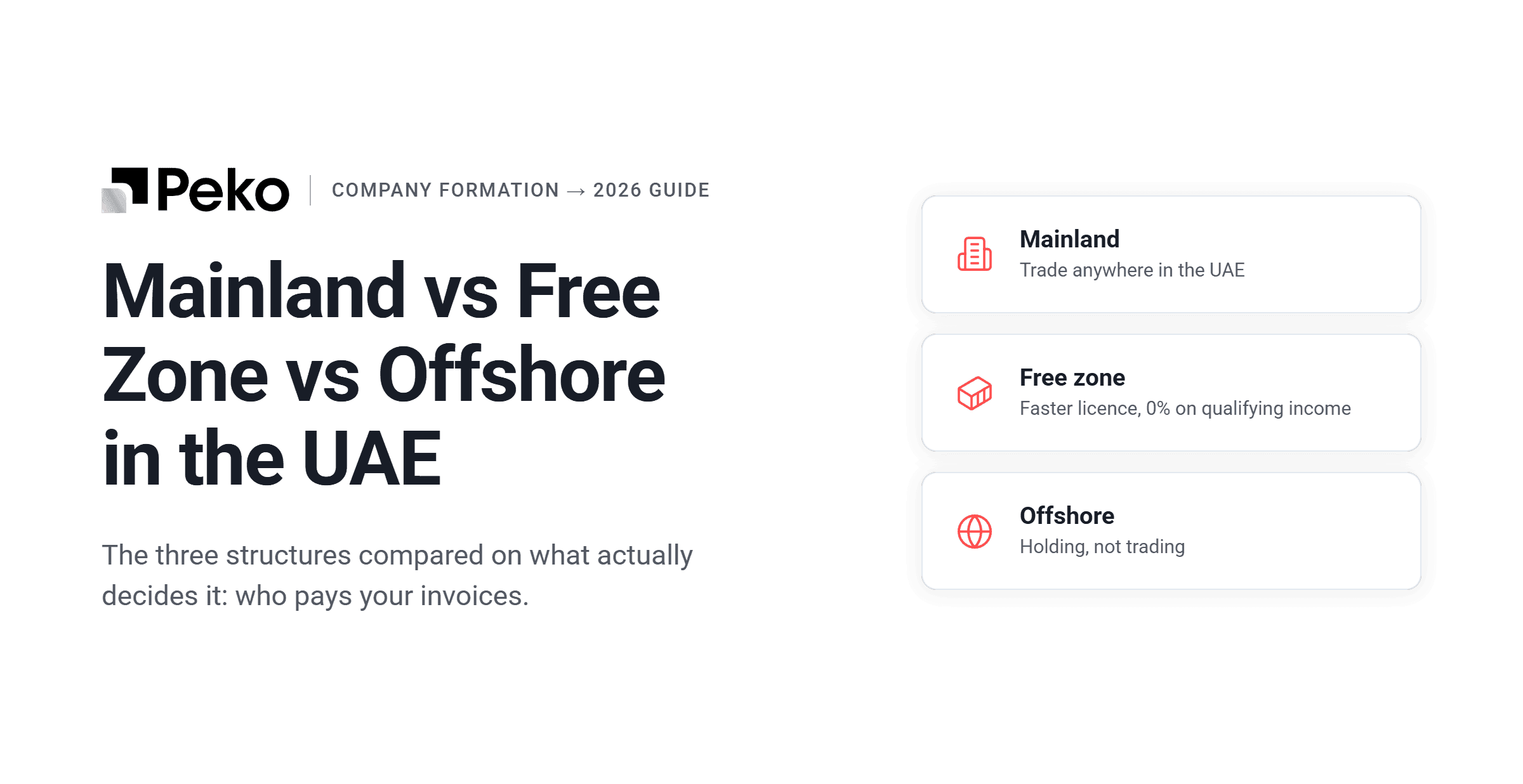
This is a companion piece to our mainland, free zone and offshore comparison. That post helps you choose a category. This one goes deep on the offshore category itself, because much of the published material on it has not kept pace with the regulatory changes of the last three years. |
Quick Answer: Is RAK ICC Right for You?
| Question | Short answer |
|---|---|
| Is RAK ICC a free zone? | No. It is a corporate registry. |
| Is RAK ICC offshore? | The plain IBC is an offshore structure. The Global and Premium Products are not. |
| Can it get a UAE residence visa? | A plain IBC does not provide one. The Global and Premium Products offer visa routes. |
| Does it have a trade licence? | A plain IBC does not. |
| Does it pay UAE Corporate Tax? | UAE-incorporated entities are generally within the Corporate Tax regime. |
| Can it operate inside the UAE? | Not without the appropriate UAE licensing. |
| 2026 IBC incorporation fee | From AED 3,250 for one year. |
| How long does it take? | About two working days for an IBC, once documents are in order. |
| Can it own Dubai property? | Structure-specific. Confirm with the Dubai Land Department before proceeding. |
| Do I still file an ESR notification? | Not for financial years ending after 31 December 2022. |
What Is RAK ICC?
RAK ICC is the corporate registry of Ras Al Khaimah, created by Decree No. 12 of 2015 as amended by Decree No. 4 of 2016. It registers companies. It does not license business activity, allocate visas, or lease you an office.
That distinction explains most of the confusion around offshore company formation in the UAE. A free zone such as DMCC or IFZA is a licensing authority with physical premises inside a defined zone. RAK ICC is closer to a registrar of companies. You incorporate through a licensed registered agent, which is mandatory under Regulation 92.
The available company forms are narrower than most listicles suggest. Under the Business Companies Regulations there are five: Company Limited by Shares, Company Limited by Guarantee, Restricted Purposes Company, Segregated Portfolio Company, and Unlimited Company. Separately, RAK ICC registers Foundations, which are not companies at all. Pages listing FZE or PLC as RAK ICC entity types are not describing forms that exist under the current Regulations.
One nuance on naming. The Regulations are titled 2018, but Regulation 1(1) and the definitions in Regulation 2 show they came into force on 20 January 2016 and were amended with effect from 24 April 2018. The 2018 label refers to the amended consolidation, not a separate instrument.
Is RAK ICC an Offshore Company or a Free Zone?
RAK ICC is a registry, and the plain IBC it registers is an offshore company. Its own Regulations define a "Zone" as a jurisdictional boundary set by the Ruler of Ras Al Khaimah rather than a licensed business park, and RAK ICC issues no trade licence to an IBC.
Where this gets misread is the Global Product, which RAK ICC itself describes as "a free zone company". So the accurate framing is that RAK ICC is a registry offering several structuring solutions, one of which is a traditional offshore IBC and another of which is a free zone company. Treating all three options as "offshore" is what produces most of the contradictory advice on this topic.
RAK ICC vs RAKEZ: What's the Difference?
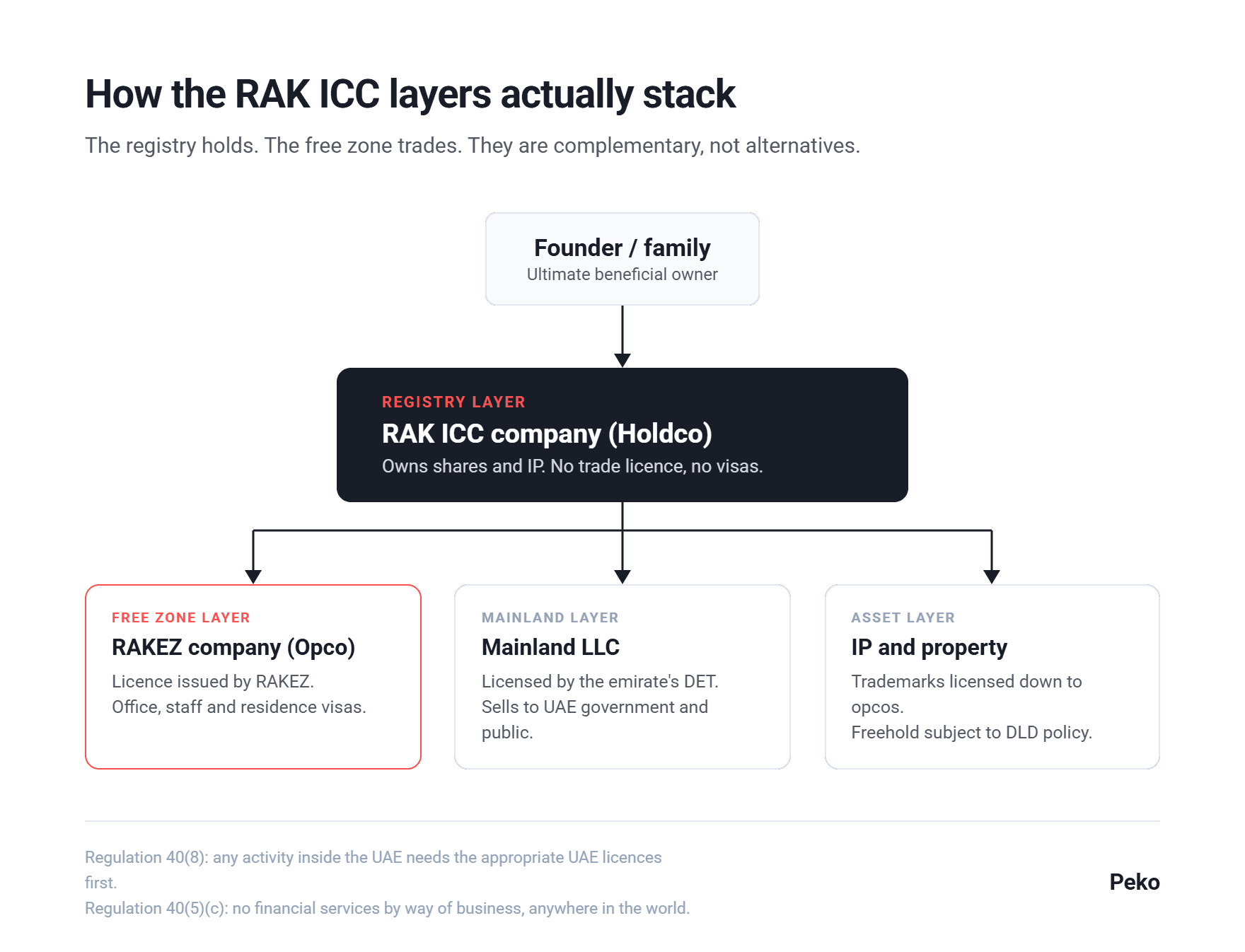
RAK ICC and RAKEZ are not competing like-for-like structures. RAKEZ is a free zone that licenses activity, provides premises and sponsors visas. RAK ICC is a registry that holds ownership, intellectual property and cross-border structure. The Premium Product exists specifically to combine them.
| Feature | RAK ICC IBC | RAK ICC Global Product | RAK ICC + RAKEZ (Premium) | RAKEZ |
|---|---|---|---|---|
| Registry | RAK ICC | RAK ICC | RAK ICC plus RAKEZ | RAKEZ |
| Trade licence | No | Yes | Yes, via the Opco | Yes |
| UAE office | No operating office | Yes | Yes | Yes |
| UAE visa route | No | Eligible to apply | Yes, via the structure | Yes |
| UAE operations | Not without separate licensing | Yes, subject to licensing | Yes, via the Opco | Yes |
| Tax Domicile Certificate | Not on this basis | Eligible to apply | Treaty benefits cited | Available |
| Main purpose | Holding and offshore | Midshore operating company | Holdco plus Opco | Operating business |
So if you are weighing "RAK ICC vs RAKEZ", the answer is often not either exclusively. Businesses that need to trade and employ people in the UAE want the RAKEZ layer. Businesses that only need to hold something want the registry. Businesses doing both, which is most past a certain size, want the stack.
The Three RAK ICC Structuring Options
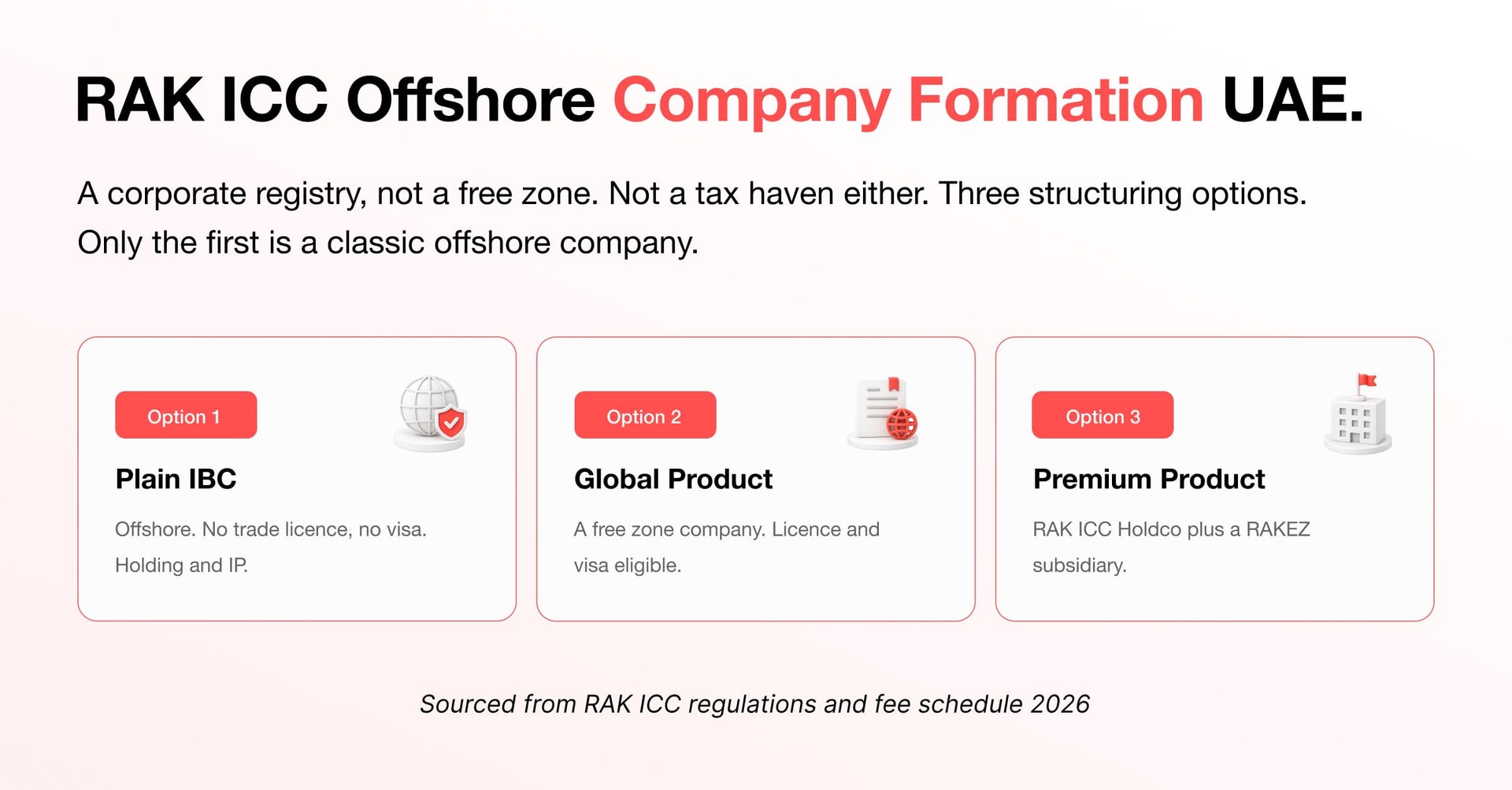
RAK ICC publishes three distinct structures on its own website, and only one is the plain offshore IBC that most competing articles describe.
| Plain IBC | Global Product | Premium Product | |
|---|---|---|---|
| What it is | Traditional offshore registry company | "A free zone company" registered via RAK ICC agents | RAK ICC Holdco plus a RAKEZ subsidiary (Opco) |
| Trade licence | None | Yes, including commercial, services, e-commerce, media, education | Issued by RAKEZ to the Opco |
| Premises | Registered agent's registered address | Coworking, serviced or executive office | Flexi, standard or executive office |
| UAE residence visa | Not provided | Eligible to apply | Eligible via the structure |
| Stated minimum capital | Not prescribed as a cash figure | From AED 10,000 (USD 2,725) | Per RAKEZ requirements |
| Typical timeline | About 2 working days | About 3 to 4 weeks | 4 to 9 working days for visas |
Sources: RAK ICC Global Product and Premium Product.
Two points follow. First, the widely repeated claim that RAK ICC offers no route to a UAE residence visa is accurate for a bare IBC and inaccurate for RAK ICC as a whole: the Global Product page lists eligibility to apply for a UAE Residence Visa and a Tax Domicile Certificate. Second, licences under the Premium Product are issued by RAKEZ, the free zone authority, not by RAK ICC.
What Can a RAK ICC IBC Do?
A plain IBC is a holding and contracting vehicle. It can own shares in other companies, hold intellectual property, contract with counterparties outside the UAE, hold bank accounts subject to the bank's own onboarding, and be redomiciled in or out of the jurisdiction. It takes a minimum of one shareholder and a maximum of 50, and a minimum of one business activity with no upper limit, though an extra fee applies beyond three activities.
One practical advantage that rarely gets reported: RAK ICC states that it "does not require the legalization of corporate documents from foreign jurisdictions". For a founder incorporating from abroad, that removes a step that other jurisdictions treat as mandatory.
What Can't a RAK ICC IBC Do?
A plain RAK ICC IBC does not have a UAE trade licence and cannot conduct UAE activities that require licensing without first obtaining the appropriate licence. Regulation 40 is the operative provision, and it is more precise than the blanket "offshore companies can never touch the UAE" line:
- 40(5)(a): no company shall carry on business with persons in the Zone unless expressly authorised by RAK ICC. "Zone" is defined in Regulation 2 as the area within the geographic limits of RAK ICC, so this concerns the registry's own jurisdiction rather than the whole country.
- 40(5)(c): no company shall provide financial services by way of business anywhere in the world. This one is absolute. Lending, deposit-taking, e-money and insurance are all out.
- 40(8): no company shall conduct activities in the UAE outside the Zone unless it has first obtained all appropriate licences from the competent UAE authorities.
Read together, 40(8) operates as a licensing condition rather than a blanket prohibition. That distinction is commercially significant, and it is why the Global and Premium Products exist.
Two further limits worth stating plainly. A bare IBC does not provide the employment, visa and establishment infrastructure normally associated with a UAE operating company, so it is not a vehicle for hiring staff. And it provides no operating office or premises through the IBC itself, only the registered address maintained via the registered agent.
The other practical wall is banking. A registry certificate is not a banking relationship. UAE banks apply their own source-of-funds, substance and purpose tests to offshore entities, and a structure with no UAE footprint, no local director and no explainable trade flow can stall at compliance review. Any guarantee of an account opening with a bare IBC is outside the promising party's control.
How Much Does RAK ICC Company Formation Cost in 2026?
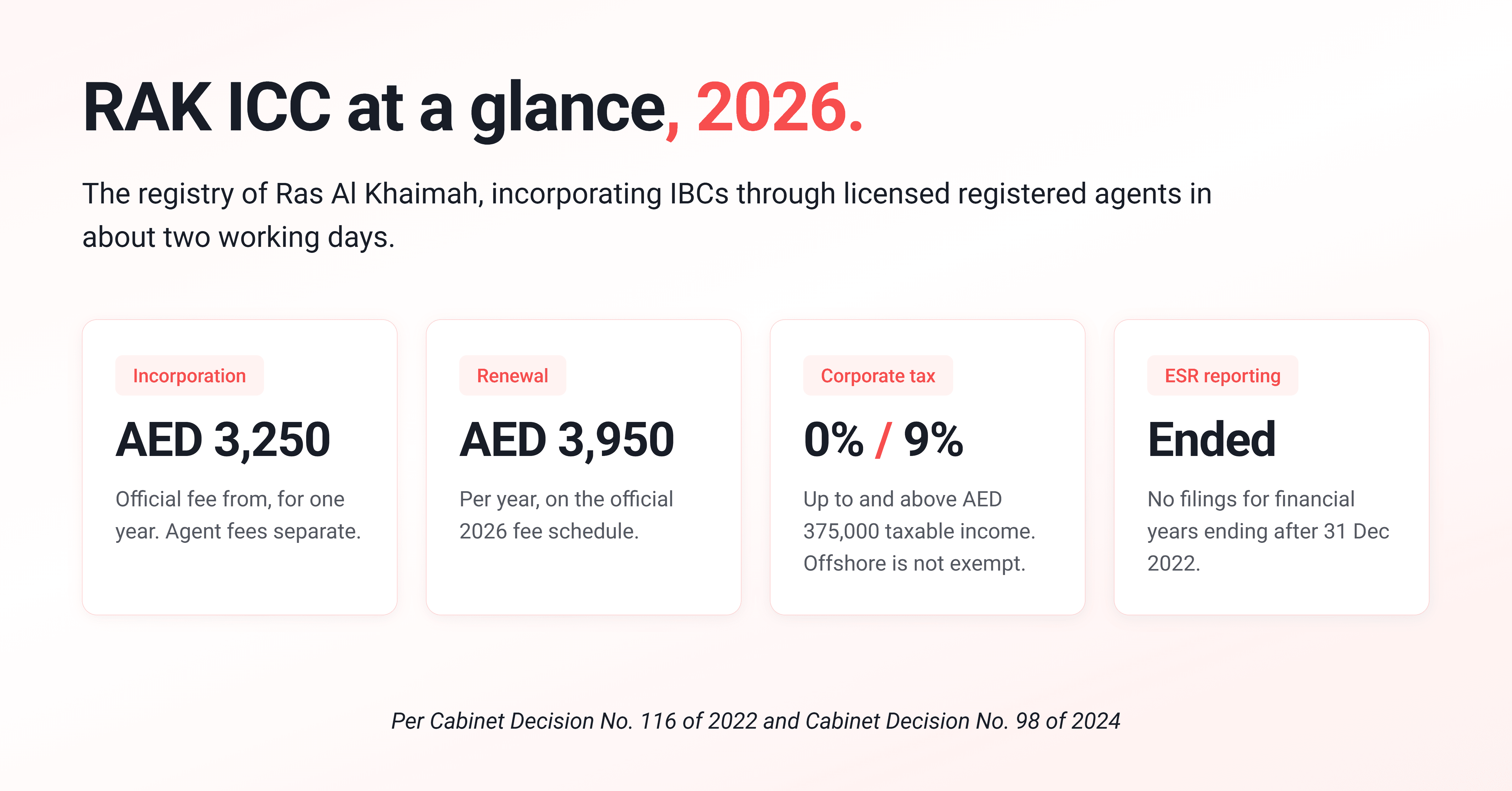
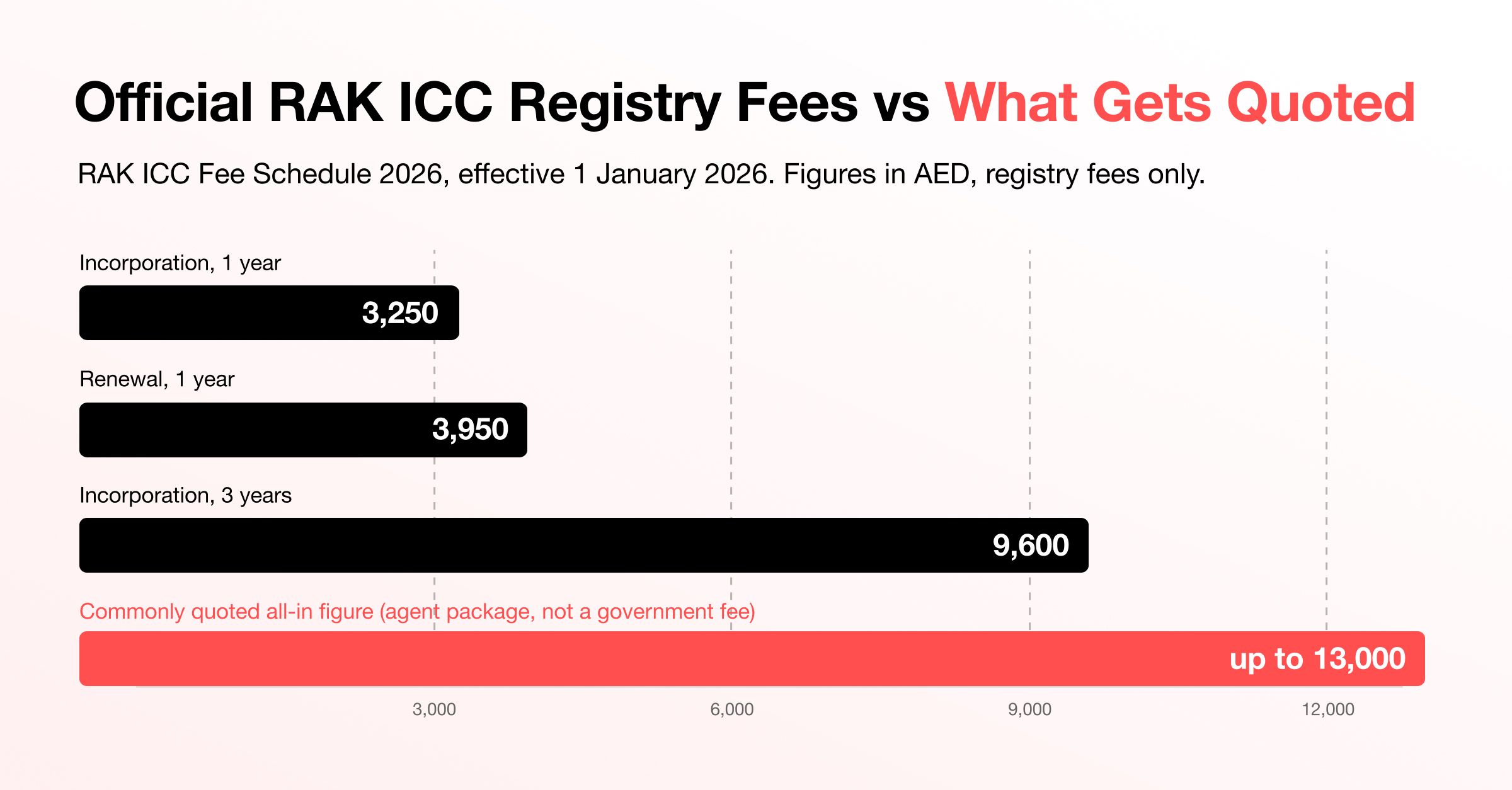
The official RAK ICC Fee Schedule 2026, effective 1 January 2026, lists IBC incorporation from AED 3,250 for one year. These are registry fees, in AED:
| Item | 1 year | 2 years | 3 years |
|---|---|---|---|
| IBC incorporation | 3,250 | 6,700 | 9,600 |
| IBC renewal | 3,950 | 7,250 | 10,650 |
| Foundation registration | 1,500 | ||
| Foundation annual licence | 750 | ||
| Certificate of Good Standing | 750 | ||
| Certificate of Incumbency | 1,000 | ||
| Share transfer (with corporate shareholders) | 1,750 | ||
| Transfer of domicile in / out | 3,250 / 5,500 |
What the registry schedule does not include, and what determines your actual budget:
- Registered-agent professional fees. Commercial, unpublished, and usually larger than the registry fee itself. Incorporation is only possible through a licensed agent.
- Office and facilities under the Global Product (coworking, serviced or executive) or the Premium Product's RAKEZ layer.
- RAKEZ licence and visa costs under the Premium Product, charged by the free zone rather than by RAK ICC.
- Ongoing compliance: corporate tax registration and filing, accounting, and any audit your bank or structure requires.
Two mechanics that reward planning. Prepaying three years of incorporation costs AED 9,600 against AED 9,750 for three separate one-year incorporations, and the renewal saving is larger. And late renewal escalates on a published ladder: renewal fees plus 10% in the second month, plus 15% in the third, plus 25% in the fourth, plus 50% in the fifth, with a strike-off notice issued in the sixth.
A note on figures circulating elsewhere: several widely-read guides present all-in packages of roughly AED 9,500 to 13,000 as "the government fee". Those totals may be reasonable as bundled agent quotes, but they should not be described as government fees. The registry's own published schedule is the reference above.
Documents and Requirements
RAK ICC does not publish a definitive public document checklist, and requirements are set in practice by your registered agent under UAE anti-money-laundering and beneficial-ownership rules. Expect to provide, at a high level:
- Passport copies for each individual shareholder, director and beneficial owner
- Proof of residential address
- Shareholder, director and, where relevant, secretary details
- Ultimate beneficial ownership information, reportable under Cabinet Decision No. 109 of 2023
- Corporate constitutional documents where a shareholder is itself a company
- Source-of-funds and source-of-wealth information where the agent's risk assessment requires it
Two things worth knowing. RAK ICC states that it "does not require the legalization of corporate documents from foreign jurisdictions", which removes an attestation step many people budget for. And because the requirements above are agent-driven and case-specific rather than published by the registry, confirm the exact list with your registered agent rather than working from any article's checklist, including this one.
How Long Does RAK ICC Company Formation Take?
RAK ICC states that "upon submission of documents an IBC is incorporated within 2 working days". Treat that as the registry's processing step rather than an end-to-end guarantee: actual timelines depend on due diligence, document complexity, name approval and your registered agent's own onboarding.
The other two options take longer by design. RAK ICC indicates roughly three to four weeks for the Global Product, since a licence and facilities are involved. The Premium Product's visa processing is quoted at four working days for VIP service and nine for normal service, on top of the underlying incorporation and RAKEZ licensing.
Corporate Tax for RAK ICC Companies
A UAE-incorporated RAK ICC entity is generally a Resident Person for UAE Corporate Tax purposes, so it is within the regime rather than exempt from it. Article 11(3) of Federal Decree-Law No. 47 of 2022, as amended, treats a juridical person incorporated or otherwise established in the State as a Resident Person, and RAK ICC incorporates under UAE law in Ras Al Khaimah. In practice that means such an entity may have Corporate Tax registration and filing obligations with the Federal Tax Authority regardless of where its customers are.
On rates, there are two separate regimes and they should not be conflated:
- Standard regime. For entities subject to the standard Corporate Tax regime, 0% applies to taxable income up to AED 375,000 and 9% applies above that, per Cabinet Decision No. 116 of 2022, which remains active. The threshold operates as a bracket rather than a cliff: taxable income of AED 500,000 attracts 9% on AED 125,000, not on the full amount.
- Free Zone regime. A Qualifying Free Zone Person can instead access a separate 0% rate on qualifying income, subject to its own conditions.
Here is the part that deserves care. Several published articles imply RAK ICC entities access the Free Zone 0% regime. We could not verify at any official source that a RAK ICC entity is treated as a Free Zone Person for Corporate Tax purposes. No Federal Tax Authority or Ministry of Finance document we reviewed names RAK ICC as a Free Zone. Because tax treatment depends on the specific legal structure and the applicable regime, and because the Global and Premium Products are structured differently from a bare IBC, obtain written advice for your exact structure rather than relying on a general 0% claim.
One further provision, largely absent from other coverage. If you are a non-resident holding UAE property through an offshore vehicle, Cabinet Decision No. 35 of 2025 governs when that creates a UAE taxable nexus. It came into force on 27 March 2025 and applies to tax periods starting on or after 1 January 2025, replacing Cabinet Decision No. 56 of 2023 for those periods. Income from immovable property in the State creates nexus and a registration obligation.
Economic Substance Reporting: What Changed
Economic Substance reporting no longer applies to financial years ending after 31 December 2022. Advisers still quoting annual ESR notifications are working from a superseded framework.
Cabinet Decision No. 98 of 2024 amended Cabinet Decision No. 57 of 2020 to cancel the requirement, and the Ministry of Finance announced it on 14 October 2024. The stated rationale was that the federal corporate tax regime now does the work ESR was introduced to do.
What survives is narrower but real: obligations for financial years ending on or before 31 December 2022, any penalties already imposed by the Federal Tax Authority, and the duty to respond to information or amendment requests from a regulatory authority or the FTA. Historic exposure does not vanish. Forward-looking filing does.
This matters here because holding companies and intellectual property businesses were both Relevant Activities under the old regime, which describes most RAK ICC entities. It was the compliance burden cited most often, and it no longer applies going forward.
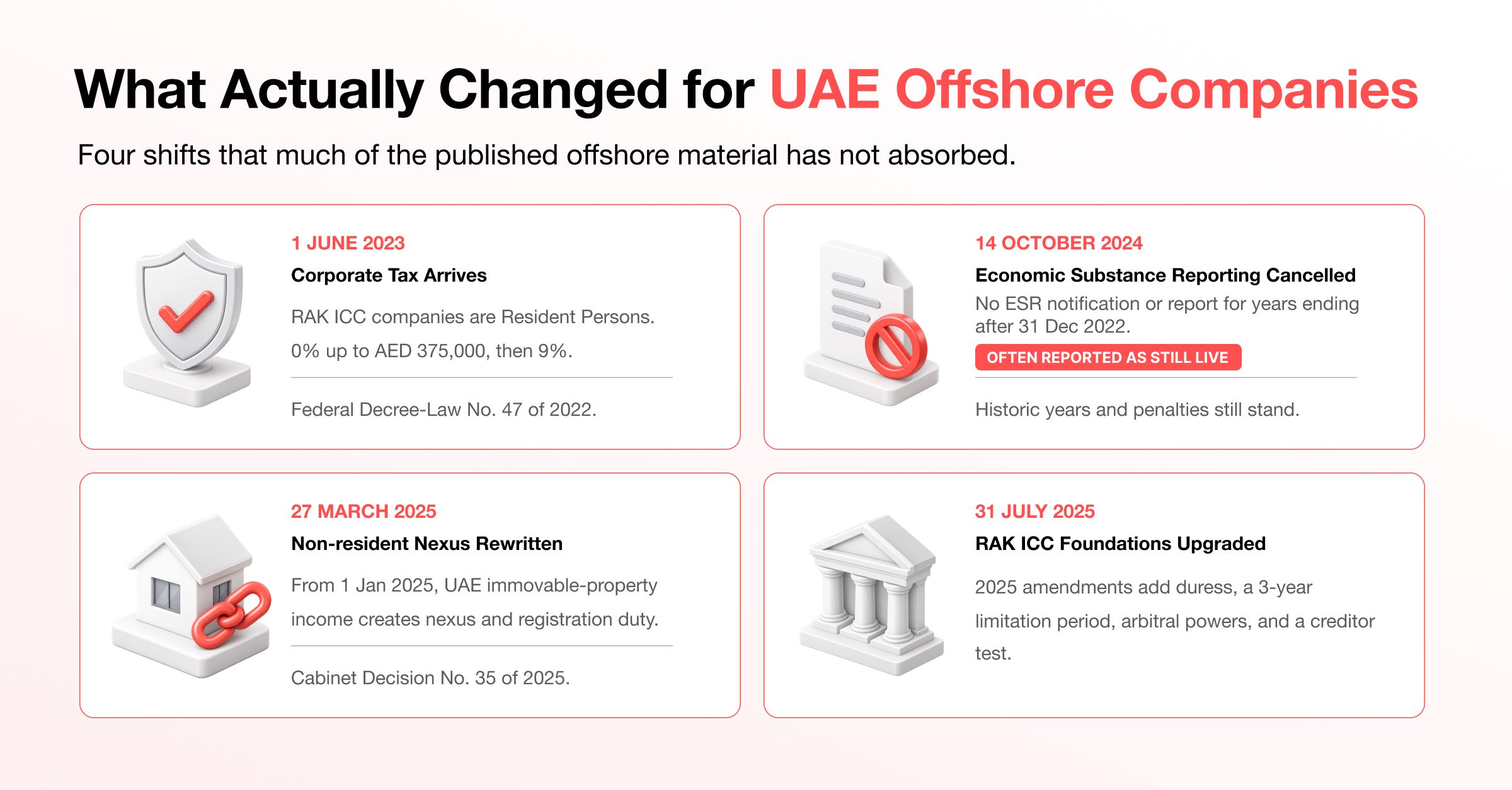
Four regulatory changes since 2023 that much of the published offshore material has not absorbed.
Can a RAK ICC Company Get a UAE Residence Visa?
A plain IBC does not provide a visa route, but RAK ICC's other two structures do. The Global Product is listed by RAK ICC as eligible to apply for a UAE Residence Visa and a Tax Domicile Certificate. The Premium Product pairs a RAK ICC holding company with a RAKEZ operating subsidiary, with visas arising through that subsidiary at a quoted four working days for VIP service and nine for normal service.
The takeaway is that "offshore means no visa" is true of the bare IBC and untrue of RAK ICC as a registry. If a visa is your primary objective, the bare IBC is the wrong product, and either the Global Product or a free zone licence is the right conversation.
Can a RAK ICC Company Own Property in Dubai?
Potentially, but this should not be treated as an automatic RAK ICC entitlement, and the official position is genuinely unsettled.
The Dubai Land Department's current company-registration guidance refers to foreign companies registered in free zones in Dubai or Ras Al Khaimah, and requires a no-objection certificate from the licensing entity along with the relevant documentation and registration fees, quoted at AED 4,000 plus VAT where there are foreign shareholders. RAK government entities also entered memoranda of understanding with DLD in 2019 concerning registration of freehold plots and rights in rem, covering RAK ICC and RAKEZ.
Against that, DLD's own investor guide Know Your Rights states that DLD "does not allow foreign companies to own real estate directly" and points to establishing a subsidiary in a Dubai free zone such as JAFZA or DMCC. The guide carries no date, so we cannot confirm it simply predates the memoranda.
There is also a structural asymmetry worth understanding. RAK ICC is a corporate registry rather than a free zone, and its Business Companies Regulations contain no provision on holding UAE real property. The JAFZA Offshore Companies Regulations, by contrast, expressly permit a company to own property in a UAE designated freehold area. So the JAFZA route rests on its own regulations while the RAK ICC route rests on DLD policy and NOC practice. Underlying eligibility for non-nationals comes from Dubai's Law No. 7 of 2006 and Regulation No. 3 of 2006, which cap ownership at 99 years and designate the eligible areas.
Because the current DLD position and the historical RAK ICC arrangements do not map neatly onto one another, confirm eligibility with DLD for the specific entity and the specific property before proceeding. This is not a question to settle from any article, including this one.
RAK ICC Foundations and Succession Planning
RAK ICC Foundations remain one of the least-covered areas in mainstream UAE offshore content, and the regime was upgraded in 2025.
A Foundation is a corporate entity with legal personality separate from its founder, with no shares and no shareholders. Qualified recipients hold contractual payment rights rather than an interest in the property. Initial capital is USD 100, the Council requires at least two members, and the founder cannot be added or changed after registration. A Foundation can hold real estate, company shares, intellectual property, investment portfolios, bank accounts and movable assets, and it continues after the founder's lifetime. Charter disputes go to the DIFC Courts or ADGM Courts by election.
The 2025 amendments came into force on 31 July 2025:
- Regulation 25A allows officers to reject demands made under compulsion or unauthorised legal process.
- Regulation 7 requires a creditor to prove both intent to defraud and resulting insolvency, and caps recovery to the transferred property.
- Regulation 67A gives arbitral tribunals court-equivalent powers, with a new Schedule 2 applying DIFC and ADGM arbitration law.
- Regulation 68A sets a three-year limitation period for challenging a Foundation or a disposition into it.
On cost, RAK ICC is the cheaper registry at AED 1,500 to register, AED 1,500 to renew and AED 750 for the annual licence. Note that DIFC prescribes no minimum capital, contrary to the USD 100 figure some articles apply to all three UAE foundation regimes. Foundations also interact with UAE succession law under Federal Decree-Law No. 41 of 2022 on Civil Personal Status, effective 1 February 2023, so the Charter should be coordinated with any will rather than assumed to override it.
RAK ICC vs Other UAE Offshore Options
Two alternatives come up constantly. One is current and widely misdated; the other we could not verify from official sources.
JAFZA Offshore is live, and its current instrument is the Jebel Ali Free Zone Offshore Companies Regulations 2023, which repealed and replaced the 2018 Regulations, which had themselves replaced the 2003 ones. Most published articles still cite 2003. The 2023 text expressly permits owning property in a UAE designated freehold area and allows residency visa applications for members of property-owning companies, and a registered agent is required unless the company maintains an office in the Zone. Where Dubai property is the objective, JAFZA's express regulatory basis is a meaningful advantage over RAK ICC's policy-based route.
Ajman Offshore requires a caveat. Ajman Free Zone's official channels list FZE, FZC, branch of a local company and branch of a foreign company, and we found no offshore category, no governing regulation and no discontinuation notice on any official Ajman source. The pages currently marketing it are formation agencies. That is not evidence it has closed. It does mean you should ask for the governing regulation by name before engaging anyone.
Who Should Use RAK ICC, and Who Shouldn't
Offshore is a structural tool rather than a general-purpose setup. Being clear about the mismatch cases matters more than listing benefits.
Good fit:
- Multi-entity founder groups and family businesses consolidating mainland and free zone operating companies under one holding entity before a raise, restructure or generational handover.
- Software, media and franchise businesses with trademarks and code licensed across several markets, where an IP holding company separates ownership from trading risk.
- Import, export and commodity trading houses whose buyers and suppliers sit outside the UAE, using the registry entity to contract and adding a licensed layer only where UAE-side activity is required.
- Property investors using a corporate vehicle for succession or liability reasons rather than tax reasons, subject to the DLD position above.
- Families and family offices using a Foundation for succession planning, particularly where the 2025 duress and limitation provisions are relevant.
- Investment holding and SPV work, where the Segregated Portfolio Company at AED 1,500 per portfolio is a useful ring-fencing structure.
- Overseas companies redomiciling into the UAE without an immediate licensed onshore presence.
Poor fit:
- UAE-facing retail, hospitality, clinic, salon or trade businesses. These need a mainland or free zone licence; a bare IBC contributes nothing.
- Financial services of any kind, anywhere. Regulation 40(5)(c) is absolute. Payments, lending, insurance and e-money businesses need a regulator such as the Central Bank, DFSA or FSRA.
- Anyone whose main objective is a residence visa. The Global Product or a free zone licence is the appropriate route, not a bare IBC.
- Anyone whose motivation is confidentiality from tax authorities. The UAE operates beneficial ownership rules under Cabinet Decision No. 109 of 2023, an AML framework under Federal Decree-Law No. 10 of 2025, corporate tax, and automatic exchange of information. This objective is not achievable and will not survive bank onboarding.
- Employers. Without a visa quota, a bare IBC cannot serve as the employing entity.
Frequently Asked Questions Regarding RAK ICC Freezone
Is RAK ICC a free zone or an offshore jurisdiction?
RAK ICC is a corporate registry, not a free zone. It registers companies but does not license business activity, provide premises or sponsor visas the way DMCC, RAKEZ or IFZA do, and its Business Companies Regulations define a "Zone" as a jurisdictional boundary set by the Ruler of Ras Al Khaimah rather than a licensed business park. The plain IBC it registers is an offshore company. The confusion arises because RAK ICC separately offers a Global Product, which it describes on its own website as a free zone company.
Does a RAK ICC offshore company pay corporate tax in the UAE?
It is generally within the UAE Corporate Tax regime rather than exempt from it. A company incorporated at RAK ICC is a Resident Person under Article 11(3) of Federal Decree-Law No. 47 of 2022, so it may have registration and filing obligations with the Federal Tax Authority. Under the standard regime and Cabinet Decision No. 116 of 2022, the first AED 375,000 of taxable income is taxed at 0% and the excess at 9%. A separate 0% regime exists for Qualifying Free Zone Persons on qualifying income, but we could not verify at any official source that a RAK ICC entity is treated as a Free Zone Person, so obtain written advice for your specific structure.
Do I still need to file an Economic Substance notification for a RAK ICC company?
Not for financial years ending after 31 December 2022. Cabinet Decision No. 98 of 2024 amended Cabinet Decision No. 57 of 2020 to cancel Economic Substance notifications and reports for those periods, announced by the Ministry of Finance on 14 October 2024. You must still address obligations for years ending on or before 31 December 2022, pay any penalties already imposed, and respond to information or amendment requests from a regulatory authority or the Federal Tax Authority.
Can a RAK ICC company get a UAE residence visa?
A plain RAK ICC IBC does not provide a visa route, but the other two structures do. RAK ICC lists the Global Product as eligible to apply for a UAE Residence Visa and a Tax Domicile Certificate. The Premium Product pairs a RAK ICC holding company with a RAKEZ operating subsidiary, and visas arise through that subsidiary. Statements that RAK ICC offers no visa route describe only the bare IBC.
How much does RAK ICC company formation cost in 2026?
The official RAK ICC Fee Schedule effective 1 January 2026 lists IBC incorporation from AED 3,250 for one year, AED 6,700 for two and AED 9,600 for three, with renewals at AED 3,950, AED 7,250 and AED 10,650. Those are registry fees only. Your registered agent charges a separate commercial fee that is typically larger and is not published, and the Global and Premium Products are priced separately because their licences and facilities come from a free zone authority.
Can a RAK ICC company own property in Dubai?
Potentially, but not as an automatic entitlement. Dubai Land Department guidance refers to foreign companies registered in Dubai or Ras Al Khaimah free zones and requires a no-objection certificate from the licensing entity, and DLD signed memoranda with RAK government entities covering RAK ICC and RAKEZ in 2019. However DLD's own investor guide still describes a Dubai free zone subsidiary route and says foreign companies cannot own directly, and RAK ICC is a registry rather than a free zone whose Regulations contain no property-holding provision of the kind JAFZA Offshore has. Confirm eligibility with DLD for the specific entity and property before proceeding.
Final Thoughts
The offshore category has an information problem more than a regulatory one. A decade of material selling confidentiality and tax-free trading left a mental model that stopped matching reality around June 2023, and much of what ranks today still runs on it. Meanwhile the genuinely useful developments went largely unreported: Economic Substance reporting ended, RAK ICC published two structures that address the visa and licensing gap, and the Foundations regime gained substantive protections in July 2025.
Our position is that offshore is narrower than it is often sold as, and more useful than it is sometimes dismissed as. It is good structural plumbing: holding, intellectual property, succession, ring-fencing and cross-border contracting. It is a poor answer to "how do I start a business in Dubai", which is what the pillar guide on company formation in Dubai covers. And it is not an answer to a tax problem.
Where to go next depends on what you actually need:
- Choosing between structures? Start with the three-way comparison of mainland, free zone and offshore.
- Need UAE operations, premises and visas? The mainland and free zone routes are covered in the company formation guide, and the documents involved in the documents required guide.
- Ready to incorporate, and thinking about what comes after? Peko Start handles the formation and keeps accounting, invoicing and payroll on one platform afterwards, which is where most of the ongoing admin actually lives.
Whichever route you take, get written advice on the corporate tax treatment of your specific structure before you incorporate.
This article is for general information and is not legal or tax advice. Regulations, fees and official policy change. Verify current requirements with RAK ICC, the Federal Tax Authority, the Dubai Land Department or a licensed adviser before acting.