


- Blogs
- Editor's Pick
- All-in-One Business Platform for UAE SMEs: 2026 Guide
Dec 31, 2025
All-in-One Business Platform for UAE SMEs: 2026 Guide

Share this article
- Why UAE SMEs Need One All-in-One Business Platform, Not Ten Tools
- What does an all-in-one business platform actually replace?
- Which SME pain points does this actually solve?
- How does one platform make corporate spending simpler and safer?
- Does an all-in-one platform work with the tools you already use?
- Does it scale as the business grows?
- What does running ten tools actually cost?
- Where ten tools still beat one
- Why Peko is the platform UAE SMEs should shortlist
- Which Industries and Audiences This Applies To
- FAQ
- Final Thoughts
Why UAE SMEs Need One All-in-One Business Platform, Not Ten Tools
Last verified: 21 August 2026. Prices and UAE regulatory dates in this post were checked against primary sources on that date. This page is reviewed quarterly, and sooner if the Ministry of Finance, the FTA or MoHRE publishes a change.
TL;DR:
- Most UAE SMEs run separate apps for payments, expenses, travel, payroll, invoicing and accounting, then use spreadsheets to join them up. The joins are where the errors live.
- The cost is not mainly the subscriptions. It is the reconciliation work, the slower close, and the audit trail that only holds together if every connector behaves.
- An all-in-one business platform trades a little feature depth for one onboarding, one dashboard and one export. That last point matters more in the UAE than most vendors admit, because corporate tax records have to survive seven years.
- Peko covers corporate cards, accounting, invoicing, payroll, bill payments and travel in one system. It is not an accredited e-invoicing service provider, and we say where else it loses.
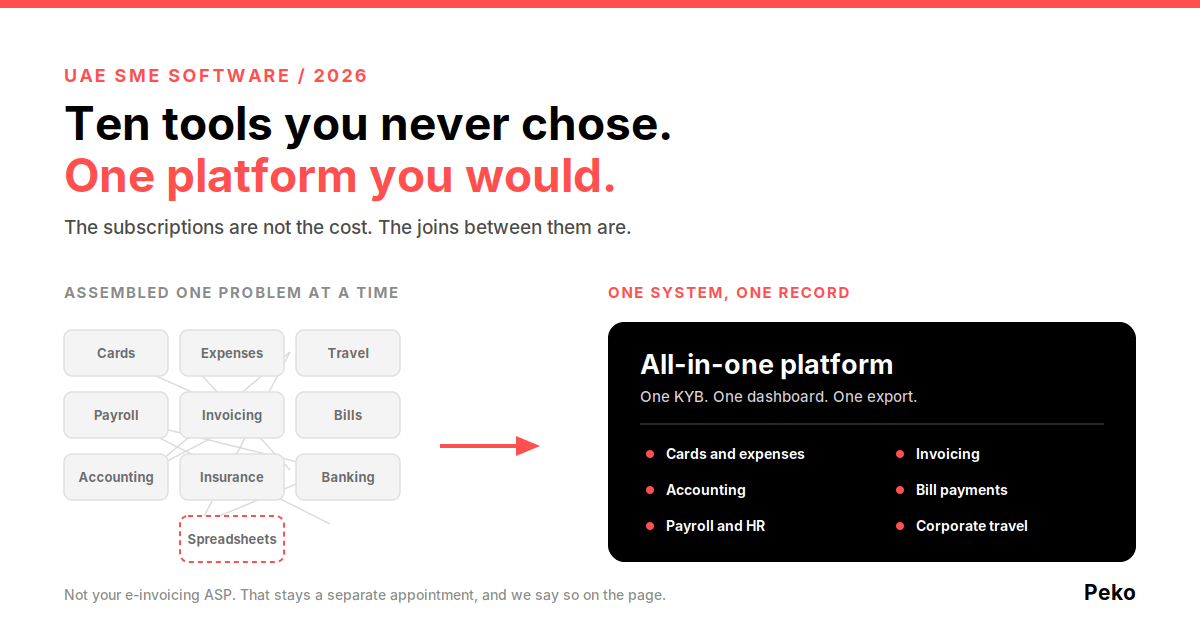
If you run a small or medium business here, you have probably assembled your software stack one urgent problem at a time. A card platform when expenses got out of hand. An accounting tool when the FTA registration deadline arrived. A payroll system when headcount hit ten. Each choice was sensible on its own. The result is a stack nobody designed, and it is the reason an all-in-one business platform has stopped being a nice idea and started being a practical one.
This post makes the case for consolidating, and is honest about where it does not hold.
What does an all-in-one business platform actually replace?
It replaces the six or seven separate subscriptions a typical UAE SME uses to move money and record it. Instead of a card tool that exports to an accounting tool that gets manually reconciled against a bank statement, the transaction, the receipt, the tax code and the ledger entry are the same record from the start.
In Peko's case, that means one system covering:
- **Corporate cards**, physical and virtual, with per-user, per-team and per-project limits, approval workflows and automated VAT support.
- **Accounting**, with a named accountant attached rather than only an integration, plus monthly or weekly reconciliation depending on tier.
- **Invoicing** and payment links, so customer collections sit next to spending rather than in a separate tool.
- **Payroll and HR**, employee records and salary workflows.
- **Bill payments** for utilities, telecom and other recurring obligations.
- **Corporate travel**, hotels and flights booked inside the same spend controls.
- **Other services**, including eSIMs, digital signatures and employee insurance, subject to availability and third-party terms.
- **Peko Start** for company formation, if you are not incorporated yet.
An AI business assistant, Co-founder AI, is on the roadmap rather than generally available today. Earlier versions of this page described it as shipped, which was wrong, and we would rather correct it than leave it.
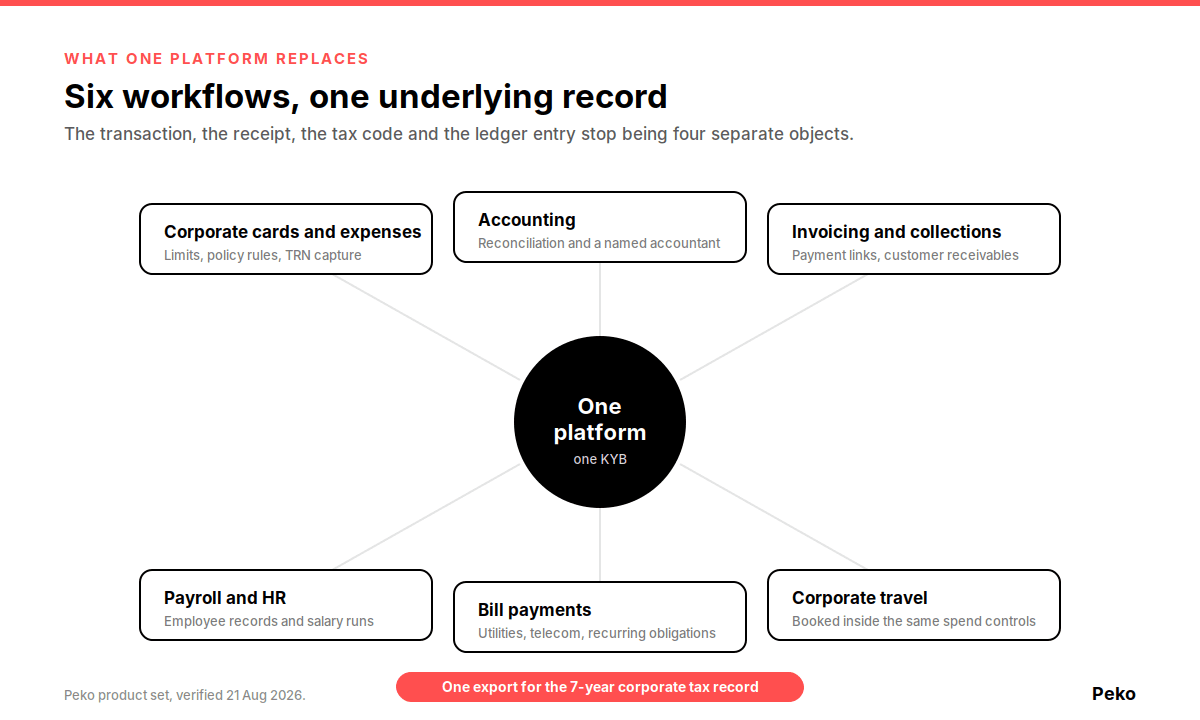
The six money workflows an all-in-one business platform brings into one system for a UAE SME
The practical difference is not the feature list. It is that cash flow, committed spend and upcoming obligations appear in one view instead of being assembled by hand every month.
Which SME pain points does this actually solve?
Three, and they are the ones that separate a small business from a large one: cash is tight, the team is small, and the shape of the business changes faster than its software.
Tight cash flow. When spending sits in four systems, the honest answer to "what have we committed this month" takes a day to produce, so nobody asks it weekly. Centralised visibility turns that into a glance, which is the difference between managing runway and discovering it.
Lean teams. Categorising expenses, reconciling card spend and chasing receipts are the tasks that expand to fill whoever is available. This is not a soft problem. In the AICPA and CIMA Future-ready finance survey of 1,446 senior finance and accounting leaders, fieldwork in August and September 2025, 32% named incompatible systems as a barrier to a more productive finance function, and another 32% named poor coordination of technology. The tooling itself is the obstacle for roughly a third of finance leaders.
Fast-changing needs. Modular matters more than complete. Starting with payments and expenses and adding payroll, travel and insurance later beats buying a suite you use a fifth of, and it beats bolting on a seventh subscription each time something breaks.
There is a fourth, quieter one. Software sprawl is real but badly measured: depending on whose methodology you accept, the average organisation now runs somewhere between 118 separate applications (BetterCloud, July 2026, survey of 525 IT professionals) and 305 (Zylo, January 2026, based on more than 40 million licences under management). Both are vendor studies of larger organisations, so treat them as direction rather than as your number. The finding that travels down to SME scale is Zylo's: roughly 36% of the licences companies pay for go unused.
Not sure what your current stack actually costs you? Peko's team can map it against the workflows below in a short call. Book a walkthrough.
How does one platform make corporate spending simpler and safer?
By moving the control to before the money leaves, instead of after the statement arrives. Shared company cards and reimbursement-by-spreadsheet both find out about a problem weeks later. A policy-based card finds out at the point of sale.
What that looks like in practice:
- Physical and virtual cards with custom limits per user, team or project, so a new hire does not need access to the company card to buy anything.
- Policy controls by category, merchant or budget, so out-of-policy spend is restricted or flagged by rule rather than discovered during the close.
- Near real-time dashboards and alerts showing who spent what, where and why, instead of waiting on statements.
- Automated VAT support on captured spend, which matters because recovering input VAT depends on holding a valid tax invoice showing the supplier's TRN, not just a total.
That last point is where consolidation earns its keep. A card transaction arrives already structured, with merchant, amount, date and currency, and the receipt attaches to it. A reimbursement claim arrives as a photograph and a typed number, often without a TRN, often weeks later. For VAT recovery the first is a record and the second is a reconstruction.
Peko's card tiers are published: Standard free, Premium AED 99 a month, Elite AED 299 a month, with additional physical cards at AED 19 each and an AED 49 annual fee after year one that is waived above AED 50,000 of annual spend. Worth knowing before you compare: Peko does not publish a headline cashback rate, while several specialists do, so if cashback is central to your decision, ask for the rate in writing rather than assuming parity.
Does an all-in-one platform work with the tools you already use?
Mostly yes, and you should interrogate this harder than any other claim on this page, including ours. No UAE SME can replace its whole stack in one weekend, so the realistic question is whether the platform sits at the centre of what you have.
Peko connects to mainstream accounting and ERP systems so finance teams keep their preferred ledger, works alongside HR and payroll structures, and supports integrations across travel, insurance and other operational services. The Enterprise accounting tier includes integration with Zoho and Wafeq at no extra cost.
Two honest caveats.
Ask whether a connector is a two-way sync or a scheduled export. Every vendor in this category publishes a wall of integration logos. The useful question is whether the connector maps VAT treatment and cost centres, or just amounts, and whether corrections flow back. That distinction decides whether you have one system or two systems and a habit.
Your platform is not your e-invoicing service provider. Under the UAE mandate, invoices are transmitted to the FTA through an Accredited Service Provider that you appoint. We checked the Ministry of Finance's accredited provider list on 21 August 2026, the day it was last updated: 44 accredited ASPs plus 8 in final production assessment. Peko is not on either list, and neither are the specialist card platforms UAE SMEs usually shortlist. What a consolidated platform does is keep the underlying records clean, coded and exportable for whichever ASP you appoint. Ask any vendor two questions: are you accredited, and which accredited providers do you integrate with today.
Here is the obligation set worth checking any platform against, since these are the rules that decide what your records need to look like.
One caution on that last row, because the internet is currently confident and wrong about it. MoHRE's Ministerial Resolution No. 340 of 2026 does exist and took effect 1 June 2026, but the widely repeated specifics, a first-of-the-month deadline, an 85% on-time compliance test and a day-by-day penalty ladder, come from law-firm and press commentary. We could not confirm them against MoHRE's own published guidance, which still describes monthly payment at the time agreed in the employment contract. Check with MoHRE or your PRO before building a process on those numbers, and be sceptical of any vendor quoting them as settled law.
Does it scale as the business grows?
It should, and the test is whether growth costs you a migration. The tools that work at three people rarely work at thirty, and the expensive kind of failure is not outgrowing a tool, it is having to rebuild your financial setup to replace it.
What to look for:
- Adding users, entities and markets without re-onboarding from scratch. One KYB, not one per product.
- Per-company pricing rather than per-seat, once the team is past a handful of people. This is the single biggest cost fork in the category, and section six puts numbers on it.
- Cost centres and project-level coding that survive a reorganisation, which matters for construction, agencies and anyone billing by job.
- An interface non-finance staff can use, because approvals stall on whoever finds the tool confusing.
Peko's accounting tiers are built around this progression: Starter AED 499 a month (up to 50 invoices, monthly reconciliation, 4 accountant meetings), Growth AED 999 (up to 100 invoices, 200 expenses, weekly reconciliation, VAT registration and filing support, 12 meetings), and Enterprise AED 1,999 (unlimited expenses and meetings, daily or on-request reconciliation, custom reports, Zoho and Wafeq integration included).
What does running ten tools actually cost?
More than the invoices, and the invoices are already not small. Below is what the same workflows cost as separate subscriptions versus inside one platform. Every specialist price was read from the vendor's own pricing page on 21 August 2026.
Compared like for like, consolidating is not automatically cheaper, and it would be dishonest to draw the chart that way. For a ten-person company, a specialist stack of Alaan Premium at AED 499 plus Zoho Expense Premium at AED 22 per user comes to roughly AED 719 a month and covers two of the six workflows, with no bookkeeping included and no published price for a bookkeeper. Peko's Elite cards at AED 299 plus Growth accounting at AED 999 comes to AED 1,298 and covers all six, with a named accountant inside that figure. The right comparison is cost per workflow actually covered, and the honest reading of that is: if you only need cards, buy cards.
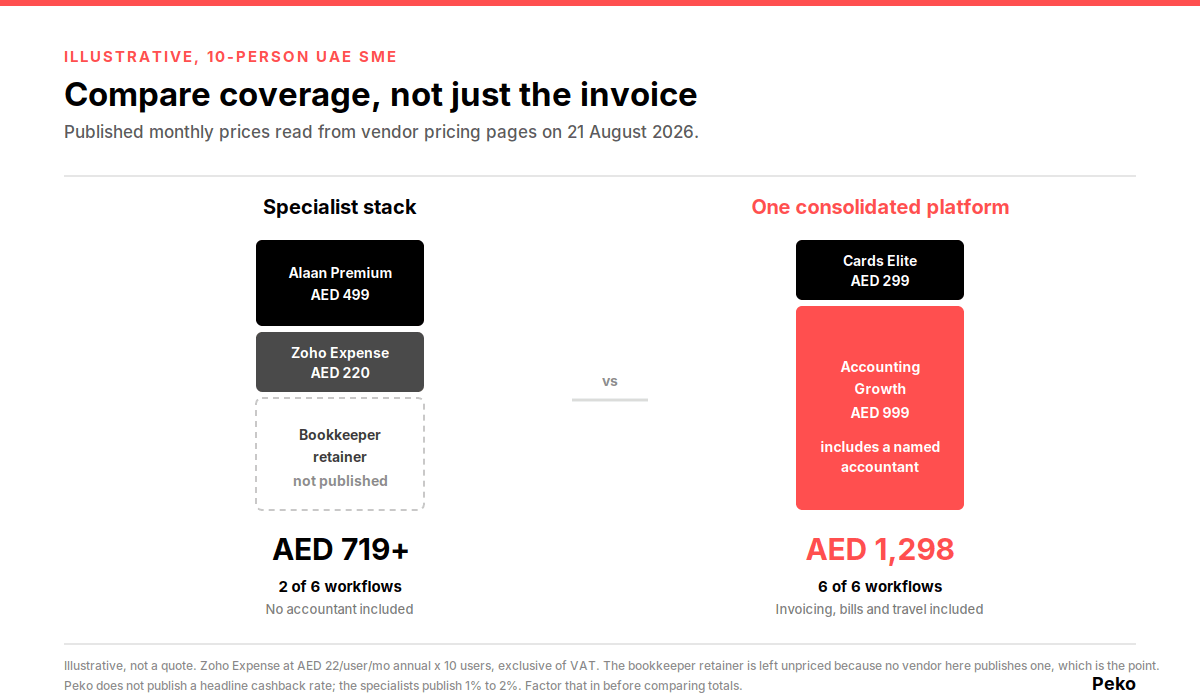
Monthly cost of a specialist UAE SME software stack compared with one consolidated platform, verified August 2026
Two structural points that a feature grid will not tell you.
Per-user pricing changes the maths as you grow. Alaan at AED 499 flat for unlimited users and Pemo at AED 399 per company get cheaper per head. Zoho Expense at AED 11 to AED 33 per user per month, with a five-user minimum and VAT on top, gets more expensive. For a twelve-person team the ranking flips depending on tier.
Watch the currency. Qashio prices in US dollars and bills its paid tiers annually. QuickBooks UAE displays AED and states billing is processed in USD. Both leave you carrying FX on a price that looked local.
Then there is the cost that never appears on an invoice: the close. APQC's benchmarking on year-end close, published 8 April 2026, puts the median annual close at 18 days, with top performers at 10 days or fewer and slower performers at 35. Organisations under 100 million dollars in revenue close in a median of 10 days. Those numbers are driven by how much of the close is manual, and in a fragmented stack the manual part is the joining up.
The oldest and most solid evidence on what manual joining costs is academic, not vendor marketing. Raymond Panko's review of spreadsheet error research found that 24% of spreadsheets across 367 audited in the field contained errors, and among audits from 1997 onward, 91 of every 100 spreadsheets examined did. Cell error rates ran between 0.4% and 2.5% in field audits. If spreadsheets are the connective tissue between your systems, that is your error rate on the joins.
If a shorter close is the goal, the fastest test is one real month run through a single platform. Start with Peko.
Where ten tools still beat one
Three situations, stated plainly, because a page that claims consolidation always wins is not worth trusting on the parts where it does.
You already run a mature ERP with working connectors. If NetSuite or Dynamics is genuinely bedded in and your finance team likes the integrations, best-of-breed plus your ERP will beat replacing the stack. Consolidation pays off against sprawl, not against a working system.
Cashback is your deciding factor. The specialists publish rates: Alaan 2% international and up to 1% domestic, Pemo up to 2% uncapped international, Pluto up to 2%. Peko publishes a rewards marketplace and no headline rate. If your card spend is large and international, do that arithmetic before anything else on this page.
You need one function at genuine depth. Complex multi-entity consolidation, heavy procurement workflows or specialist industry compliance can justify a dedicated tool. An all-in-one platform is broad by design, and breadth costs depth somewhere.
Why Peko is the platform UAE SMEs should shortlist
Because it is one of the few options in this market that covers all six money workflows in a single system rather than four of them plus connectors, and because the accounting layer includes a person rather than only software.
The case, in order of how much it matters:
- Custody, not convenience. When cards, ledger, payroll and invoices live in one system, the seven-year corporate tax record and the VAT evidence trail are one export instead of six reconciliations. In a six-tool stack, your audit trail is only as good as your weakest connector.
- An accountant, not just an integration. Every tier of Peko's accounting service includes dedicated accountant support and scheduled meetings. Compare that to a bookkeeper on retainer, not to a software seat.
- Card pricing below the specialists. AED 99 and AED 299 a month sit under Alaan's AED 499 and Pemo's AED 399 paid tiers, with a genuinely free entry tier.
- Built for this market. Company formation through Peko Start, WPS-aware payroll, VAT support, and UAE bill payment rails, rather than a global product with an AED price list bolted on.
- Modular entry. Start with cards and expenses, add accounting, payroll and travel as the business earns the complexity.
And the honest counterweight, in the same list because it belongs there: Peko is not an accredited e-invoicing service provider, publishes no headline cashback rate, and Co-founder AI has not shipped. If any of those three is your deciding criterion, buy accordingly.
Which Industries and Audiences This Applies To
Consolidation pays off fastest where spending is frequent, distributed across people, or heavy on recoverable VAT.
- Professional services firms in Dubai and Abu Dhabi, 5 to 50 staff, rebilling disbursements to clients, where a missing TRN on a rebilled expense is a straight margin loss.
- F&B groups and retail chains running several outlets with daily supplier purchases and real petty-cash exposure, needing per-branch limits rather than one shared company card.
- Logistics and last-mile operators whose drivers spend on fuel, tolls and repairs across emirates, where card controls replace cash floats.
- Construction and contracting SMEs with project-level cost centres and site purchases that must be coded to the right job before the close.
- Free zone trading companies with multi-currency supplier spend, where FX handling and multi-entity books decide the tool.
- Ecommerce and D2C brands carrying heavy recurring software, ads and marketplace fees, and most exposed to paying USD on an AED-quoted plan.
- Clinics, salons and fitness studios buying consumables and reimbursing part-time staff, usually the least well served by enterprise tooling.
- Founders approaching AED 3m revenue, for whom Small Business Relief and clean monthly numbers now matter through 31 December 2029, following Ministerial Decision No. 131 of 2026 which extended the previous 2026 cutoff.
- Any business under AED 50m revenue, all of which have an ASP appointment due by 31 March 2027 and go live on e-invoicing 1 July 2027.
For context on why this segment matters: SMEs make up 98% of businesses in Abu Dhabi, employ 46% of its workforce and contribute 42.8% of its non-oil GDP, according to the Abu Dhabi Department of Economic Development, whose page was last updated 24 July 2026. Nationally, the UAE Government portal puts the count at 557,000 SMEs as of mid-2022, contributing as much as 63.5% of non-oil GDP, with a target of one million by 2030.
FAQ
What is an all-in-one business platform for SMEs?
It is a single system that handles several core business workflows that would otherwise need separate subscriptions, typically corporate cards and expenses, accounting, invoicing, payroll, bill payments and travel. The distinction from a suite is that the workflows share one underlying record rather than syncing between modules, so a card transaction, its receipt, its VAT treatment and its ledger entry are the same object. For UAE SMEs the practical benefit is a single export when you need records for the FTA, rather than reconciling several systems.
How much does an all-in-one business platform cost in the UAE?
Peko's corporate card tiers are free, AED 99 and AED 299 a month, and its accounting service runs AED 499, AED 999 and AED 1,999 a month depending on invoice volume, reconciliation frequency and accountant meetings. For comparison, specialist card platforms published AED 499 a month flat (Alaan Premium), AED 399 a month per company (Pemo Premium) and USD 125 to USD 500 a month billed annually (Qashio) when read on 21 August 2026. Per-company pricing generally beats per-user pricing once you are past a handful of staff.
Is all-in-one business management software better than best-of-breed tools?
It depends on whether your problem is sprawl or depth. Consolidation wins on custody: fewer systems means fewer connectors between you and a clean multi-year record, and one onboarding instead of six. Best-of-breed wins when you already run a working ERP with good integrations, when a single function needs genuine depth such as complex multi-entity consolidation, or when a specialist's cashback rate outweighs the admin saving. Sprawl that nobody designed is the case for consolidating; a system that works is not.
Does an all-in-one platform make my business UAE e-invoicing compliant?
No, and treat any vendor who implies otherwise with caution. Invoices must be transmitted to the FTA through an Accredited Service Provider that you appoint. As of 21 August 2026 the Ministry of Finance lists 44 accredited ASPs plus 8 in final assessment, and Peko is not on either list, nor are the specialist card platforms UAE SMEs commonly shortlist. What the platform does is keep the underlying invoice and expense records clean and exportable for whichever ASP you appoint. Businesses under AED 50m revenue need an ASP appointed by 31 March 2027 and must be live by 1 July 2027.
Can an all-in-one business platform replace my accountant?
Peko's model is the opposite of that: every accounting tier includes a dedicated accountant and a set number of meetings, so the software and the person come together. Software alone can categorise transactions and produce reports, but it will not make a judgement call on a corporate tax position, a Small Business Relief election or an unusual VAT treatment. The realistic saving is on bookkeeping and reconciliation time, not on professional judgement, and the honest comparison for a service like this is against a part-time bookkeeper rather than against a software seat.
How long do I need to keep expense and invoice records in the UAE?
Corporate tax records must be kept for at least seven years following the end of the tax period, per FTA guidance. General tax records are five years after the relevant tax period under Article 3 of Cabinet Decision No. 74 of 2023, with real-estate records at seven years, and an April 2026 amendment added up to two further years where a refund claim is pending. The practical question for any software decision is what happens after you cancel, so ask every vendor in writing how you export complete historical records, because a five to seven year obligation outlasts most software choices.
Final Thoughts
The argument for one platform is usually sold on convenience, and convenience is the weakest version of it. The real case is that every connector between two systems is a place where a record can quietly fail to arrive, and in the UAE you are keeping those records for five to seven years and may need to produce them for an authority that was not party to your integration choices.
That is also the limit of the argument. If your stack works, consolidating for its own sake is a project with no payoff. The businesses that gain here are the ones whose stack was assembled re-actively, one urgent problem at a time, and who are now spending real hours each month making six tools agree with each other.
So the useful test is not a feature comparison. Run one real month of spending, payroll and invoicing through a single platform, then look at the export at the end of it. If it is one clean file instead of six that need joining, you have your answer. If it is not, you have learned something cheap.
Talk to Peko if you want help mapping your current stack against the six workflows above first, including the parts we do not cover.
This post is general information about UAE tax and labour rules, not legal, tax or financial advice. Prices, deadlines and accreditation lists change. Verify against the Ministry of Finance, the Federal Tax Authority and MoHRE, or take professional advice, before acting.