Sep 16, 2026
Construction Companies in Dubai: 2026 List & Rules

Share this article
- Construction Companies in Dubai: 2026 List, Types and New Rules
- The construction companies in Dubai worth knowing, by discipline
- Why "top 10" lists of construction companies in Dubai go stale
- How Dubai classifies and licenses contractors
- What Law No. (7) of 2025 changes, and by when
- Compliance and operating costs for construction companies in Dubai
- How to verify a contractor before you sign
- Which Businesses This Applies To
- Frequently Asked Questions About Construction Companies In Dubai
- Final Thoughts
Construction Companies in Dubai: 2026 List, Types and New Rules
TL;DR
- Dubai's construction market is served by a mix of large civil contractors, MEP and electrical specialists, interior fit-out firms and infrastructure builders. Which one you need depends on the discipline, not on who sits highest in a "top 10" list.
- Law No. (7) of 2025 regulating contracting activities in Dubai puts every contractor in the emirate into a single Dubai Municipality register, including firms in free zones and the Dubai International Financial Centre. Airport-related contracting is exempt.
- The law takes effect six months after its publication in the Official Gazette, and contractors already operating when it comes into force get one year to regularise their status, extendable by a further year.
- Fines under the law run from AED 1,000 to AED 100,000, doubling to as much as AED 200,000 for a repeat violation within a year, with suspension, classification downgrade and removal from the register available for serious cases.
Most pages listing construction companies in Dubai give you a ranked top ten, copied from the list published the year before. This one starts with who builds what, organised by discipline, then covers the part those lists leave out: the rule-book for every contractor in the emirate changed in 2025.
The construction companies in Dubai worth knowing, by discipline
Dubai's contracting market splits into four broad disciplines: civil and building works, MEP (mechanical, electrical and plumbing), interior fit-out, and infrastructure or specialist works. A firm that excels at a 60-storey tower core is not automatically the right choice for a hotel refurbishment, and under Dubai's classification system it may not even be permitted to take the job.
The names below are widely recognised in their segments. Treat them as a map of the market, not a ranking, and confirm any contractor's current classification and permitted scope before you shortlist them.
Civil and building contractors
Civil and building contractors handle structure: excavation, foundations, concrete frame, envelope and handover of the completed building. This is the segment most people mean by "building construction companies in Dubai", and it is where the largest firms sit.
The established names include ALEC, Al Naboodah Construction Group, Al Habtoor Engineering, Arabian Construction Company, ASGC, Trojan Construction Group, Dutco Construction, Khansaheb and China State Construction Engineering Corporation. Several are arms of older UAE family groups that moved into contracting as Dubai grew, which is why the contracting entity and the parent group often share a name but are separate legal entities with separate licences.
The table is deliberately unranked and deliberately thin on detail. Headcounts, revenues and project counts circulate widely on contractor listicles without sources attached, and they age badly. What actually determines whether a contractor can take your package is its current classification, and that lives on the register rather than in any article.
MEP, electrical and HVAC contracting companies in Dubai
MEP contractors install and commission the systems that make a building work: power distribution, water, drainage, fire protection, and heating, ventilation and air conditioning. On a large project the MEP package is frequently the single biggest subcontract by value, and it is usually the one that determines whether the programme holds.
Electrical, HVAC and other MEP-related works can fall under specific contracting classifications rather than one bundled "MEP" scope, so buyers should verify a contractor's approved activity before awarding a package. That matters more than it used to. Under Dubai's classification rules a contractor may only work within its approved classification and capacity, so a firm cannot simply absorb an adjacent package because the programme slipped.
Interior fit-out contractors
Fit-out contractors take a completed shell and turn it into a usable space: partitions, ceilings, joinery, finishes, and the coordination of services above the ceiling line. Retail, hospitality and office fit-out is a distinct trade in Dubai with its own approval route.
It is also the corner of the market where firms turn over fastest, which makes checking a fit-out contractor's current standing more important than in the heavier disciplines, not less.
Infrastructure and specialist contractors
Infrastructure contractors build roads, bridges, utilities, drainage networks and marine works, usually for government clients or master developers rather than for private buyers. Specialist contractors cover narrower scopes: swimming pools, facades, steel fabrication, piling, demolition.
Demolition is worth separating out, because Dubai Municipality classifies contractors specifically across construction, building and demolition activities, and issues professional competency certificates to technical personnel working in them.
Why "top 10" lists of construction companies in Dubai go stale
Ranked lists of Dubai contractors are unreliable because the market changes faster than the lists do, and because most are assembled by copying an older list rather than by checking a register.
Arabtec is the clearest example. On 30 September 2020, Arabtec's shareholders voted to adopt a plan of liquidation and dissolution, citing an untenable financial situation after a first-half loss of AED 794 million and accumulated losses of AED 1.46 billion, according to Gulf News reporting at the time. Six years on, Arabtec still appears on published "top contractors in Dubai" lists.
Firms cease trading, restructure, or change classification, and a copied list records none of it. Use the list as a starting point and the register as the answer. The verification section below covers how to check.
How Dubai classifies and licenses contractors
Dubai Municipality classifies contractors and sets the scope each one is permitted to work within. Classification is not a badge of quality so much as a permission boundary: it defines the technical and financial limits of what a contractor may take on.
Three rules follow from that, and all three are now backed by statute:
- A contractor must operate within its approved classification and financial capacity.
- A contractor may not exceed its technical limits.
- A contractor may not subcontract without prior approval.
Dubai Municipality also issues professional competency certificates to technical personnel, so the requirement reaches individuals as well as companies. The municipality publishes its own binding standards covering contractor activity classification, technical staff requirements and the licensing criteria applied to building, steel and demolition contracting, and it maintains a Consultants and Contractors Register that traces back to Circular No. (133) of 2005.
For anyone commissioning work, the practical consequence is that "they said they could do it" is not the same as "they are permitted to do it", and the difference becomes your problem when approvals stall.
If you are forming a contracting company rather than hiring one, classification shapes the structure decision before the licence is issued, not after. Peko Start handles UAE company formation, trade licensing, visas and PRO work across all seven emirates, and new businesses get a year of Peko+ for bill payments, invoicing and expense management alongside it.
What Law No. (7) of 2025 changes, and by when
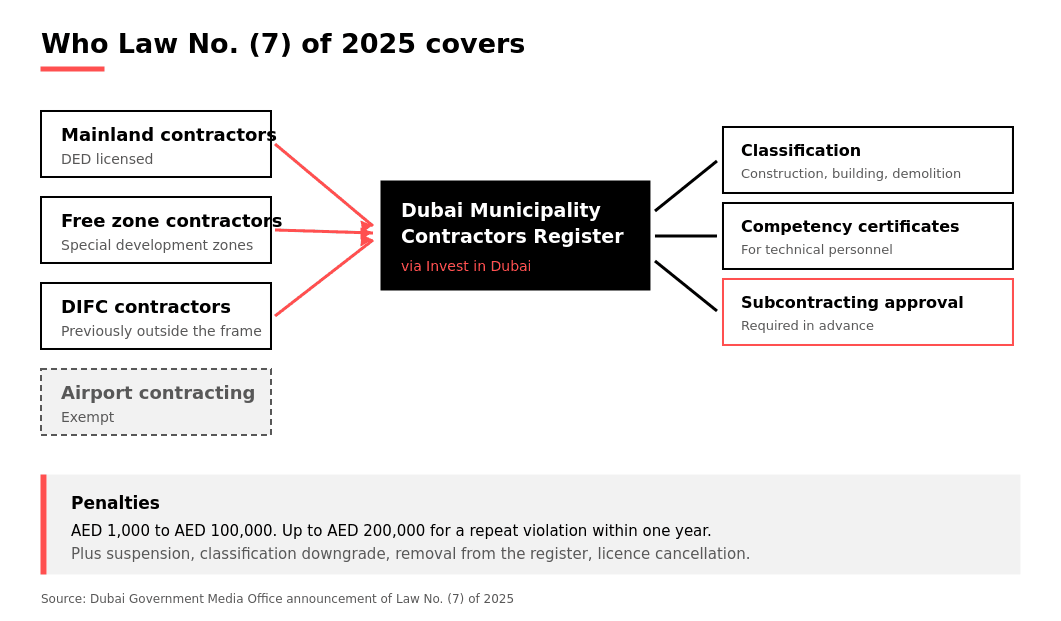
How Dubai Law No. 7 of 2025 brings mainland, free zone and DIFC contractors into one Dubai Municipality register
Law No. (7) of 2025 regulates contracting activities across the Emirate of Dubai and brings every contractor in the emirate under one registration and classification framework administered by Dubai Municipality. It was issued by His Highness Sheikh Mohammed bin Rashid Al Maktoum and announced by the Dubai Government Media Office in July 2025.
Here is what the law actually does, according to the official announcement.
One register for the whole emirate. Dubai Municipality establishes and manages an integrated electronic system covering all contracting activities in the emirate, linked to the Invest in Dubai platform. That system is the central registry contractors must appear on.
It reaches free zones and the DIFC. The law applies to all contractors in Dubai, including those in special development zones and free zones such as the Dubai International Financial Centre. Exemptions include airport-related contracting and activities excluded by executive decision. A free zone licence is no longer a reason to sit outside the emirate's contracting framework.
Classification and competency are formalised. Dubai Municipality classifies contractors across construction, building and demolition activities, and issues professional competency certificates to technical personnel.
Obligations are explicit. Contractors must comply with applicable legislation, operate within their approved classification and financial capacity, and may not exceed technical limits or subcontract without prior approval.
The penalties have teeth. Fines under the law range from AED 1,000 to AED 100,000. A repeat violation within one year carries a doubled fine of up to AED 200,000. Beyond fines, the available sanctions include suspension from contracting, downgrade of classification, removal from the register and cancellation of the licence.
The timing, stated precisely
This is the part most summaries get wrong, so it is worth being exact.
The law comes into effect six months after its publication in the Official Gazette. Contractors already operating in Dubai when the law comes into force are required to regularise their status within one year, and the committee overseeing implementation may extend that window by a further year if needed.
You will find articles online quoting a specific calendar date for the deadline. The official announcement frames it relative to Gazette publication rather than as a fixed date, so if you are planning around it, confirm the Gazette publication date for your own records rather than relying on a secondary summary. The one-year regularisation window is the number that matters for an existing contractor.
This section summarises publicly announced provisions and is not legal advice. Contractors should confirm their own classification and registration position directly with Dubai Municipality.
Compliance and operating costs for construction companies in Dubai
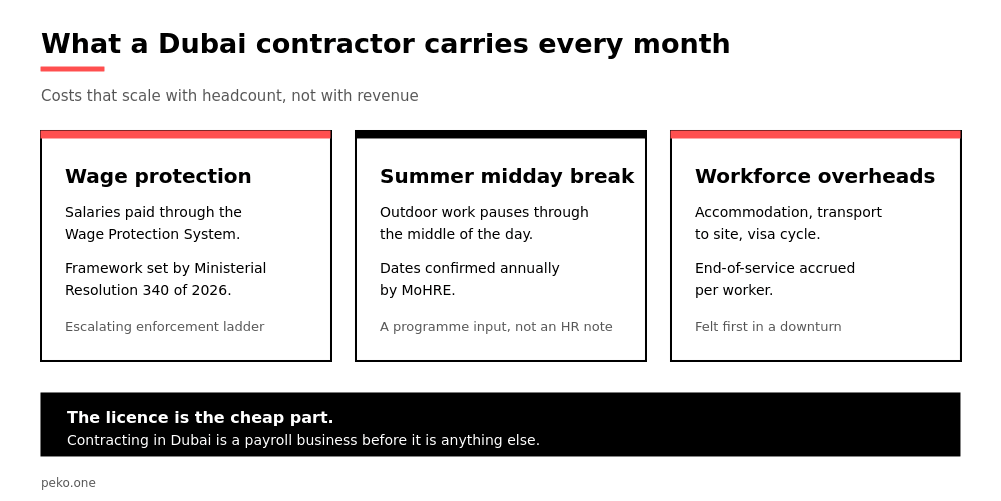
The three recurring workforce obligations a Dubai construction company carries: wage protection, summer midday break and accommodation
The licence is the cheap part. Contracting in Dubai is a payroll business before it is anything else, and the recurring obligations sit on the workforce rather than on the trade licence.
Construction is among the most labour-intensive sectors in the UAE, which means a contractor carries three overlapping sets of obligations that a professional services firm never touches.
Wage protection. Salaries must be paid through the Wage Protection System, and the framework governing payment deadlines and penalties was rewritten by Ministerial Resolution 340 of 2026. The enforcement ladder is now tighter than the regime it replaced, and it escalates from notifications through work permit suspension to administrative fines and, for larger establishments, labour disputes. If you employ in the UAE, the WPS rules that changed in June 2026 set out the current deadline and the penalty timeline in detail.
Summer working restrictions. A midday break applies to outdoor work during the summer months each year, with the dates confirmed annually by the Ministry of Human Resources and Emiratisation. For a site-based contractor, this is a programme input, not an HR footnote: it removes productive hours from the middle of every working day across the hottest part of the year, and it needs to be priced into the tender rather than absorbed later.
Accommodation and mobilisation. Firms running large blue-collar headcounts carry worker accommodation, transport to site and the visa cycle for every worker. Those costs scale with headcount rather than with revenue, which is why contractors feel a downturn faster than most sectors.
Payroll size is also what makes the administrative load distinctive. Running a few hundred salaries a month through a compliant process, with end-of-service accruals tracked per worker, is a different problem from running thirty. That is the practical reason contractors end up on dedicated payroll systems earlier than comparably sized firms in other sectors.
Running payroll for a site-based workforce? Peko's payroll and HR platform disburses salaries through WPS-supporting workflows, generates pay slips, tracks leave, and calculates overtime, reimbursements, deductions and end-of-service in one place. Employers remain responsible for their own regulatory compliance.
Site spend and materials. The second administrative drag on a contractor is money leaving the business across multiple sites at once: materials, fuel, plant hire, small tools, subcontractor disbursements. Petty cash and personal cards make that invisible until reconciliation, which is exactly when a VAT position gets messy.
Spending across several sites? Peko corporate cards let you set per-employee limits and approval workflows, issue unlimited digital cards plus physical ones, and keep expenses tracked with VAT support that syncs to your accounting or ERP system.
Getting paid. Contracting is a slow-payment trade. Certification cycles, retention and staged milestones mean the cash gap between doing the work and being paid for it is wider than in most sectors, and chasing it manually is its own overhead.
Chasing certified amounts? Peko invoicing creates and tracks invoices, generates payment links you can send by email, SMS or WhatsApp, schedules reminders, and supports VAT compliance. Utility, telecom, and internet bills can run through bill payments from the same dashboard.
If you are setting up rather than already trading, the structure question comes first, and mainland, free zone and offshore are not interchangeable for contracting work now that Law No. (7) of 2025 reaches into the free zones.
How to verify a contractor before you sign
Check the registers, not the rankings. Four sources are worth more than any published list.
- Dubai Municipality's registered contracting companies data. Dubai Municipality publishes consultants, contractors and suppliers data, including a Database of Registered Contracting Companies, reachable through its corporate practice permit portal and the Dubai BPS mobile app.
- Dubai Municipality's licensing standards. The municipality's consultants and contractors licensing standards set out activity classification, technical staff requirements and the evaluation criteria applied to building, steel and demolition contracting.
- The federal list of contractors and consultants. The Ministry of Energy and Infrastructure publishes a list of classified contractors and consultants at federal level.
- Build in Dubai. The Dubai government's Build in Dubai platform is the route for construction permitting in the emirate and lists consultants and contractors.
A checklist before you appoint a contractor
Work through these before signing, not after the first approval stalls:
- Current Dubai Municipality registration status
- Approved contracting activity, matched against your scope
- Classification category and what it permits
- Technical staff qualifications on the municipality's published requirements
- Technical and financial capacity against the contract value
- Which packages will be subcontracted, and to whom
- Whether the required subcontracting approvals are in place
- Relevant project experience in the same discipline
- Trade licence status and expiry
- Contract documentation and insurance cover
A contractor that answers all ten cleanly is telling you something more useful than a position on a list.
Which Businesses This Applies To
This guide is written for the people on both sides of a Dubai construction contract.
Main contractors and subcontractors already trading in Dubai, who now have a registration and classification position to confirm within the regularisation window, whether they are licensed on the mainland or inside a free zone.
MEP, electrical, HVAC and fit-out specialists, for whom the classification boundary is a live commercial constraint on which packages they can bid for.
Developers, master developers and property owners assembling tender shortlists, who need a verification routine rather than a published ranking.
Facilities management and maintenance firms whose work overlaps with licensed contracting activity and who may fall inside the framework depending on scope.
Finance and HR teams inside contracting firms, who carry the wage protection, accommodation and end-of-service load that makes construction payroll different from everyone else's.
Free zone and DIFC-licensed entities carrying out contracting work, who were previously outside the emirate-level framework and are now inside it.
Frequently Asked Questions About Construction Companies In Dubai
Who are the top construction companies in Dubai?
The large civil and building contractors operating in Dubai include ALEC, Al Naboodah Construction Group, Al Habtoor Engineering, Arabian Construction Company, ASGC, Trojan Construction Group, Dutco Construction, Khansaheb and China State Construction Engineering Corporation. Any ranked "top 10 construction companies in Dubai" list should be treated as a starting point only, since published lists go stale and some still include firms that no longer trade.
How do I find a full list of construction companies in Dubai?
Use the official registers rather than a blog list. Dubai Municipality maintains the emirate's contractor register under Law No. (7) of 2025, accessed through the Invest in Dubai platform, and the Ministry of Energy and Infrastructure publishes a federal list of classified contractors and consultants. Build in Dubai is the government platform for construction permitting and also lists consultants and contractors.
Does Law No. (7) of 2025 apply to free zone contracting companies in Dubai?
Yes. Law No. (7) of 2025 applies to all contractors in Dubai, including those operating in special development zones and free zones such as the Dubai International Financial Centre. Airport-related contracting is exempt, along with activities excluded by executive decision. A free zone licence no longer places a contractor outside the emirate's registration and classification framework.
What are the penalties for contracting without the right classification in Dubai?
Under Law No. (7) of 2025, fines range from AED 1,000 to AED 100,000, and a repeat violation within one year can carry a doubled fine of up to AED 200,000. Dubai Municipality can also suspend a contractor from contracting activity, downgrade its classification, remove it from the register, or cancel its licence.
How long do existing contracting companies in Dubai have to comply?
Contractors already operating in Dubai when Law No. (7) of 2025 comes into force have one year to regularise their status, and the committee overseeing implementation may extend that period by a further year. The law itself takes effect six months after its publication in the Official Gazette.
What payroll rules apply to construction companies in Dubai?
Construction companies in Dubai must pay salaries through the Wage Protection System, under the framework set by Ministerial Resolution 340 of 2026, which tightened both the payment deadline and the penalty escalation compared with the earlier regime. Site-based contractors also work around the annual summer midday break for outdoor work, and typically carry worker accommodation, transport and visa costs that scale with headcount.
Final Thoughts
The interesting thing about Dubai's contracting market in 2026 is not who is biggest. It is that the question "is this contractor allowed to do this work" now has a clearer, centralised verification route, and that it reaches inside the free zones and the DIFC too.
For contractors, that turns classification from paperwork into a commercial position. A firm that regularises early, gets its technical staff certified and keeps its subcontracting approvals clean can bid for work that a competitor scrambling at the end of the regularisation window cannot touch. For anyone commissioning work, it replaces reputation-by-list with a register you can actually query.
The administrative side is where the cost of getting it wrong compounds quietest. Wage protection, site spend, accommodation, end-of-service and the summer programme hit every month regardless of how the tender went, and construction carries more of that load per dirham of revenue than almost any other sector in the UAE.
Managing payroll, spend and day-to-day operations across a growing construction workforce?
Peko brings payroll and HR, corporate cards, invoicing and bill payments together in one platform so finance and HR teams run the month from one place instead of five. See what Peko covers for UAE businesses, or start with the payroll and HR module if wage protection is the pressing problem.
Last reviewed: 16 September 2026. Regulatory information checked against primary sources in September 2026.
This article is for general information and is not legal advice. Contractors should confirm their registration, classification and compliance position directly with Dubai Municipality and take professional advice where needed.
About the author
Adil Rashid Lone is SEO Manager at Peko, specialising in UAE B2B search across payroll, company formation, fintech and business operations content.