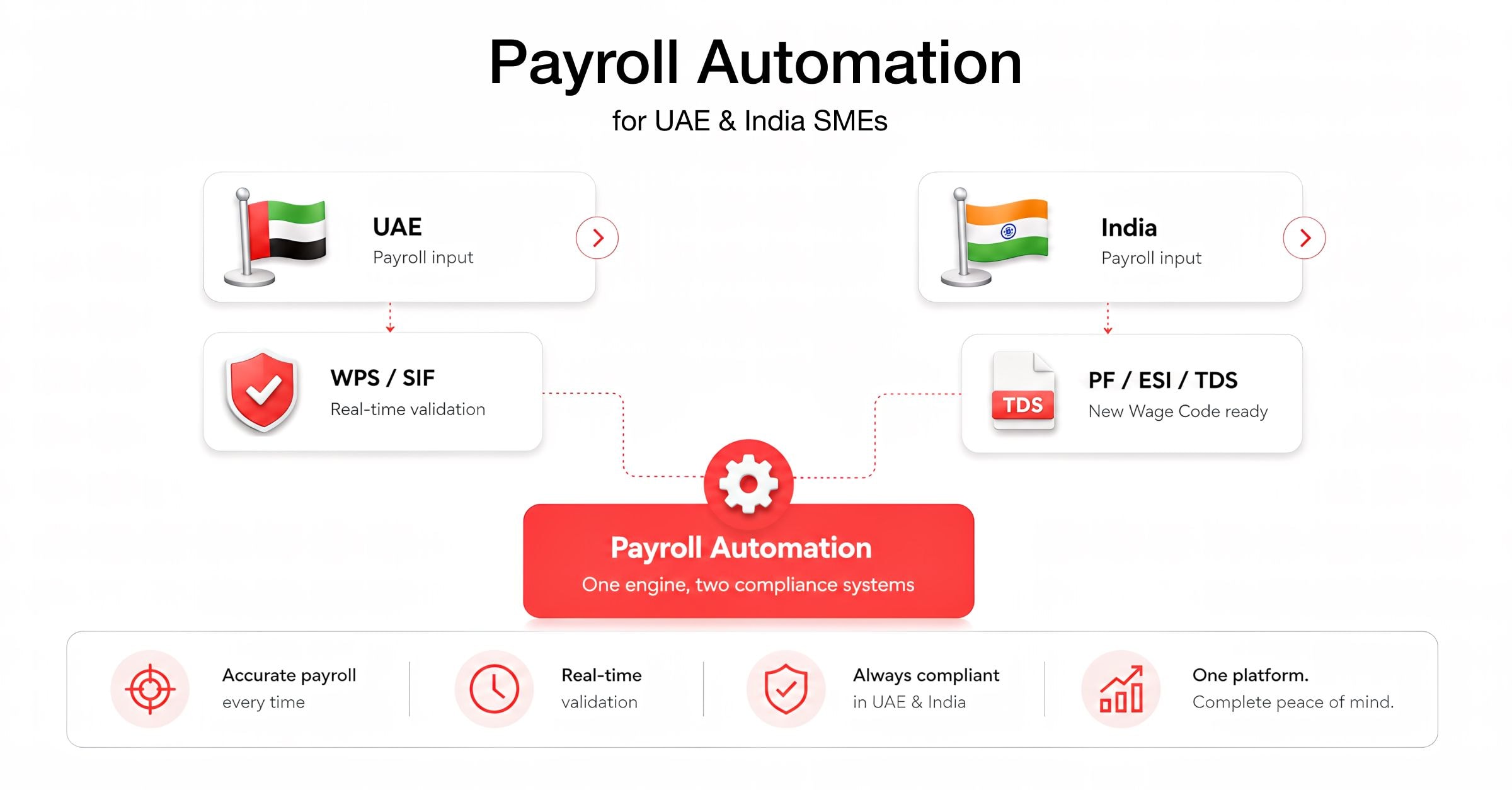
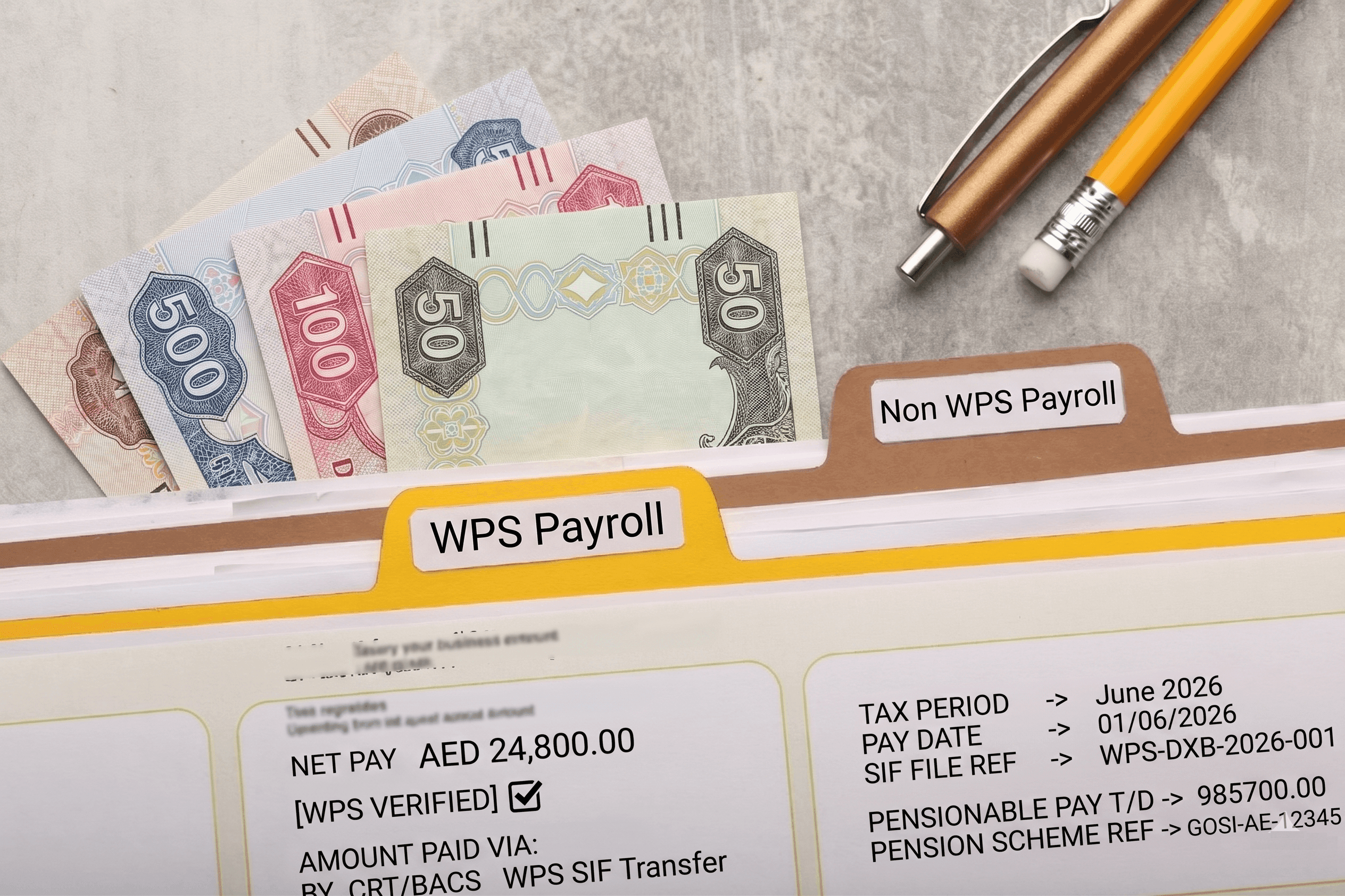
- Blogs
- WPS Payroll and HR
- UAE Gratuity Calculator 2026: Formula and Worked Examples
Oct 06, 2026
UAE Gratuity Calculator 2026: Formula and Worked Examples
Share this article
- UAE Gratuity Calculator: How End-of-Service Gratuity Is Calculated, With Worked Examples
- UAE Gratuity Calculator
- How to Use the UAE Gratuity Calculator
- What Is End-of-Service Gratuity in the UAE?
- The Gratuity Calculation UAE Formula, Step by Step
- Basic Salary vs Total Pay: What Actually Drives the Number
- Worked Examples: Resignation, Termination, Incomplete Service and More
- Limited vs Unlimited Contracts: Why the Old Rules Still Cause Wrong Payouts
- Deductions, the 14-Day Payment Deadline and the Claim Window
- The Savings Scheme Alternative to Gratuity
- What Records Employers Must Keep for Gratuity
- Common Gratuity Calculation Mistakes SMEs Make
- Where Peko Fits in Your Gratuity Process
- Which Industries and Businesses This Applies To
- Frequently Asked Questions About Gratuity In The UAE
- Final Thoughts
UAE Gratuity Calculator: How End-of-Service Gratuity Is Calculated, With Worked Examples
TL;DR:
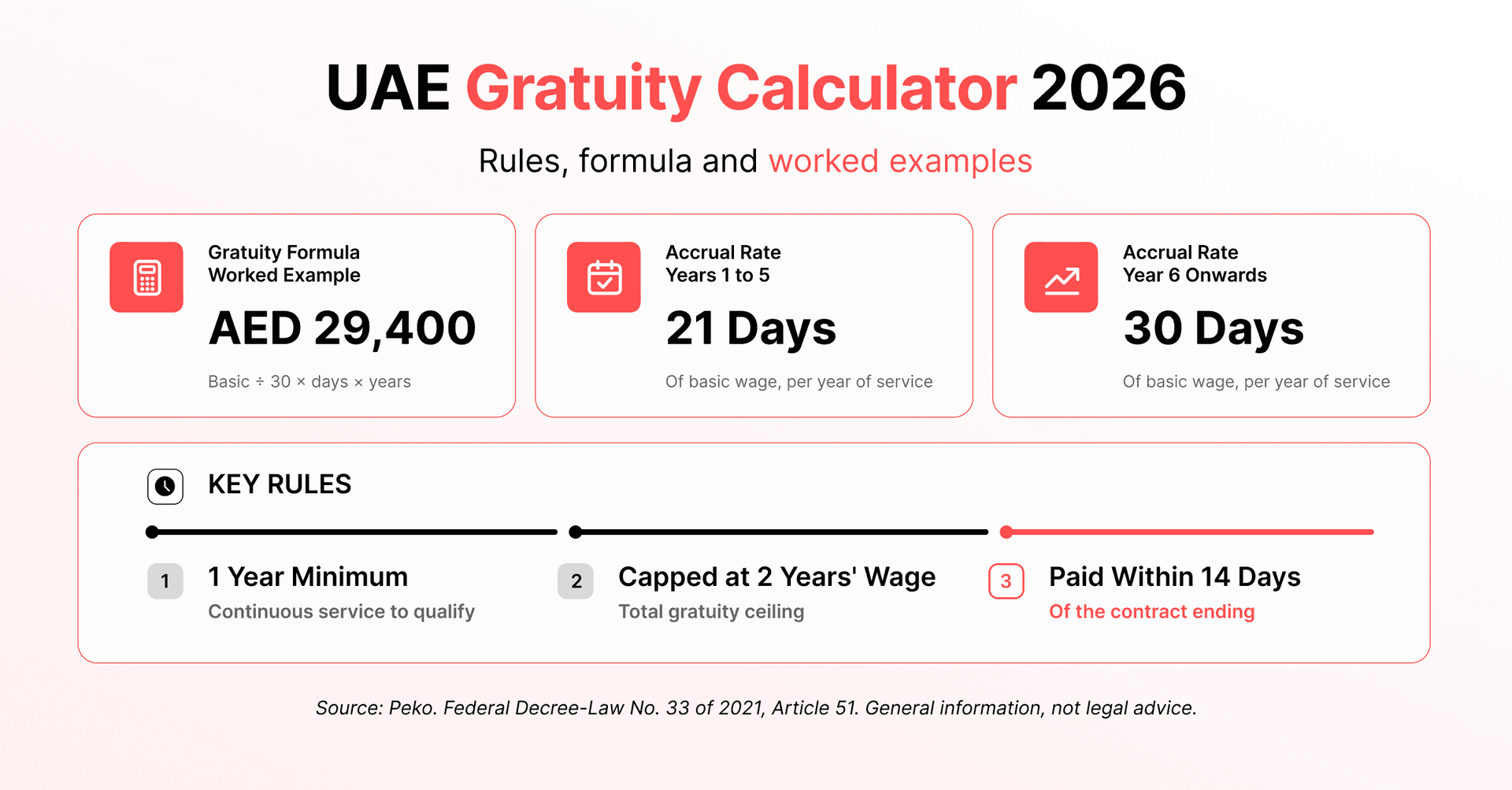
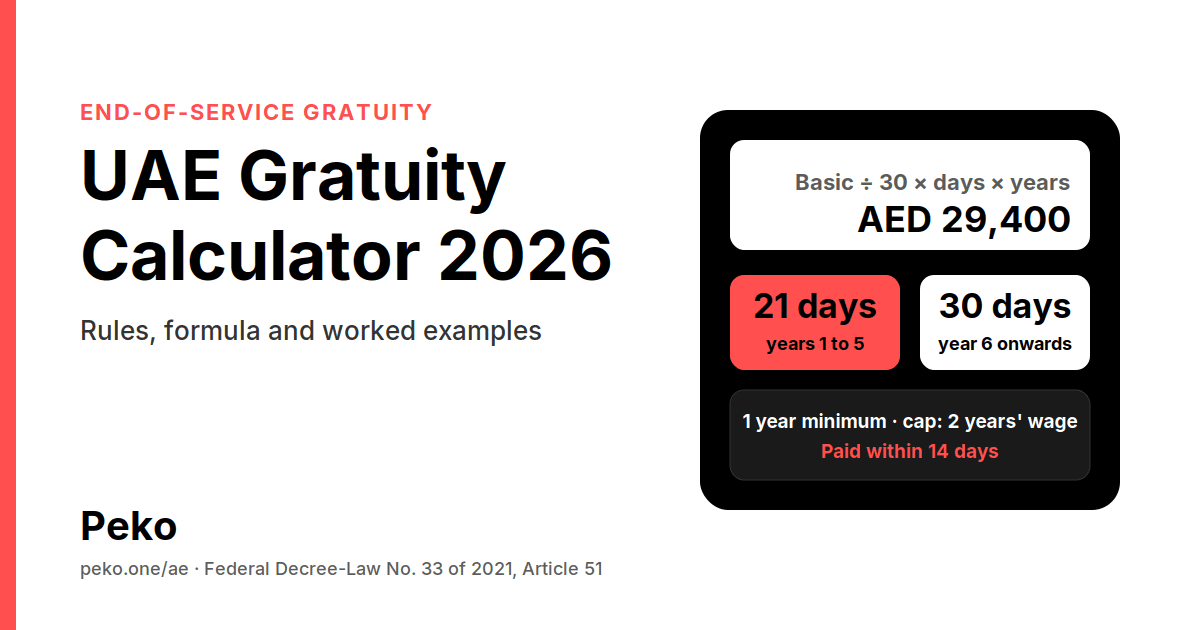
- UAE private-sector gratuity is 21 days of basic salary for each of the first five years and 30 days for each year after that, once an employee has one year of continuous service (Article 51, Federal Decree-Law No. 33 of 2021).
- One day of basic salary is monthly basic ÷ 30. That is the method Dubai Development Authority's official calculator uses, and it means each of the first five years is worth 0.7 of a month's basic pay.
- Resigning no longer cuts the payout, and a limited or unlimited contract no longer changes the maths. Unpaid leave, part-time hours and the two-year wage cap still do.
- Employers must pay within 14 days of the contract ending and keep the worker's file for at least two years afterwards.
The UAE gratuity calculator below gives you the number in about ten seconds. The rest of this page explains where that number comes from, so you can check it, defend it in a MoHRE dispute, and budget for it long before anyone resigns. I have worked the formula through nine real examples, including the ones most online calculators get wrong: unpaid leave, part-time staff, all-inclusive salary packages and the old limited versus unlimited contract rules.
How to Use the UAE Gratuity Calculator
Enter the first and last working day, monthly basic salary, total monthly wage and any unpaid leave days, and the calculator returns the gratuity with a year-by-year breakdown. Everything runs in your browser. Nothing you type is stored or sent anywhere. In my tests against Dubai Development Authority's official calculator on 25 September 2026, the results matched to within AED 1 (DDA rounds up to the whole dirham).
A few inputs matter more than people expect:
- Basic salary, not total salary. Use the basic figure written in the employment contract registered with MoHRE. Housing, transport and other allowances do not count towards the gratuity itself.
- Total monthly wage. This is only used to check the legal cap of two years' wage. Leave it blank and the calculator applies the cap to basic salary, which is the cautious reading.
- Unpaid leave days. These come off the length of service before anything is calculated.
- Part-time percentage. For part-time contracts, enter contracted hours as a share of full-time hours.
The result is an estimate built on the federal minimum. A contract, company policy or court ruling can give an employee more. It cannot lawfully give them less.
What Is End-of-Service Gratuity in the UAE?
End-of-service gratuity is a lump sum that a UAE private-sector employer owes a non-UAE national employee when employment ends after at least one year of continuous service. It rewards length of service, and it is owed whether the employee resigns, is let go, or reaches the end of a fixed-term contract.
The rule sits in Article 51 of Federal Decree-Law No. 33 of 2021 on the Regulation of Labour Relations, which took effect on 2 February 2022. The official text on the UAE legislation portal shows the law as active, with its last amendment dated 29 July 2024. That amendment, Federal Decree-Law No. 9 of 2024, changed Articles 54 and 60 (disputes and fines). It did not touch gratuity.
Who the federal formula covers, and who it does not:
- Expatriate full-time employees of mainland companies and most free zone companies: covered by Article 51.
- UAE nationals: Article 51 sends them to the pension and social security legislation instead, so the gratuity formula on this page does not apply.
- Part-time employees: covered, pro-rated by hours (more on that below).
- DIFC employees: gratuity accrual stopped on 1 February 2020 when the DIFC moved to DEWS, a funded savings plan, according to Mercer's summary of the DIFC Employment Law amendment. Entitlements earned before that date were kept.
- ADGM employees: the ADGM Employment Regulations 2024 use the same 21-day and 30-day basis in Section 61, and allow employers to offer a pension or savings scheme as an alternative.
If your company sits in DIFC, this calculator is the wrong tool for service after February 2020. Everywhere else, keep reading.
The Gratuity Calculation UAE Formula, Step by Step
The gratuity calculation in the UAE comes down to four steps: work out the daily basic wage, count eligible years of service, apply 21 days per year for the first five years and 30 days per year after that, then check the result against the cap of two years' wage.
Here is the formula in plain terms:
- Work out the daily basic wage: monthly basic salary ÷ 30. The law does not name the divisor. I tested Dubai Development Authority's official calculator on 25 September 2026: AED 12,000 basic from 1 January 2021 to 1 July 2024 returned exactly AED 29,400, which only works with ÷ 30.
- Count eligible service: total service minus unpaid leave days. If the result is under one year, gratuity is zero and you can stop here.
- Apply the two rates.
- First five years: 21 × daily basic wage × years (up to 5)
- Every year after five: 30 × daily basic wage × each extra year
- Part years count pro rata, as long as the one-year threshold is met
- Check the cap. The total cannot exceed two years' wage.
Put the ÷ 30 through the formula and you get a shortcut worth remembering. Each of the first five years earns 0.7 of one month's basic salary (21 ÷ 30). Each year after that earns one full month.
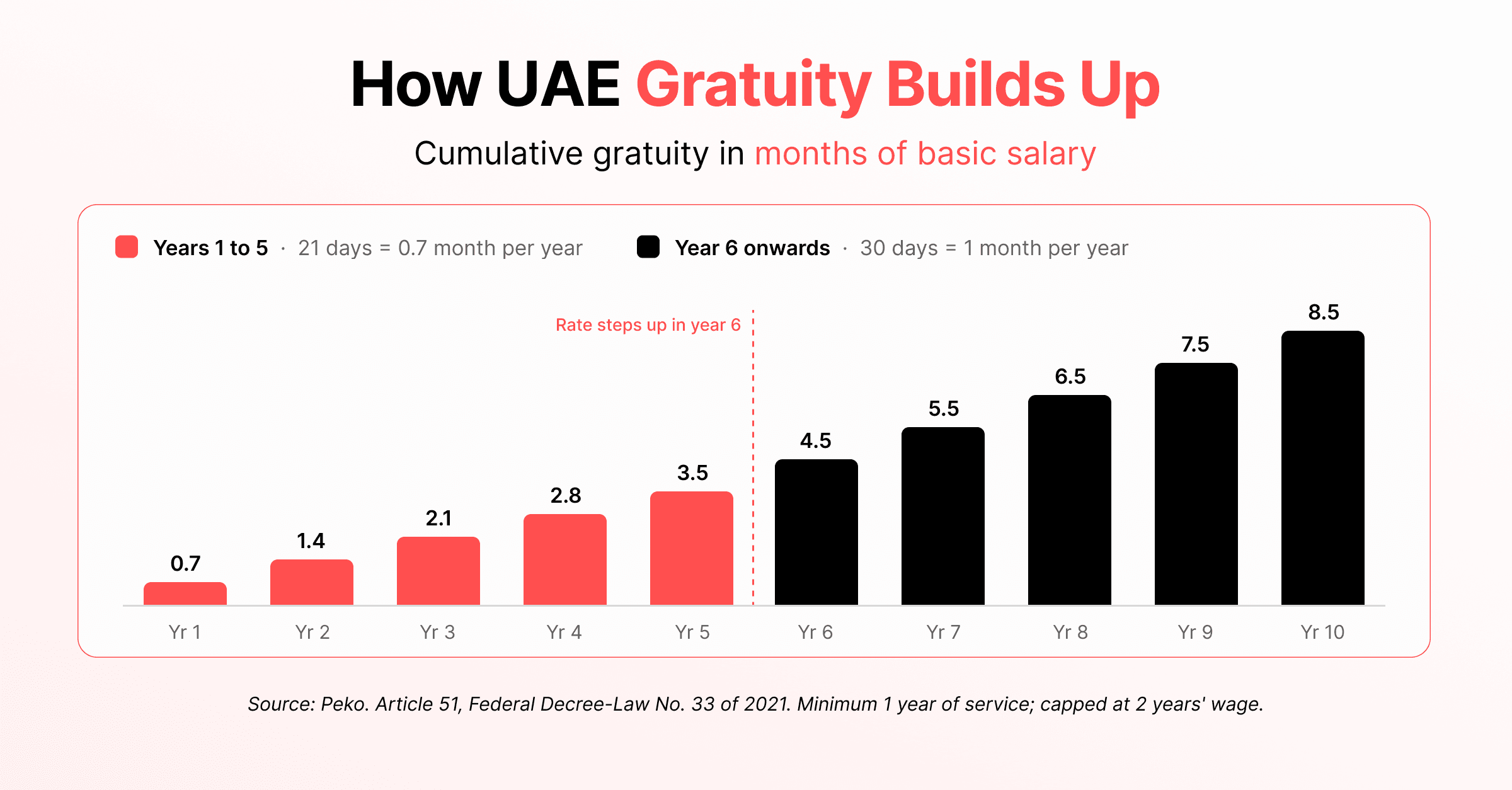
Diagram of the UAE gratuity formula showing 21 days of basic salary per year for years one to five and 30 days per year from year six
One detail that trips up older guides: the law counts calendar days of basic wage, not working days. Afridi & Angell noted when the law was issued that reading it as "working days" would have inflated accruals by roughly 29%, and the calendar-day reading is the one that held.
Basic Salary vs Total Pay: What Actually Drives the Number
Gratuity is calculated on the last basic salary only. Total or gross pay matters in exactly one place: the two-year cap. So the way a salary package is split between basic and allowances decides most of the liability.
Take two employees who both earn AED 18,000 a month and both leave after five years.
- Employee A has a basic salary of AED 9,000 plus AED 9,000 in allowances. Gratuity: 9,000 × 3.5 = AED 31,500.
- Employee B is on an all-inclusive package, so the full AED 18,000 is basic. Gratuity: 18,000 × 3.5 = AED 63,000.
Same take-home pay, twice the gratuity. That is why the basic and allowance split in an offer letter is a gratuity decision as much as a payroll one, and why an employer who calculates gratuity on gross salary by mistake overpays by the full allowance share.
It works the other way too. Gulf News reported on 22 September 2026 that a cut to basic salary only reduces gratuity if the change is properly documented through a signed amendment or a MoHRE-registered contract change. Without that paperwork, the original contractual basic may still be the figure a dispute uses.
When the Two-Year Cap Kicks In
The cap rarely bites on a normal package, because allowances push "two years' wage" well above the formula. It does bite on long service with an all-inclusive salary.
Example: 30 years of service on an all-inclusive AED 22,000 basic. The formula gives AED 77,000 for the first five years plus AED 550,000 for the next 25, a total of AED 627,000. Two years' wage is 24 × 22,000 = AED 528,000, so the payout is capped at AED 528,000.
Worked Examples: Resignation, Termination, Incomplete Service and More
Every scenario below uses the same Article 51 formula, because the current law does not change the rate based on why employment ended. What changes the result is length of service, unpaid leave, contracted hours and the basic salary on the last day.
Resignation After 3 Years and 6 Months
Basic salary AED 12,000, total wage AED 20,000. Daily basic wage is 12,000 ÷ 30 = AED 400. Annual accrual is 21 × 400 = AED 8,400. Multiply by 3.5 years: AED 29,400. This is the same case I ran through DDA's calculator, and it matched to the dirham.
Under the old 1980 labour law, the answer would have depended on the contract. On an unlimited contract, resigning with 3.5 years' service paid two-thirds of the entitlement. On a limited contract, resigning before the contract's end date paid nothing, because the employee had under five years' service. Today the contract type is irrelevant and they get all of it.
Termination After 8 Years
Basic salary AED 15,000. Daily basic wage is AED 500.
- First five years: 21 × 500 × 5 = AED 52,500
- Years six to eight: 30 × 500 × 3 = AED 45,000
- Total: AED 97,500
Termination for redundancy, restructuring or performance makes no difference to the gratuity. Notice pay, any unused annual leave and any compensation for arbitrary dismissal are separate entitlements, paid on top.
Incomplete Service: Under One Year, and Just Over It
An employee who leaves after 11 months gets no gratuity, whatever the reason. The one-year threshold is a hard line.
Once the threshold is crossed, part years are paid pro rata. An employee on AED 8,000 basic who leaves after 1 year and 4 months gets 21 × (8,000 ÷ 30) × 1.333 = AED 7,466.67.
Unpaid Leave Inside the Service Period
Six years of service on AED 10,000 basic, including 60 days of unpaid leave. Those 60 days come off first, leaving 5.836 years of eligible service.
- First five years: AED 35,000
- Remaining 0.836 years: 30 × 333.33 × 0.836 = AED 8,356.16
- Total: AED 43,356.16, against AED 45,000 if unpaid leave had been ignored
That AED 1,644 gap is exactly the kind of line item that ends up in a dispute when leave records are patchy.
Part-Time Employees
Article 30 of the Executive Regulation (Cabinet Resolution No. 1 of 2022) pro-rates part-time gratuity by hours: contracted annual hours divided by full-time annual hours, applied to the full-time gratuity. A part-timer on 50% of full-time hours, six years' service and AED 10,000 basic gets 50% × 45,000 = AED 22,500.
Summary Dismissal Under Article 44
Under the old law, an employer could withhold gratuity from an employee dismissed for gross misconduct. Al Tamimi & Company's analysis of the new law is clear that this has gone: an employer cannot forfeit gratuity when dismissing someone under Article 44. The employer can still deduct amounts the employee legally owes (see the section on deductions).
Limited vs Unlimited Contracts: Why the Old Rules Still Cause Wrong Payouts
Limited and unlimited contracts no longer exist as separate gratuity categories. Since 2 February 2022 every private-sector contract must be fixed-term, and gratuity follows one formula regardless of contract type or who ended it. The confusion survives because the old law treated the two contract types very differently, and many calculators still ask for contract type and run the pre-2022 rules.
Under Federal Law No. 8 of 1980, the 21-day and 30-day formula itself was the same for both contract types (Article 132). What differed was what happened when the employee resigned:
- Unlimited contracts (Article 137): resigning after one to three years paid one-third of the gratuity, three to five years paid two-thirds, and more than five years paid the full amount.
- Limited contracts (Article 138): an employee who resigned before the contract's end date got no gratuity at all unless their continuous service exceeded five years. An employee who worked until the contract expired got the full amount.
Employers had until 31 December 2023 to move remaining unlimited contracts onto fixed-term ones, after Ministerial Resolution No. 27 of 2023 extended the original deadline, as Squire Patton Boggs reported. Since then, the rules are the same for everyone.
Worked comparison: an employee resigns after four years on AED 10,000 basic. Under the old law, an unlimited-contract employee received two-thirds of AED 28,000, which is AED 18,666.67. A limited-contract employee who resigned before the contract ended received AED 0. Under the current law, both receive the full AED 28,000.
One transitional point matters for older claims. Gulf News has explained that resignations or terminations that took place before 2 February 2022 are assessed under the old law, even if the claim is filed later. Anything that ended after that date uses the current rules.
Deductions, the 14-Day Payment Deadline and the Claim Window
The employer must pay gratuity and all other end-of-service dues within 14 days of the contract ending, under Article 53. Article 51 lets the employer deduct amounts the employee legally owes, and an employee has two years from the end of employment to bring a claim.
What that means in practice:
- The 14-day clock starts on the date the contract ends, not the date the paperwork is finished. Build the final settlement calculation into the notice period so it is ready on the last day.
- Deductions must be for amounts the employee actually owes, such as an outstanding salary advance or loan. Keep the signed loan agreement or advance record on file, because an undocumented deduction is the easiest part of a settlement to challenge.
- The claim window is two years from the end of the employment relationship, after Federal Decree-Law No. 9 of 2024 extended it from one year (Clyde & Co and Gulf News both covered the change, effective from late August 2024).
- Small claims are fast. MoHRE decides claims up to AED 50,000 directly, and its decision can only be challenged at the Court of First Instance within 15 working days.
The Savings Scheme Alternative to Gratuity
Cabinet Resolution No. 96 of 2023 created a voluntary alternative: employers can pay monthly contributions into an approved investment fund instead of paying a lump-sum gratuity at the end. The scheme went live on 10 October 2023, according to Clyde & Co.
The contribution rates are the gratuity formula in monthly form:
- 5.83% of monthly basic salary for the first five years of service
- 8.33% of monthly basic salary after five years
Those percentages are not arbitrary. 5.83% is 0.7 months of basic pay spread over 12 months, and 8.33% is one month spread over 12. The scheme remains optional: MoHRE ran a public consultation on it in February 2026, and Morgan Lewis's review of that consultation confirms employers still choose whether to enrol. Once an employee is enrolled, gratuity already earned stays frozen at the basic salary on the enrolment date and is paid when employment ends.
Even if you never join the scheme, the rates are useful. Setting aside 5.83% of basic salary each month for every employee under five years' service is a simple way to stop gratuity arriving as a surprise bill.
What Records Employers Must Keep for Gratuity
Article 13 of the Decree-Law requires employers to keep each worker's file and records for at least two years after their service ends. For gratuity, the file needs to prove four things: when the employee started, what their basic salary was on the last day, how much unpaid leave they took, and what was paid and when.
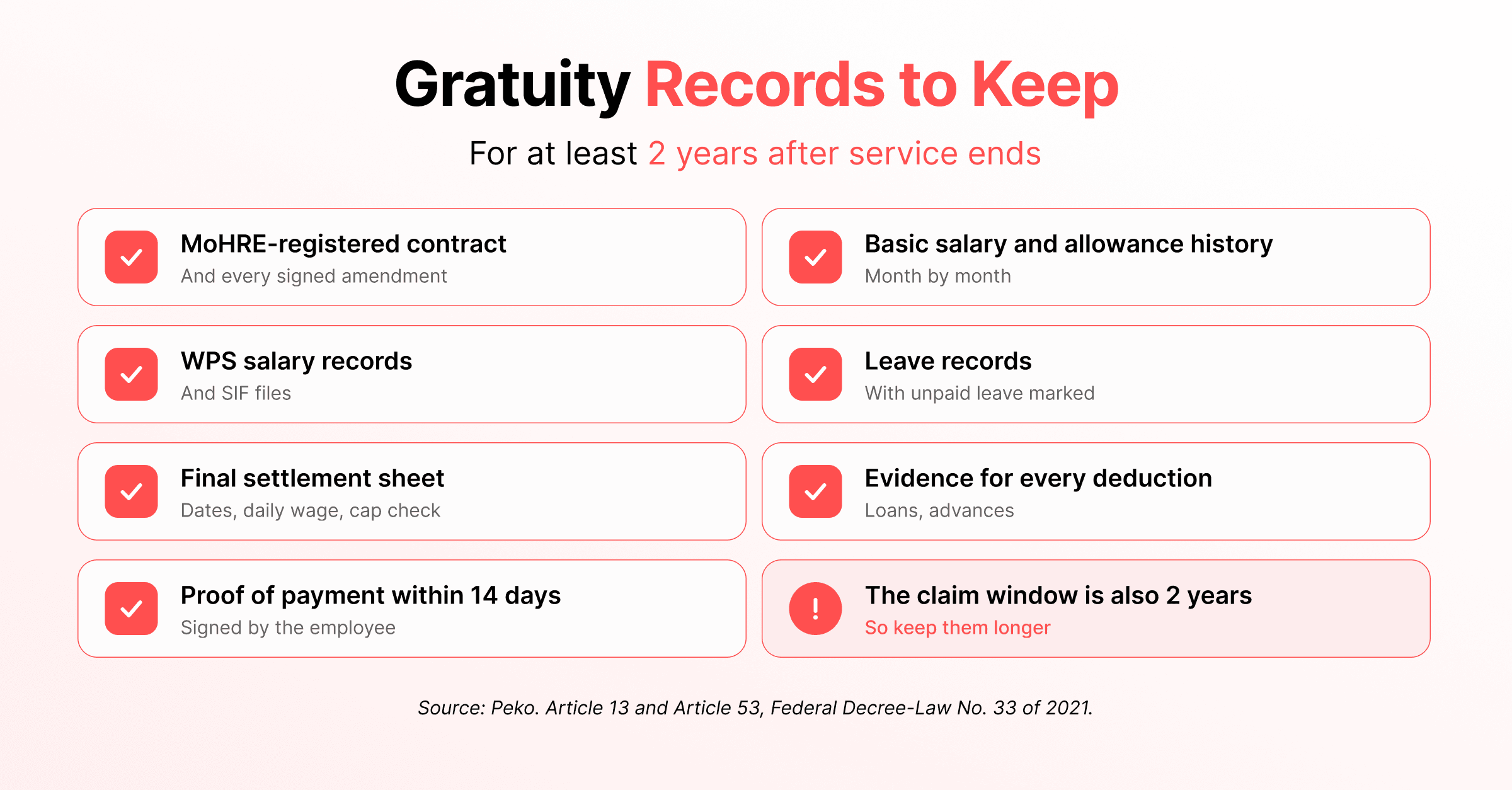
Checklist of the gratuity records a UAE employer should keep for at least two years after an employee leaves
The records I would keep for every leaver:
- The MoHRE-registered employment contract and every signed amendment, especially any change to basic salary.
- Salary history, showing basic salary and allowances separately, month by month.
- WPS salary records and SIF files, which show what was actually paid, when, and through which agent.
- Leave records, with unpaid leave clearly marked, since it reduces service length.
- The final settlement calculation, showing service dates, unpaid leave deducted, daily wage used, cap check and any deductions.
- Evidence for each deduction, such as a signed loan or advance agreement.
- Proof of payment within 14 days, plus the employee's signed acknowledgment of the settlement.
Two years is the legal floor, and it lines up exactly with the two-year claim window. That leaves no margin. Keeping the file for longer costs almost nothing and removes the risk of a claim arriving the week after the records were deleted.
Common Gratuity Calculation Mistakes SMEs Make
Most gratuity errors come from using the wrong input, not from misunderstanding the formula. These are the ones that show up most in disputes:
- Calculating on gross salary. This overpays by the whole allowance share, often doubling the figure.
- Applying the old resignation rules. Paying one-third or two-thirds (the old unlimited-contract cuts), or nothing (the old early-exit rule for limited contracts), to someone who resigned after 2 February 2022 underpays them, and the employee will win the claim.
- Ignoring unpaid leave. Paying for days that do not count inflates the settlement; guessing them without records invites a challenge.
- Using the wrong basic salary. The basic in force on the last day counts, but only if every change was properly documented.
- Forgetting the cap on long service. Rare, but expensive on all-inclusive packages.
- Paying late. Missing the 14-day deadline turns a routine settlement into a MoHRE complaint.
- Not accruing for it. A five-year employee on AED 20,000 basic carries a AED 70,000 liability. If nobody has been setting money aside, one resignation can wreck a month's cash flow.
Where Peko Fits in Your Gratuity Process
Peko is a business management platform for UAE businesses, combining payroll and HR technology with WPS-supporting salary workflows alongside invoicing, corporate cards and accounting. For gratuity, its job is to keep the inputs accurate: the joining date, the basic salary history, leave records and proof of every salary paid.
Every mistake in the list above traces back to a missing or inconsistent record. Peko's payroll and HR tools hold employee profiles and salary information in one place, track leave, generate payslips, process salaries through workflows that support WPS compliance, produce SIF files and give you payroll reports with historical data. When someone resigns, the numbers the gratuity formula needs are already there, in the same system that paid their salary every month.
To be precise about scope: Peko's payroll product does not currently list automated gratuity calculation among its features. Use the calculator on this page for the figure, and Peko for the records that make the figure defensible. If you are still sorting out the monthly side, our UAE WPS compliance guide covers the salary deadline rules that took effect on 1 June 2026, and the WPS salary transfer process guide walks through SIF files step by step.
Which Industries and Businesses This Applies To
Gratuity applies to every private-sector employer in the UAE with expatriate staff, but the exposure looks very different by sector. These are the businesses where getting it wrong costs the most:
- Construction and contracting firms with large site workforces and high turnover at project end, where dozens of settlements can land in the same fortnight.
- Hospitality, restaurants and cafes, where staff often have long service on modest basic salaries and patchy unpaid-leave records.
- Retail and e-commerce operators running mixed full-time and part-time teams, where the Article 30 pro-rating has to be applied correctly.
- Logistics, transport and delivery companies, where allowance-heavy pay packages make the basic versus gross distinction matter most.
- Manufacturing and industrial SMEs with long-tenure employees who cross the five-year line, where the accrual rate jumps from 21 to 30 days.
- Free zone startups and professional services firms in zones that apply the federal labour law, especially those offering all-inclusive packages that raise the gratuity base.
- Growing SMEs moving from spreadsheets to a payroll system, which is usually the moment old calculation errors surface.
If your company is in DIFC, remember DEWS replaced gratuity accrual from February 2020, and ADGM companies should check the ADGM Employment Regulations 2024 directly.
Frequently Asked Questions About Gratuity In The UAE
How is gratuity calculated in the UAE for 5 years of service?
For five years of service, UAE gratuity is 21 days of basic salary for each year: 105 days in total, or 3.5 months of basic pay. On an AED 10,000 basic salary that is AED 35,000. From the sixth year, each additional year earns 30 days of basic salary.
Does resignation reduce gratuity under the new UAE labour law?
No. Under Federal Decree-Law No. 33 of 2021, an employee who resigns after one year of service receives the full gratuity. The one-third and two-thirds cuts for resigning from an unlimited contract, and the zero payout for resigning early from a limited contract, belonged to the old 1980 law and only apply to employment that ended before 2 February 2022.
Is UAE gratuity calculated on basic salary or gross salary?
UAE gratuity is calculated on the last basic salary only, excluding housing, transport and other allowances. Total wage matters only for the legal cap, which limits gratuity to two years' wage. Calculating on gross salary is one of the most common and expensive employer mistakes.
Is an employee entitled to gratuity with less than one year of service in the UAE?
No. An employee needs at least one year of continuous service to qualify for end-of-service gratuity in the UAE. Once that year is completed, any additional part year is paid on a pro-rata basis.
What is the difference between limited and unlimited contract gratuity calculation in the UAE?
For employment ending after 2 February 2022 there is no difference. All private-sector contracts are now fixed-term, and gratuity uses one formula whatever the contract type or reason for leaving. Under the old law, resigning from an unlimited contract cut gratuity to one-third or two-thirds before five years, and resigning early from a limited contract with under five years' service paid nothing. Those rules only apply to employment that ended before 2 February 2022.
How long does a UAE employer have to pay gratuity?
A UAE employer must pay gratuity and all other end-of-service dues within 14 days of the contract ending, under Article 53 of Federal Decree-Law No. 33 of 2021. The employee then has two years from the end of employment to file a claim if payment is wrong or missing.
Final Thoughts
Gratuity is simple maths wrapped around messy records. The formula fits on a sticky note: 0.7 of a month's basic salary per year for five years, one month per year after that. Almost every dispute starts with an input nobody could prove: the basic salary after a pay cut that was never documented, unpaid leave nobody logged, or a resignation run through reduction tables that stopped applying in 2022.
So treat gratuity as a monthly liability, not an end-of-service surprise. Accrue 5.83% of basic salary every month, check each leaver against the calculator above, and keep the file for longer than the two-year minimum. If your salary records are spread across spreadsheets and bank portals, putting payroll into one system is the fix that makes every future settlement easier to defend. See how Peko's payroll and HR tools keep those records in one place, or read the payroll automation guide for UAE and India SMEs for the wider picture.
This article explains the federal rules as verified on 25 September 2026 and updated on 5 October 2026. It is general information, not legal advice. For a disputed or unusual case, check with MoHRE or a qualified UAE employment lawyer.