- Blogs
- WPS Payroll and HR
- WPS vs Non-WPS Salary UAE 2026: Which Is Legal? | Peko
Jul 07, 2026
WPS vs Non-WPS Salary UAE 2026: Which Is Legal? | Peko
Share this article
- WPS vs Non-WPS Salary in UAE (2026): Legal Differences, Penalties & Banking Impact
- What Is a WPS Salary in UAE?
- What Is a Non-WPS Salary?
- WPS vs Non-WPS Salary: Complete Comparison
- Who Is Legally Exempt from WPS in UAE?
- Which UAE Companies Are Exempt From WPS?
- Free Zones - When WPS Does and Doesn't Apply
- Is Cash Salary Illegal in the UAE?
- What Is the Penalty for a UAE Company Not Paying Through WPS?
- Non-WPS Salary and Banking: Credit Cards, Loans, Mortgages
- How to Check If Your Salary Is WPS-Compliant
- WPS 2.0: How December 2025 Changed Everything
- Should Employees Worry About a Non-WPS Salary?
- Should SME Owners Run WPS Even If Exempt?
- How Peko Helps UAE Businesses Run Compliant Payroll
- Frequently Asked Questions
- Conclusion
- About the Author
WPS vs Non-WPS Salary in UAE (2026): Legal Differences, Penalties & Banking Impact
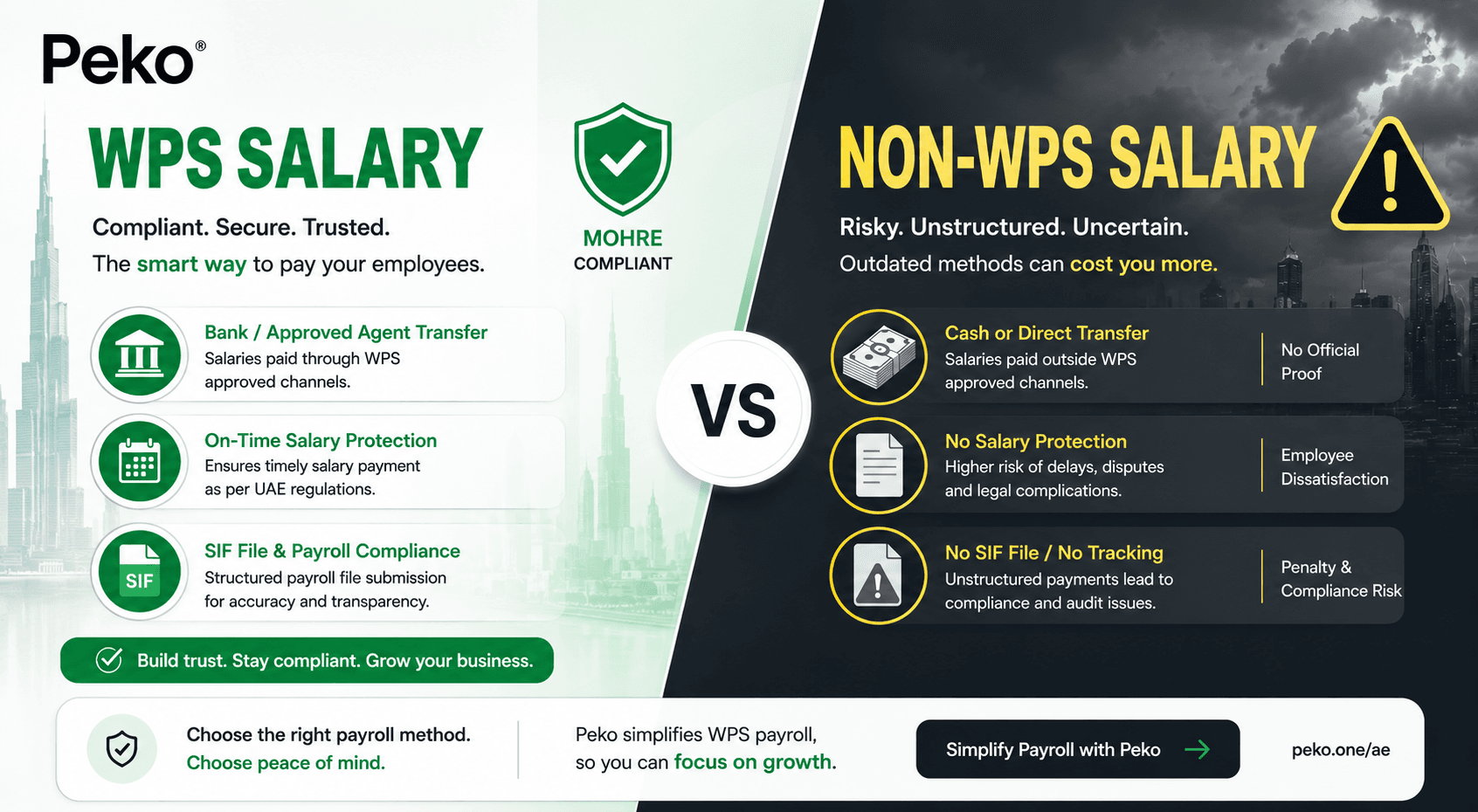
If you've been offered a job in the UAE that pays "non-WPS," or you run a business unsure whether the Wage Protection System applies to your free-zone setup, you're in the right place. This guide gives you the legal answer, the financial impact, and what changed under WPS 2.0 in December 2025.
Quick Answer: A WPS salary is paid through the UAE's mandatory Wage Protection System, an electronic, government-monitored channel. A non-WPS salary is paid outside this system, either legally (because the employer or employee is exempt) or illegally (when the employer is required to use WPS but isn't). For mainland UAE companies and most free zones, WPS is mandatory. Non-WPS payment for a non-exempt employer triggers fines of AED 1,000 per worker, work permit suspension within 17 days, and possible criminal referral by day 30. |
At a glance WPS vs Non-WPS:
What changed in 2025: MoHRE launched WPS 2.0 in December 2025, introducing real-time SIF validation and AI-assisted contract matching. The old grey zone where employers paid "part in WPS, part in cash" is now flagged within seconds.
Now let's break this down properly for employees evaluating job offers, for business owners deciding on payroll structure, and for anyone trying to understand the AED 50,000-question of compliance.
What Is a WPS Salary in UAE?
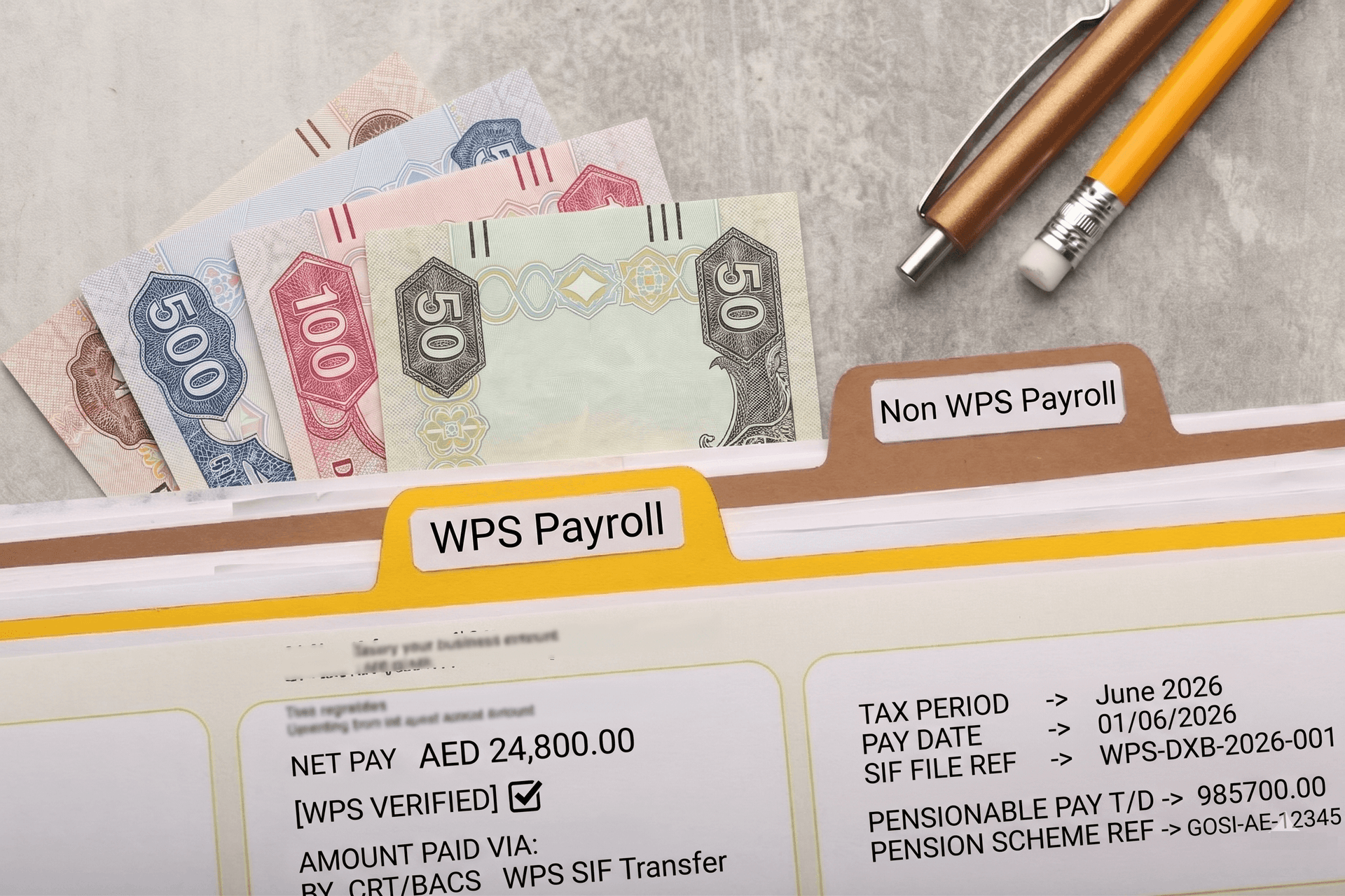
The Wage Protection System (WPS) is a UAE government-mandated electronic salary transfer framework. It was launched in 2009 by the Ministry of Human Resources and Emiratisation (MoHRE), the federal ministry responsible for private-sector labour relations in the UAE in partnership with the Central Bank of the UAE, which oversees the banking and exchange-house network that processes WPS transfers.
WPS requires private-sector employers to pay employee wages through approved banks, financial institutions, or licensed exchange houses rather than through cash, cheques, or unmonitored bank transfers.
<!-- DESIGN: process diagram showing employer → SIF file → WPS agent (bank/exchange) → employee account, with MoHRE monitoring layer above the entire flow -->
When a salary is paid through WPS, the employer prepares a Salary Information File (SIF) containing each employee's labour card number, bank or payroll-card details, salary amount, and pay period. The SIF is submitted to a WPS-approved agent, which transfers the funds and reports the transaction back to MoHRE. The ministry then matches the payment record against the registered employment contract.
The legal foundation rests on three core instruments:
- Federal Decree-Law No. 33 of 2021 the current UAE Labour Law, effective 2 February 2022
- Ministerial Resolution No. 598 of 2022 the WPS-specific regulations issued by MoHRE
- Cabinet Resolution No. 21 of 2020 employer classification and the penalty framework
According to the UAE Government portal, WPS today covers more than 99% of private-sector employees in the UAE, with monthly salary transfers exceeding AED 35 billion making it one of the largest payroll compliance systems in the MENA region.
| "99% of UAE private-sector employees covered by WPS" + "AED 35 billion monthly transfers" |
For the complete walk-through of how SIF generation and transfer works, see our WPS Salary Transfer Process UAE Complete Guide 2026.
What Is a Non-WPS Salary?
A non-WPS salary is any wage payment made outside the Wage Protection System through direct bank transfer, cash, cheque, or another channel not routed through a WPS-approved agent.
Critically, non-WPS payments split into two very different categories:
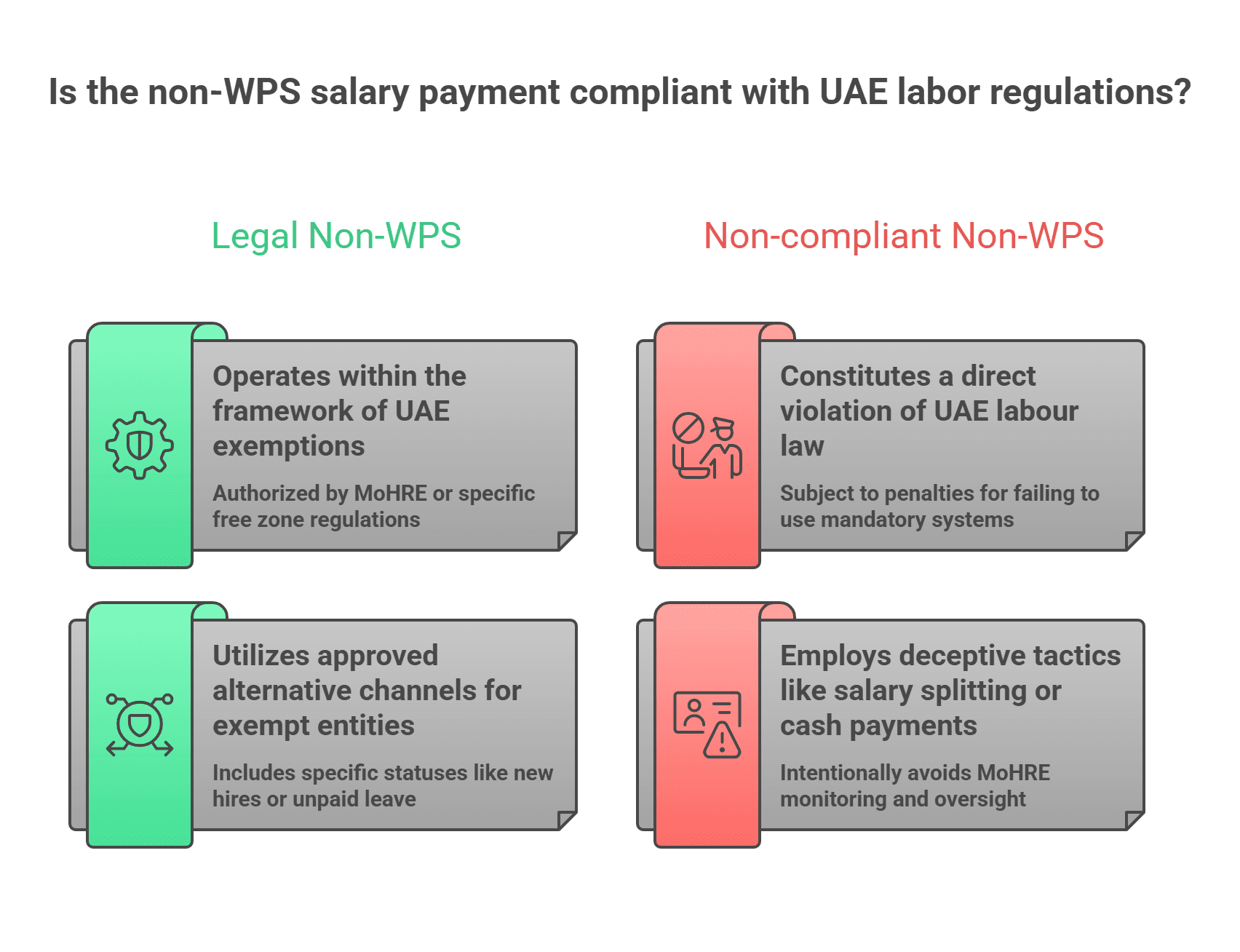
A real-world example to ground this:
Priya, a marketing manager at a Dubai Internet City (DIC) tech startup, receives her AED 18,000 salary as a direct bank transfer with no SIF involved. This is fully legal DIC operates under the Dubai Development Authority, which does not require WPS. Her compliance status is clean. |
In contrast: Ahmed, a sales executive at a mainland Dubai LLC, earns AED 8,000 AED 5,000 through WPS and AED 3,000 in cash. Before WPS 2.0, this practice often went unnoticed for months. Today, the system flags mismatches between the contract on file and the SIF amount within seconds. Ahmed's employer is now actively at risk. |
The distinction matters enormously. Same payment channel (direct bank transfer), wildly different legal outcomes driven entirely by the company's licensing jurisdiction.
WPS vs Non-WPS Salary: Complete Comparison
Ten dimensions employers and employees should evaluate before deciding (or accepting) which payment model applies:
This table is the heart of the WPS vs non-WPS decision.
Who Is Legally Exempt from WPS in UAE?
According to MoHRE, there are eight specific categories where WPS does not apply. Four are employee-status exemptions, and four are establishment-type exemptions.
Employee-status exemptions:
- Employees who have filed a wage-related labour complaint that has been referred to the judiciary
- Employees reported absent under a 'work abandonment' or absconding report
- New employees during their first 30 days from the wage due date
- Employees on documented unpaid leave (with supporting documents submitted to MoHRE)
Establishment-type exemptions:
- Fishing boats owned by UAE citizens
- Public taxis owned by UAE citizens
- Banks
- Places of worship
Which UAE Companies Are Exempt From WPS?
The following are outside the WPS scope:
- Government entities and public sector institutions
- Fishing boats owned by UAE citizens
- Public taxis owned by UAE citizens
- Banks and financial institutions
- Places of worship
- Companies licensed in DDA free zones (Dubai Internet City, Dubai Media City, Dubai Design District) and Meydan Free Zone
- Shareholders and partners who aren't on the employee payroll
This list isn't fixed forever - free zone coverage has been expanding. DMCC, for example, moved from exempt to fully WPS-covered in 2024, and JAFZA is now covered as well. If your business operates in a free zone, check its current status with the free zone authority rather than assuming last year's exemption still applies.
Outside these clearly defined categories, every mainland private-sector employer registered with MoHRE, regardless of size, from one employee to thousands, must pay through WPS.
Free Zones - When WPS Does and Doesn't Apply
This is where most UAE business owners get confused. The free zone vs mainland distinction is the single biggest driver of legitimate non-WPS payroll.
Mainland UAE (always mandatory): Every company licensed by the Department of Economic Development in any emirate and registered with MoHRE must process salaries through WPS. No exceptions for company size even a one-employee firm must comply.
Jebel Ali Free Zone (JAFZA): The UAE's flagship industrial free zone, home to over 8,000 companies. WPS is fully mandatory; JAFZA was the first free zone to fully adopt the system.
Dubai Multi Commodities Centre (DMCC): One of the UAE's largest free zones with over 25,000 member companies. WPS became mandatory for DMCC entities from January 2024 after a transition year. Non-compliance now triggers the same MoHRE-style penalties.
Dubai International Financial Centre (DIFC) and Abu Dhabi Global Market (ADGM): These two financial free zones operate under their own employment laws not the federal Labour Law and run WPS-equivalent salary protection systems. DIFC also has the DEWS (DIFC Employee Workplace Savings) scheme, which replaces end-of-service gratuity. The principle is the same: prove you paid your people on time through a tracked channel.
Dubai Development Authority (DDA) free zones, including Dubai Design District, Dubai Internet City, and Dubai Media City, where WPS does not apply. Employers can pay through direct bank transfer without the SIF and MoHRE monitoring layer.
Meydan Free Zone: Not integrated with MoHRE, so WPS is not automatically required. Employers can pay employees directly via bank transfer. Many founders opt into a WPS-style framework anyway when client contracts require it or expansion to the mainland is planned.
Other free zones (IFZA, SPC, RAKEZ, SHAMS, KIZAD): Vary by zone. The trend is that unmistakable free zones are increasingly aligning toward WPS or WPS-equivalent oversight.
For a complete look at how mainland and free-zone rules differ, see our Mainland vs Free Zone UAE guide.
Is Cash Salary Illegal in the UAE?
Cash salary is illegal only when your employer is required to pay through WPS. Mainland companies and major free zones like JAFZA and DMCC must pay through WPS; paying cash is a violation.
If your employer falls into one of the exemption categories above, the picture changes: companies in DDA free zones and Meydan can legally pay through direct bank transfer or another channel outside WPS. Even so, pure cash payments are rare even in exempt zones, mainly because banks and auditors expect a traceable payment trail for visa sponsorship, mortgage applications, and end-of-service calculations.
The practical test: if your company is mainland or in a WPS-covered free zone and your salary isn't showing up in your bank statement with a "WPS" label, that's not a grey area, it's a compliance issue you can report to MoHRE.
What Is the Penalty for a UAE Company Not Paying Through WPS?
If a company is required to use WPS and doesn't, the enforcement consequences escalate quickly. MoHRE's monitoring is now automated and progressive.
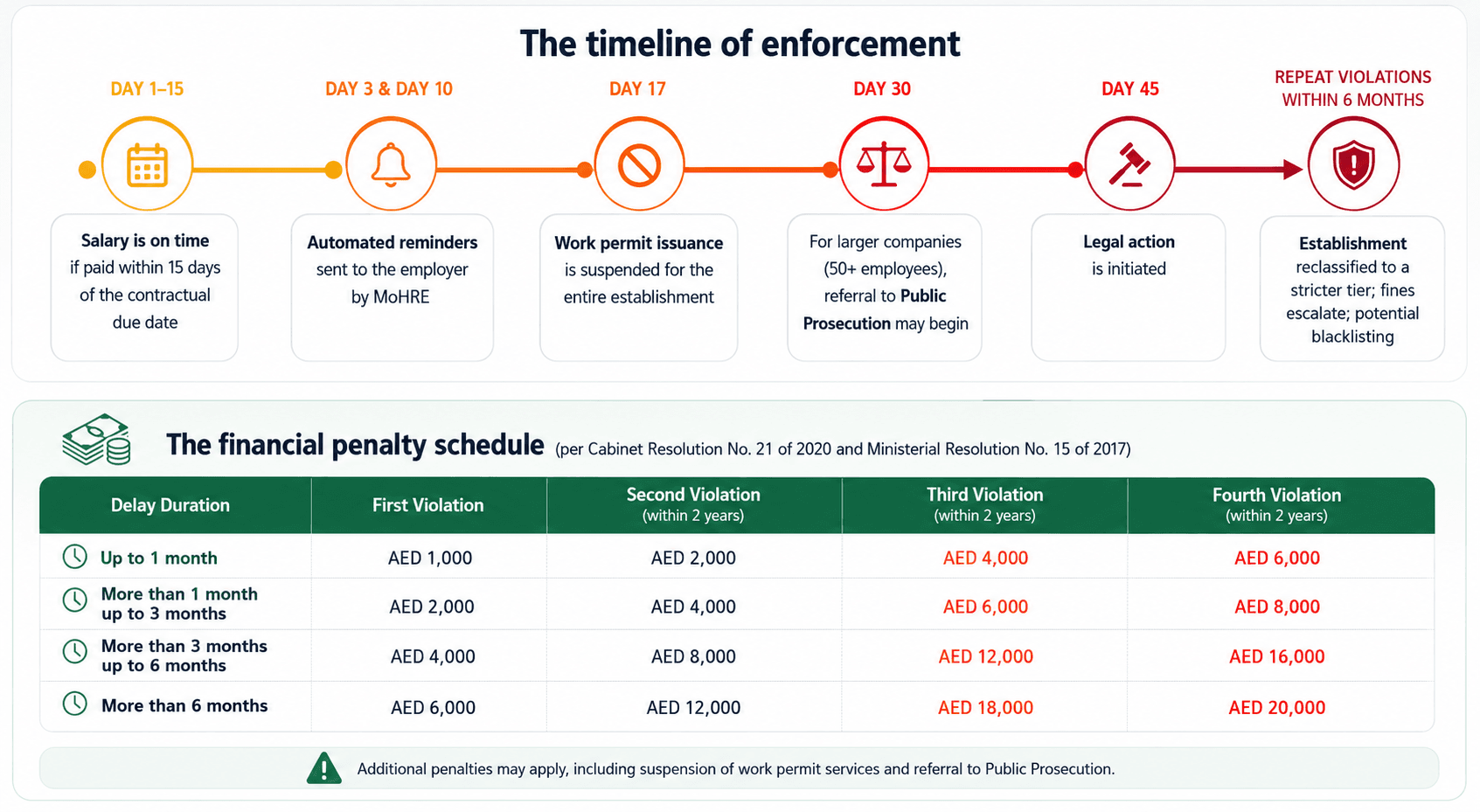
The financial penalty schedule (per Cabinet Resolution No. 21 of 2020 and Ministerial Resolution No. 15 of 2017):
| Delay beyond Day 30 (50+ employees) | Referral to public prosecution |
| Repeat violations | Establishment blacklisting |
The Day 17 and Day 30 triggers are the ones that catch employers off guard. A single late payroll run doesn't just cost the per-employee fine, it can freeze work-permit services for the entire company, not just the affected employees. That's usually the point where a genuinely unintentional delay turns into a hiring and retention problem.
AED 50,000 Maximum Penalty Per Case + Work Permit Ban
|
Beyond fines, the operational damage is severe. Work permit bans block new hiring, visa renewals, and employee transfers until WPS status is cleared. Repeated non-compliance can lead to license suspension.
This is why many UAE SMEs are moving from spreadsheet payroll to automated WPS payroll software. Manual payroll workflows especially under WPS 2.0's real-time validation are increasingly the source of avoidable penalties. Platforms like Peko's WPS Payroll & HR automate the SIF generation, salary calculation, and end-of-service tracking that used to require dedicated headcount.
For the complete enforcement framework and WPS 2.0 changes, see our UAE WPS Compliance Guide 2026.
Non-WPS Salary and Banking: Credit Cards, Loans, Mortgages
This is the most under-discussed dimension of the WPS vs non-WPS question, and for many employees, it's the most financially significant. UAE banks categorise customers heavily based on whether their salary is "WPS-transferred" or "non-WPS-transferred."
Credit cards
WPS-salary customers typically qualify for credit limits of 3x–5x their monthly salary. Non-WPS-salary customers face lower limits, fewer card product options, and at some banks, complete ineligibility for premium tiers.
Major UAE banks including Emirates NBD, First Abu Dhabi Bank (FAB), ADCB, Mashreq, and DIB explicitly require WPS transfer status during credit card application, often as a tickbox on the eligibility form.
Personal loans
Most UAE bank personal loans require WPS salary transfer as a baseline qualification. Non-WPS earners are often routed to specialist non-WPS loan products with:
- Higher interest rates (typically 2–4% above standard)
- Lower borrowing caps (often capped at 5x salary instead of 20x)
- More stringent documentation requirements (6–12 months of bank statements + salary certificates + sometimes guarantor)
Mortgages and home finance
For UAE expatriates seeking property finance, WPS salary history is a primary underwriting input. Non-WPS salary applicants typically face:
- Higher down payment requirements often 35–50% versus the standard 20–25%
- Lower loan-to-value ratios
- Tighter income verification
- Limited lender choice (some banks won't lend to non-WPS earners at all for mortgages)
The salary transfer letter workaround
Some non-WPS earners use employer-issued salary certificates and 6 months of bank statements showing consistent deposits to qualify for credit. This works for some products at some banks, but the friction is significantly higher. You'll typically need:
- A notarised salary certificate from your employer
- 6 months of bank statements with clearly labelled salary deposits
- Sometimes an attested employment contract
- Sometimes a guarantor with WPS salary
Banks more flexible with non-WPS salaries
A handful of UAE banks have non-WPS-friendly products targeting free-zone employees: ENBD-X (some products), Liv (the Emirates NBD digital bank), some Mashreq Neo products, and a few digital-only fintechs. Worth comparing if you're in a DDA free zone or Meydan.
Practical implication
If you're weighing a job offer that pays non-WPS, factor the banking impact into the total compensation comparison. A 10% higher non-WPS salary may not offset the credit and borrowing capacity you lose. For a marketing manager earning AED 18,000 non-WPS at DIC versus AED 17,000 WPS at a mainland company, the second offer may unlock AED 90,000 in credit card limit and access to a 25-year mortgage financial leverage the first job won't deliver.
How to Check If Your Salary Is WPS-Compliant
Three quick methods:
- Check your bank statement. WPS transfers are labelled with the prefix "WPS" or "Salary - WPS" depending on your bank. If your monthly deposit just says "Credit Transfer" or "Direct Transfer" without WPS labelling, you're not on WPS.
- MOHRE Smart App / MoHRE website. Log in with your labour card details to see your WPS payment status, including payment date, amount, and contract match status.
- Call MoHRE helpline 600 590 000 to request a "To Whom It May Concern" certificate confirming your salary payment status, or to raise a concern about delayed/non-WPS payments. Your identity is kept confidential.
If you discover your salary isn't on WPS and your employer is on the mainland or in JAFZA/DMCC, that's grounds for a formal complaint.
WPS 2.0: How December 2025 Changed Everything
In December 2025, MoHRE launched the most significant upgrade to the Wage Protection System since its introduction in 2009. Built in collaboration with the Central Bank of the UAE and Al Etihad Payments, WPS 2.0 fundamentally changes how compliance is monitored.
Real-time validation: Every SIF file is now validated instantly against the Unified Labour Contract held in MoHRE's records. Previously, mismatches surfaced only at periodic audits. Now, a wrong IBAN, a labour ID mismatch, or even a one-dirham discrepancy between the submitted SIF amount and the registered contract amount causes the file to be rejected before the bank processes it.
AI-assisted compliance scanning: WPS 2.0 includes AI validation that flags unpaid leave without correct deduction codes, outdated contract details, and basic-pay drift from MoHRE records.
Aani instant payments: The system now integrates with Aani, the UAE's instant payment platform. Salary transfers that previously took 1–3 banking days can now clear in seconds.
Why this matters for non-WPS payments: Before WPS 2.0, a common grey-zone practice was to split salary, pay the registered contract amount through WPS, and pay the rest in cash. Under WPS 2.0, this is now significantly riskier. The system flags the amount drift between contracts and SIFs immediately. MoHRE's enforcement view of "what you paid" vs "what's on the contract" is no longer delayed by months.
For business owners running legitimate non-WPS payroll, WPS 2.0 doesn't change the fundamentals, but the gap between the modernised WPS user experience and a manual non-WPS spreadsheet workflow has widened considerably.
Should Employees Worry About a Non-WPS Salary?
The answer depends entirely on whether your employer is legally exempt or non-compliantly avoiding WPS.
Three questions to ask your employer:
- Where is the company licensed? Mainland UAE? JAFZA? DMCC? DIFC? ADGM? A DDA free zone like Dubai Internet City? Meydan? The license location determines whether WPS is mandatory.
- What is your labour card/work permit status? If you hold a MoHRE-issued labour card and your employer isn't paying through WPS, ask why.
- Does your contract specify the payment channel? UAE Labour Law requires employers to pay the agreed salary on the agreed date through the agreed channel.
When to file a MoHRE complaint: If your employer is on the mainland (or in JAFZA/DMCC) and isn't paying through WPS, or if salary is delayed beyond 15 days without explanation, you have grounds to file a confidential labour complaint with MoHRE. The ministry uses WPS data automatically and can compel the employer to release shortfalls.
Practical action steps:
- Document everything: keep copies of your contract, offer letter, payment receipts, bank statements
- Verify your WPS status on the MoHRE website or Smart App
- Call MoHRE on 600 590 000 to raise a concern your identity is protected
- Submit a formal complaint through the MoHRE portal
Should SME Owners Run WPS Even If Exempt?
For business owners in DDA free zones, Meydan, or similar exempt jurisdictions, the question is whether to voluntarily use WPS or a WPS-style structured payroll.
The case for voluntary WPS-style payroll:
- Banking and credit: Employees gain full banking eligibility increasingly a hiring differentiator
- Audit trail: Structured electronic salary records protect the business in disputes, end-of-service settlements, and tax assessments
- Talent acquisition: Top candidates often prefer WPS-paid roles for protection and banking benefits
- Future-proofing: Free zone WPS coverage has expanded steadily DMCC in 2024, others likely to follow
- Corporate tax alignment: Since the UAE's 9% corporate tax took effect, clean payroll records directly support accurate financial reporting
The case against:
- Cash flow flexibility payments can align with revenue cycles
- Slightly lower direct cost (WPS per-employee fees)
- Less administrative overhead in very early stage
For most growing SMBs, the long-term operational and reputational benefits of structured WPS-compliant payroll outweigh the short-term flexibility of staying outside it. This is true even when WPS isn't legally required; many founders running DIC or Meydan entities now use WPS-compatible payroll platforms by choice rather than by mandate, because the audit trail and banking benefits accrue to their team.
How Peko Helps UAE Businesses Run Compliant Payroll
Managing payroll under WPS 2.0 with real-time validation, contract-matching, and the AED 50,000 penalty ceiling for errors has raised the stakes for manual workflows. For SMBs without dedicated payroll teams, the monthly cycle of compiling salary data, calculating overtime, formatting SIF files, and chasing agent deadlines is now a real compliance risk.
Peko's WPS Payroll & HR platform is built to help UAE businesses run compliant, automated payroll from a single dashboard:
- Automated salary calculations for basic salary, overtime, bonuses, increments, reimbursements, deductions, and end-of-service benefits
- WPS compliance support including SIF file maintenance, salary record tracking, and salary status visibility
- Centralised employee management profiles, salary information, leave tracking, document management, and asset allocation
- Time savings of 10+ hours monthly on payroll processing
- Integrated workflow with accounting and corporate tax records
For deeper context, see Best practices for WPS Payroll and employee management and Streamlining payroll and HR processes for SMEs.
Frequently Asked Questions
Can my employer pay me partly in cash and partly through WPS, is that legal?
If your employer is required to use WPS (mainland UAE, JAFZA, DMCC), then splitting your salary between WPS and cash is a violation. Under WPS 2.0's real-time validation, the system now flags any mismatch between your registered contract amount and the SIF amount within seconds. This was a common grey-zone practice before December 2025 it's now actively dangerous for the employer.
Will my UAE visa get affected if my salary isn't in WPS?
Indirectly, yes. If your employer is non-compliant with WPS, MoHRE can suspend their work permit services starting Day 17 of any late payment. This affects new visa issuance, renewals, and transfers across the entire company, not just yours. A clean WPS payment history on your employer's side supports smoother visa renewals.
Can I get a credit card or loan in the UAE without a WPS salary?
Yes, but with significant limitations. Most UAE banks require WPS as a baseline qualification for credit cards and personal loans. Non-WPS earners typically face lower limits, fewer product options, and higher interest rates. For mortgages, expect down payments of 35–50% instead of the standard 20–25%. A handful of digital banks (Liv, ENBD-X, Mashreq Neo) are more flexible with non-WPS customers.
Can I resign from my job if my employer isn't paying through WPS?
If your employer is required to use WPS and isn't, you may have grounds for constructive dismissal, meaning you can resign and still claim end-of-service gratuity. UAE Labour Law treats systematic non-payment or non-WPS payment as a contract breach. File a complaint with MoHRE first to document the situation, then consult a UAE labour lawyer before resigning to ensure you maximise your end-of-service entitlements.
Is cash salary illegal in UAE?
Cash salary is illegal only when WPS is mandatory for your employer. Mainland companies and major free zones (JAFZA, DMCC) must pay through WPS cash as a violation. Companies in DDA free zones (Dubai Internet City, Dubai Media City, Dubai Design District) and Meydan can legally pay through direct bank transfer or other channels, though pure cash payments are rare even there because of banking traceability needs.
What is the difference between WPS and non-WPS salary in UAE?
A WPS salary is paid through the Wage Protection System, an electronic, MoHRE-monitored channel using approved banks or exchange houses. A non-WPS salary is paid outside that system. WPS is mandatory for most mainland and major free zone employers; non-WPS is legal only where the employer or employee is exempt. The financial and compliance differences are substantial, especially for banking, credit eligibility, and dispute resolution.
Which UAE companies are exempt from WPS?
Government entities, public sector institutions, fishing boats owned by UAE citizens, public taxis owned by UAE citizens, banks, places of worship, and most companies licensed in DDA free zones (Dubai Internet City, Dubai Media City, Dubai Design District) and Meydan Free Zone. Shareholders and partners not on the employee payroll are also outside WPS scope.
How do I check if my company is paying me through WPS?
Three ways:
Check your bank statement; WPS transfers are labelled with the "WPS" prefix;
Log in to the MOHRE Smart App or mohre.gov.ae with your labour card details;
Call the MoHRE helpline on 600 590 000. If your monthly deposit isn't labelled WPS and your employer is mainland or in JAFZA/DMCC, that's a compliance issue.
What is the penalty for a UAE company not paying through WPS?
Failure to pay on due dates: AED 1,000 per employee. Entering incorrect data to evade WPS: AED 5,000 per worker, capped at AED 50,000 per case. Forcing employees to sign false payslips: AED 5,000 per employee. Plus work permit suspension within 17 days of any delay, public prosecution referral by day 30 for companies with 50+ employees, and potential establishment blacklisting for repeat violations.
What changed with WPS 2.0 in December 2025?
WPS 2.0 introduced real-time validation against MoHRE labour contracts, AI-assisted scanning for compliance issues, and integration with Aani instant payments. SIF files are now validated instantly when uploaded, so mismatches between the contract and submitted salary are caught immediately rather than at audit. Salary transfers now clear in seconds via Aani rather than 1–3 banking days. The split-salary grey zone has effectively closed.
Can a free-zone employee in Dubai Internet City get a mortgage?
Yes, but expect higher down payments (typically 35–50% instead of 20–25%) and a narrower lender pool. Some UAE banks won't lend at all to non-WPS earners for mortgages; others have specific non-WPS mortgage products. Bring 12 months of bank statements showing consistent salary deposits, an attested salary certificate, and ideally a guarantor with WPS salary. Working with a UAE mortgage broker rather than going direct to a bank often unlocks better options for non-WPS applicants.
Should my business voluntarily use WPS even though I'm in a DDA free zone?
It depends on your hiring plans and growth path. Voluntary WPS adoption helps your employees qualify for full banking products, creates an audit trail useful for end-of-service and tax compliance, and future-proofs you if WPS coverage expands to your free zone (as it did for DMCC in 2024). The cost is modest, typically AED 5–15 per employee per month in WPS agent fees. For most SMBs scaling past 5 employees, voluntary adoption pays back through reduced talent friction.
Conclusion
The WPS vs non-WPS question is no longer a grey-zone decision in 2026. With WPS 2.0's real-time validation, expanding free zone coverage, and increasingly automated MoHRE enforcement, the operational and legal cost of non-compliant non-WPS payment has risen sharply.
For employees: a non-WPS salary is fine if your employer is legitimately exempt and a red flag if they're not. The banking, credit, and dispute-resolution differences are real and material.
For business owners: if WPS is mandatory for your structure, compliance isn't optional; the AED 50,000 maximum penalty per case plus work permit bans make manual workflows a serious liability. If WPS isn't mandatory, voluntary adoption increasingly delivers more value than the cash-flow flexibility of staying outside it.
For UAE businesses, payroll mistakes are no longer minor admin issues; they now directly affect visas, banking relationships, hiring ability, and regulatory standing. As WPS enforcement becomes increasingly automated, structured payroll systems are quickly becoming a business necessity rather than a compliance checkbox.
Book a demo with Peko and see how the platform supports compliant, automated payroll and HR for UAE businesses from startups to scaling enterprises.
About the Author
Adil Rashid is an SEO & Content Lead at Peko with 10+ years of experience in UAE payroll, HR compliance, and B2B SaaS content. He has covered UAE labour law developments and WPS regulatory changes since 2017.
🔗 LinkedIn | Medium | Substack
Last reviewed: July 2026
Sources: UAE Government Portal (u.ae), MoHRE, Central Bank of UAE, Federal Decree-Law No. 33 of 2021, Ministerial Resolution No. 598 of 2022, Cabinet Resolution No. 21 of 2020, Al Etihad Payments.
This content is for informational purposes only and does not constitute legal or financial advice. Consult a qualified UAE labour lawyer or licensed financial advisor for personal situations.