


- Blogs
- Business Communication
- WhatsApp Business API UAE: Pricing, Features & Payments
Nov 04, 2026
WhatsApp Business API UAE: Pricing, Features & Payments
Share this article
- WhatsApp Business API in the UAE: Market, Convert and Collect Payments in One Chat
- What Is the WhatsApp Business API?
- Why UAE Businesses Are Moving Sales Into WhatsApp
- What Peko's WhatsApp Business Service Includes
- Market, Convert, Collect: How a Sale Runs Inside WhatsApp
- How Much Does the WhatsApp Business API Cost in the UAE?
- Official API vs Unofficial Bulk Tools: Compliance and Account Risk
- How to Get Started With WhatsApp Business API on Peko
- Which UAE Industries Benefit Most From the WhatsApp Business API
- FAQ About WhatsApp business API In UAE
- Final Thoughts
WhatsApp Business API in the UAE: Market, Convert and Collect Payments in One Chat
TL;DR:
- The WhatsApp Business API is Meta's official platform for businesses that need to message customers at scale, with approved templates, multiple agents and automation, which the free WhatsApp Business app cannot do.
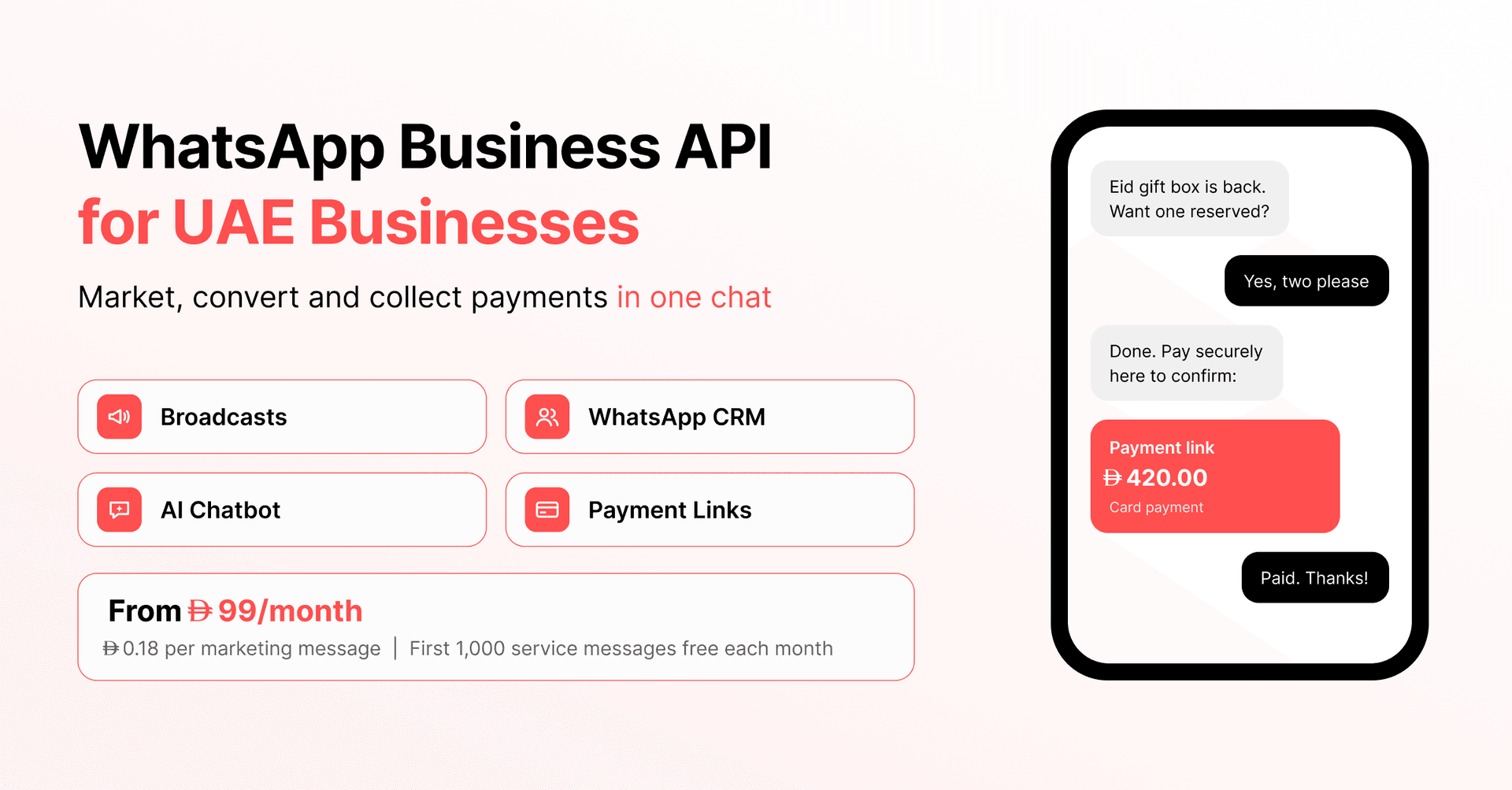
- Peko's WhatsApp Business service gives UAE businesses broadcast campaigns, a WhatsApp CRM and an optional AI chatbot, plus Peko payment links, so a customer can see an offer, ask questions and pay without leaving the chat.
- Pricing on Peko: AED 99/month for the basic plan, AED 250/month with the AI chatbot, a flat AED 0.18 per marketing message, and the first 1,000 service messages each month free.
- It runs on Meta's official WhatsApp Business Platform, which gives you a supported way to follow Meta's opt-in and template rules. Unofficial bulk-senders automate regular accounts against WhatsApp's Terms of Service, which allow WhatsApp to suspend or disable accounts.
Most UAE customers already talk to businesses on WhatsApp. They ask about stock, send a location pin, request a quote, then disappear when it is time to pay because payment means "I'll transfer it later." The WhatsApp Business API fixes the first half of that problem: it lets a business message thousands of opted-in customers, route chats to a team and automate replies. Pair it with payment links and you fix the second half too.
This guide explains what the API actually is, what it costs in the UAE after Meta's October 2026 pricing changes, why the official route matters, and how Peko puts marketing, conversations and collections in one place.
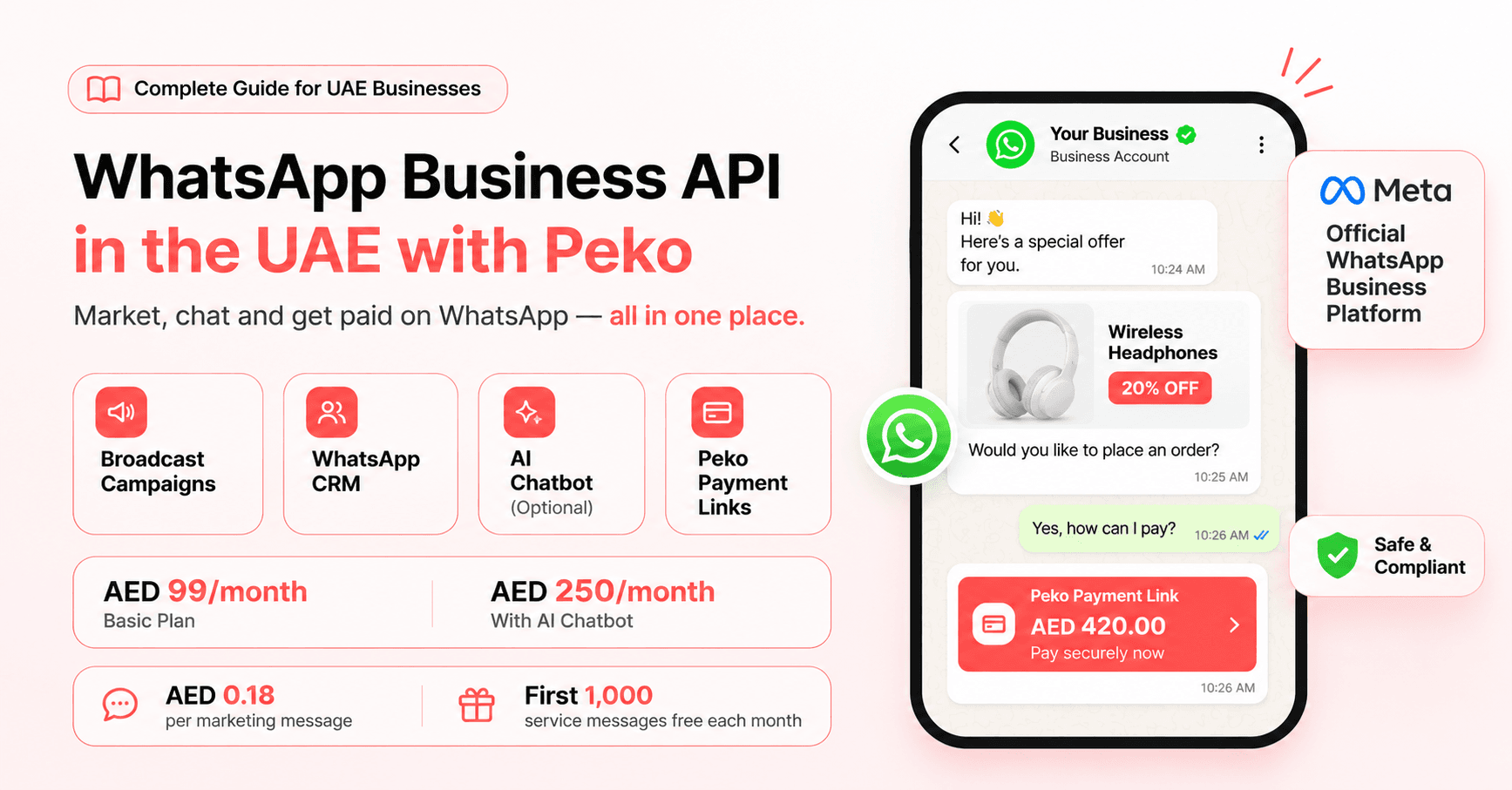
Peko WhatsApp Business API for UAE businesses: market, convert and collect payments in one chat
What Is the WhatsApp Business API?
The WhatsApp Business API, which Meta now calls the WhatsApp Business Platform, is the official way for a business to send and receive WhatsApp messages through software instead of a single phone. It supports approved message templates, broadcast campaigns to opted-in contacts, many agents on one number, chatbots and integrations, none of which the free WhatsApp Business app is built for.
The naming confuses people, so here is the short version. "WhatsApp Business app" is the free green-and-white app on a phone. "WhatsApp Business Platform" is Meta's umbrella name for the business messaging product. "Cloud API" is the Meta-hosted connection that software uses to plug into it. Older guides still call the whole thing the "WhatsApp Business API", and people still search for it that way, which is why this guide does too.
Meta's pricing documentation states the Platform covers pricing "across Cloud API and the Marketing Messages API" with four main message categories: marketing, utility, authentication and service. That category system is the backbone of how campaigns, replies and costs work, and it comes up again in the pricing section.
WhatsApp Business App vs WhatsApp Business API
The app is fine for a one-person shop answering a few dozen chats a day. Once you have a team, a contact list in the thousands, or a need to send order updates automatically, the app becomes the bottleneck.
If you recognise your business in the right-hand column, the API is the tool you are missing.
Why UAE Businesses Are Moving Sales Into WhatsApp
UAE businesses are moving sales into WhatsApp because their customers are permanently online and mobile, and chat is where buying questions already happen. Moving the offer, the conversation and the payment into that same thread removes the steps where customers usually drop off.
The connectivity numbers back this up. According to DataReportal's Digital 2026 report for the United Arab Emirates, 11.3 million people used the internet at the end of 2025, an online penetration of 99.0 percent, and the country had 23.0 million active cellular mobile connections, equal to 202 percent of the population. In a market where almost everyone is online and many people carry two phones, a chat app is not a channel you test. It is where the customer already is.
What changes with the API is control. A boutique in Dubai Mall, a clinic in Al Barsha or a B2B distributor in Sharjah can stop treating WhatsApp as a personal phone habit and start running it as a sales system: proper opt-in lists, campaigns that go out on schedule, a team inbox that does not live on the owner's handset, and a record of every customer conversation.
What Peko's WhatsApp Business Service Includes
Peko's WhatsApp Business service bundles four things UAE businesses usually buy separately: broadcast campaigns, a CRM for WhatsApp chats, an AI chatbot and payment links. Peko is a business management platform, so the WhatsApp tools sit next to the invoicing, payroll, corporate cards and accounting your business may already run on Peko.
You can activate it from the WhatsApp for Business option on Peko's Other Services page.
Broadcast Campaigns
Broadcast campaigns let you send an approved WhatsApp message template to a list of opted-in contacts in one go, instead of copying the same message into hundreds of chats. Think Ramadan offers, a new collection drop, a clinic's appointment slots for next week, or a restock alert for a product people asked about.
Each campaign uses a template that Meta reviews and categorises. That sounds like friction. In practice it is how the official API is designed to carry promotional messages at scale, whereas bulk messaging from a regular WhatsApp account goes against WhatsApp's Terms of Service.
CRM for WhatsApp Chats
A WhatsApp CRM gives your team one place to see and answer every customer conversation on your business number, with each chat attached to a contact record. No more "who replied to this customer?" and no more sales history stuck on one employee's phone when they go on leave.
For a team of three to thirty people, this is usually the feature that pays for the subscription. Leads stop slipping between shifts, and the next person picking up a chat can see what was promised.
AI Chatbot
Peko's AI chatbot, available on the AED 250/month plan, answers the routine questions that eat your team's day: opening hours, delivery areas, prices, order status, "do you have this in medium?" It keeps working after midnight, on Fridays and through the Eid weekend.
The honest test for a chatbot is not how clever it sounds. It is whether the questions it answers are the repetitive ones your staff dread, so humans can spend their time on the chats that actually close a sale.
Payment Links Inside the Chat
This is the part generic WhatsApp tools do not have. Peko already runs invoicing and payment links for UAE businesses, so you can send a secure payment link straight into the WhatsApp conversation. According to Peko's invoicing page, customers pay by debit or credit card from any device, and you are notified when payment completes. Payment processing fees for payment links are charged separately from the WhatsApp plan.
If you want the background on how payment links work alongside UAE invoicing rules, the UAE e-invoicing and payment links guide covers it in detail.
Market, Convert, Collect: How a Sale Runs Inside WhatsApp
On Peko, a WhatsApp sale runs in three stages in the same thread: a broadcast campaign markets the offer, the CRM and chatbot convert the reply into an order, and a payment link collects the money. The customer never switches to a website, an app or a bank transfer screen.
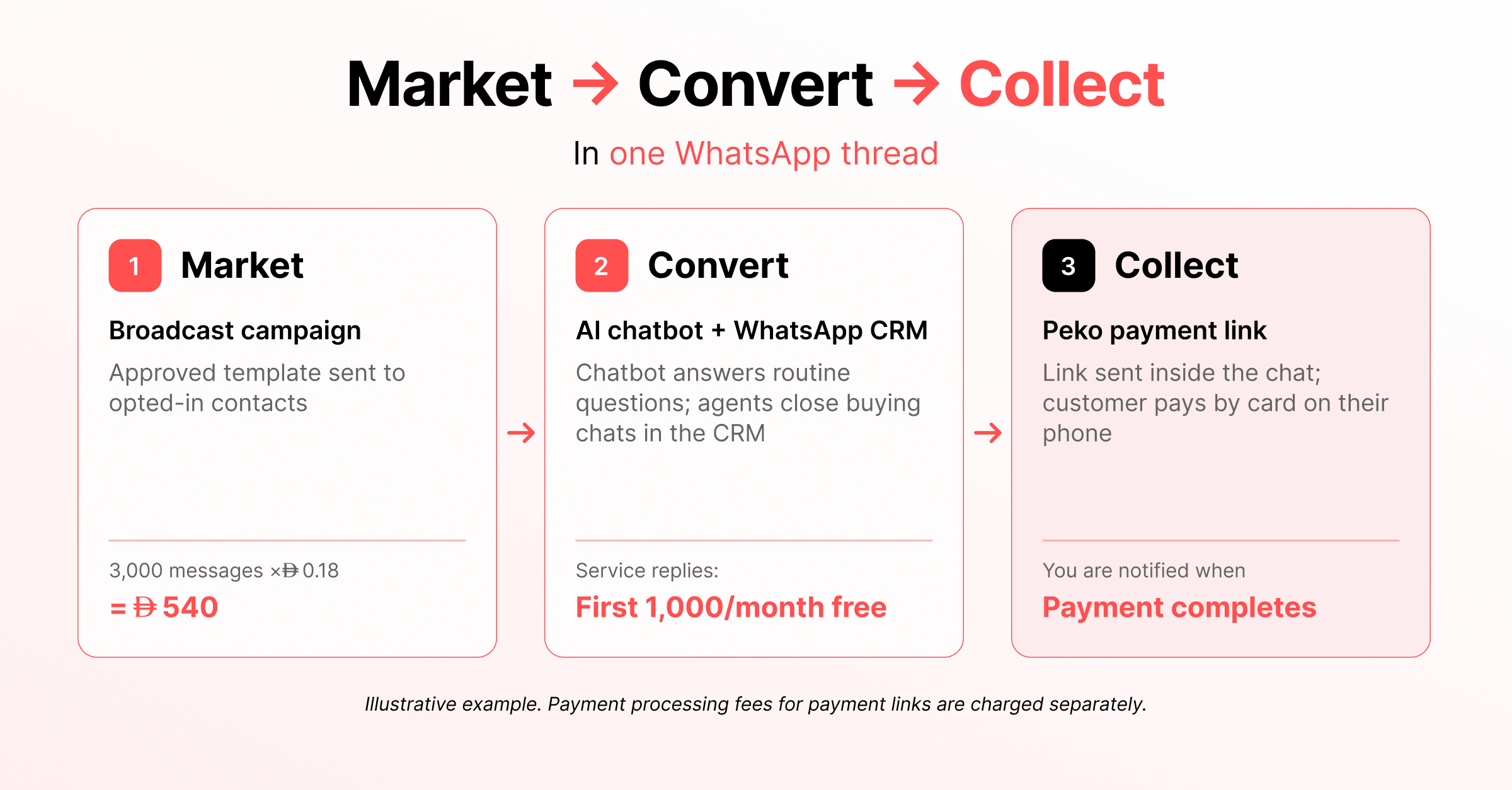
Market, convert, collect flow on Peko WhatsApp Business API: broadcast, chat and chatbot, payment link
Here is how that looks for a home-fragrance brand in Dubai selling a limited Eid gift box.
- Market. On Monday morning the brand sends a marketing template to 3,000 customers who opted in at checkout or in store. Cost on Peko: 3,000 × AED 0.18 = AED 540.
- Convert. Around 200 people reply. The AI chatbot answers "what's inside?" and "do you deliver to Abu Dhabi?" instantly, and hands buying-intent chats to a sales agent in the CRM.
- Collect. The agent confirms the order and drops a Peko payment link into the chat. The customer pays by card on their phone. The team sees the payment confirmation and arranges delivery.
Replies inside the conversation are service messages. On Peko the first 1,000 service messages each month are free, so a campaign like this often adds nothing beyond the marketing messages themselves.
Notice what is missing: no "please transfer to this IBAN and send a screenshot", no chasing on Thursday, no manual reconciliation of who paid. That gap between "yes, I'll take it" and money in the account is where WhatsApp sales usually leak.
How Much Does the WhatsApp Business API Cost in the UAE?
On Peko, the WhatsApp Business API costs AED 99 per month for the basic plan or AED 250 per month with the AI chatbot, plus a flat AED 0.18 per marketing message. The first 1,000 service messages each month are free, and inbound messages from customers cost nothing.
Peko WhatsApp Business Pricing
How Meta's Per-Message Pricing Works Behind the Scenes
Meta charges per delivered message, not per conversation. Meta's pricing documentation says that "effective July 1, 2025", it "charges on a per-message basis", by message category and by the customer's country. Messages from customers to a business are not charged, and Meta only charges for messages that are delivered.
Three October 2026 details matter for UAE budgets, all from Meta's pricing page (updated 30 September 2026):
- Service messages are no longer automatically free. Service messages had been free since 1 November 2024. From 1 October 2026 Meta charges for them again, but every business phone number gets a free tier of 1,000 service messages per month, with charges starting at the 1,001st. Unused messages do not roll over. Peko's 1,000 free service messages a month follow the same line.
- UAE marketing rates went up. Meta lists the United Arab Emirates as a standalone market on its rate card, with marketing rate increases effective 1 October 2025 and again on 1 October 2026.
- Click-to-WhatsApp ads open a free window. When a customer messages you from a Click to WhatsApp ad, Meta opens a free entry point window that "may remain open for up to 7 days", during which marketing, utility, authentication and service messages are not charged.
Peko's flat AED 0.18 per marketing message is the practical answer to that moving target. Meta bills in its own rate-card currency and adjusts rates on a published calendar. A flat dirham price per message means a UAE business can budget a campaign on a napkin: messages × AED 0.18, plus the monthly plan.
Worked Monthly Cost Examples
These examples assume service replies stay within the first 1,000 free messages each month. A support-heavy business that answers thousands of chats a month should ask Peko for the current per-message service rate beyond the free tier before it plans its budget.
If you also sell to customers in India, the rates there are different again. Peko's guide to WhatsApp Business API pricing in India breaks down that market.
Official API vs Unofficial Bulk Tools: Compliance and Account Risk
The official WhatsApp Business API gives businesses a supported way to follow Meta's rules on opt-in, template review and quality ratings. It does not guarantee that a number will never be restricted. Unofficial bulk-sending tools that automate a regular WhatsApp account go against WhatsApp's Terms of Service, which allow WhatsApp to suspend or disable accounts.
WhatsApp's Terms of Service are blunt about it. They prohibit using the service in ways that "involve sending illegal or impermissible communications such as bulk messaging, auto-messaging, auto-dialing, and the like", and they say WhatsApp may take action "including disabling or suspending your account". For a business whose customer relationships live on one number, that is a risk worth taking seriously.
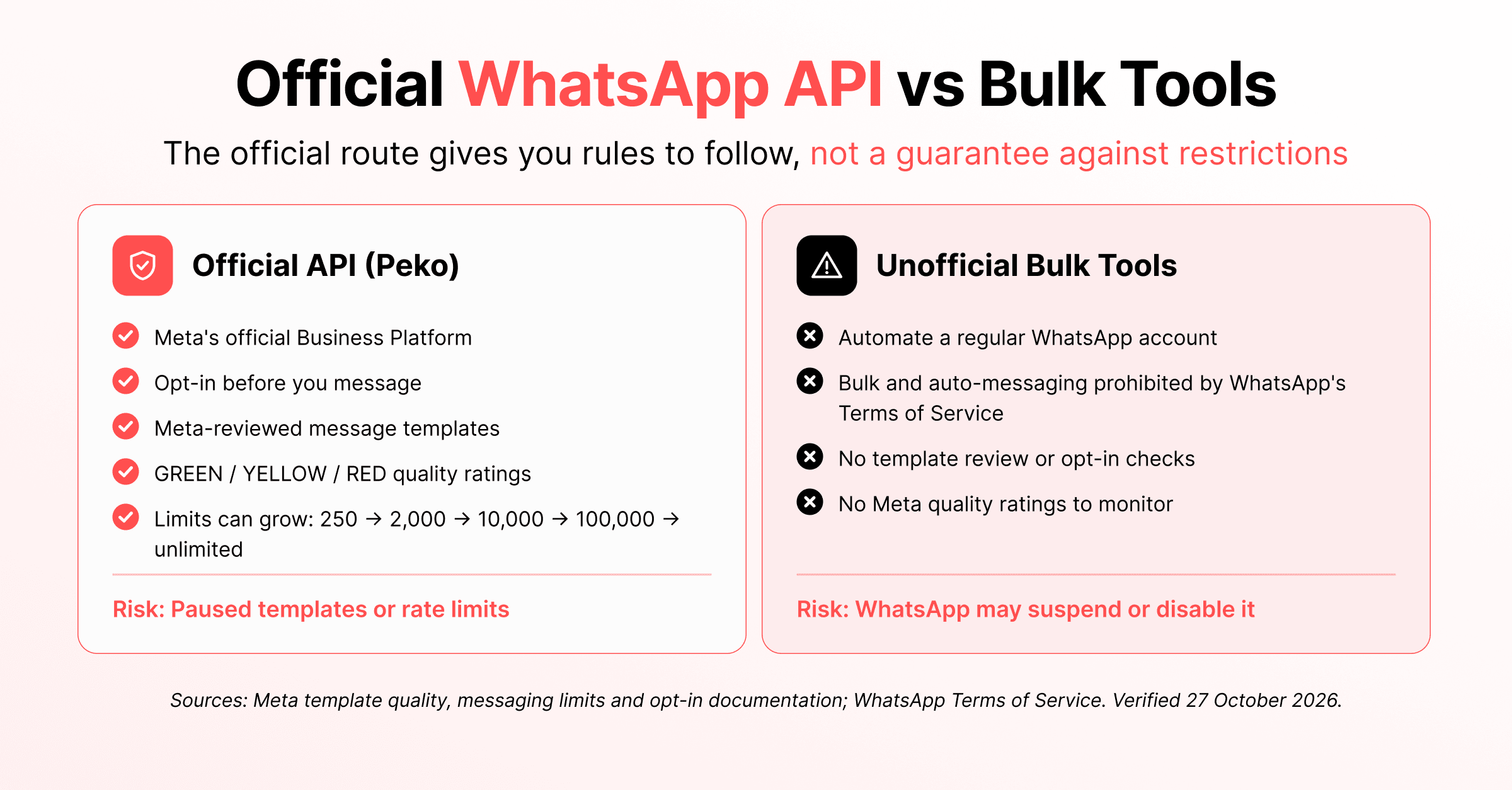
Official WhatsApp Business API vs unofficial bulk tools: opt-in, templates, quality ratings and account risk
What Meta Checks on the Official Platform
Meta polices the official platform through three mechanisms, and understanding them is most of what "compliance" means in practice.
Opt-in. Meta's opt-in documentation says businesses "are required to obtain opt-in permission" before messaging people, that the opt-in must clearly state the person is agreeing to hear from the business, must name the business, and must comply with applicable law. Opt-in can come from your website, in store on paper, by SMS or over the phone.
Template quality ratings. Every message template gets a quality rating from Meta. GREEN means little or no negative feedback. YELLOW means negative feedback from multiple users or low read rates. RED means the template "is in danger of being paused or disabled soon." This is the "rated red" problem marketers talk about: when people block or report your messages, templates can be paused.
Messaging limits. Meta caps how many unique customers you can message outside an open conversation in a moving 24-hour period. New business portfolios start at 250, can reach 2,000 by completing a scaling path such as business verification, then scale automatically to 10,000, 100,000 and unlimited when message quality stays high and the business uses at least half its current limit over 7 days.
Peko's WhatsApp Business service runs on Meta's official WhatsApp Business Platform and is onboarded through an official Meta Business Partner. That does not make every campaign safe: on the official API, unwanted messages can still lead to paused templates, and Meta's opt-in guidance says its systems "will rate limit businesses if the business's quality is low for a sustained period of time." What it gives you is a supported, rules-based way to message customers at scale, with quality signals you can act on.
How to Get Started With WhatsApp Business API on Peko
Getting started takes five steps: activate WhatsApp for Business on Peko, connect and verify your business number, set up opt-in, get your first templates approved, then launch a small campaign before scaling. Most of the effort is in the opt-in list and templates, not the technology.
- Activate the service. Choose the basic plan at AED 99/month, or the AED 250/month plan if you want the AI chatbot from day one.
- Connect a business number. Use a number you control long term, ideally a dedicated business line. Meta requires display name information when you register a business phone number, so have your trading name ready.
- Build a clean opt-in list. Add a WhatsApp consent line to your checkout, booking form or in-store sign-up. Import only contacts who agreed to hear from you.
- Create your first templates. Start with one marketing template and one utility template, such as an order confirmation, and submit them for Meta's review.
- Start small, then scale. Send your first campaign to your warmest segment, watch template quality ratings, and let your messaging limit grow as quality holds. Business verification is one of the paths that lifts a new account from 250 to 2,000 contacts a day.
Then add the payment link to your sales replies, and the full market, convert, collect loop is live.
Which UAE Industries Benefit Most From the WhatsApp Business API
The WhatsApp Business API pays off fastest for UAE businesses that sell through conversation, take repeat orders, or chase payments: retail and e-commerce, food and beverage, salons and clinics, real estate, education and B2B trading. The common thread is customers who prefer to ask before they buy.
- Retail and e-commerce: restock alerts, abandoned-cart nudges, Ramadan and White Friday campaigns, and payment links for orders confirmed in chat.
- Restaurants, cloud kitchens and cafés: weekly menus to regulars, catering quotes for office events, and pay-before-dispatch links for direct orders.
- Salons, spas and aesthetic clinics: appointment slots, package offers, and deposits collected by payment link to cut no-shows.
- Real estate brokers and holiday-home operators: new listings to buyers who opted in, viewing coordination in the CRM, and booking deposits.
- Training centres and tutors: course launches, batch reminders and fee collection by link.
- B2B distributors and trading companies: quotes, delivery updates and invoice payment links for trade customers who already live on WhatsApp.
- Freelancers and service SMEs: a professional business number and paid-on-the-spot invoices without a full e-commerce site.
FAQ About WhatsApp business API In UAE
How much does the WhatsApp Business API cost in the UAE?
On Peko, AED 99 per month for the basic plan or AED 250 per month with the AI chatbot, plus a flat AED 0.18 per marketing message. The first 1,000 service messages each month are free.
What is the difference between the WhatsApp Business app and the WhatsApp Business API?
The app is a free phone app for one person answering chats by hand. The API is Meta's business platform for teams, broadcast campaigns, chatbots and integrations such as payment links.
Can my UAE business number be restricted for WhatsApp marketing?
It can. WhatsApp's Terms of Service prohibit bulk and auto-messaging from regular accounts and allow WhatsApp to suspend or disable accounts. The official API lets you follow Meta's opt-in and template rules, but low-quality messaging can still lead to paused templates or rate limits.
Are WhatsApp service messages free in the UAE after October 2026?
Not all of them. Since 1 October 2026, Meta gives each business number 1,000 free service messages a month and charges from the 1,001st. On Peko, the first 1,000 service messages each month are free.
Can I collect payments on WhatsApp in the UAE?
Yes. Peko lets you send a payment link inside the chat, and the customer pays by debit or credit card. Payment processing fees are charged separately.
Do I need customer opt-in to send WhatsApp broadcast messages in the UAE?
Yes. Meta requires opt-in before you message people, and the opt-in must name your business and comply with applicable law.
Final Thoughts
The WhatsApp Business API is not a new marketing channel for UAE businesses. It is the channel customers already chose, finally run properly: campaigns that reach people who asked to hear from you, a team inbox instead of one overloaded phone, and a payment link at the exact moment someone says yes.
My take: the payment piece is the one most businesses underrate. Plenty of tools can blast messages. Far fewer close the loop so that "I'll take two" turns into money in your account five minutes later, inside the same chat. That is where Peko's WhatsApp Business service earns its keep, alongside the invoicing and other tools Peko already runs for your business.
Start small. Pick your warmest customer segment, get one template approved, send a campaign of a few hundred messages, and watch what happens to your reply and payment rates. If it works at 500, it will work at 50,000.
Ready to market, convert and collect in one chat? Activate WhatsApp for Business on Peko.