- Blogs
- Business Communication
- WhatsApp Business API Pricing India 2026: Cost Per Message
Sep 09, 2026
WhatsApp Business API Pricing India 2026: Cost Per Message
Share this article
- WhatsApp Business API Pricing India: What You'll Actually Pay in 2026
- What WhatsApp Business API costs in India right now
- The model changed: per message, not per conversation
- What changes on 1 October 2026
- Is WhatsApp Business API free?
- What your BSP adds on top
- Is GST charged on WhatsApp Business API pricing in India?
- What 10,000 messages a month actually costs
- How to cut your WhatsApp bill before October
- WhatsApp Cloud API vs WhatsApp Business API: does pricing differ?
- Which industries and business types this applies to
- Frequently Asked Questions About WhatsApp Business API Cost
- Final Thoughts
WhatsApp Business API Pricing India: What You'll Actually Pay in 2026
TL;DR:
- WhatsApp Business API pricing in India is per message, not per conversation. Meta switched models on 1 July 2025, so any guide still counting 24-hour "conversations" is describing a system that no longer exists.
- Current India rates: ₹0.8631 per marketing message, and ₹0.115 per utility or authentication message. Marketing went up roughly 10% on 1 January 2026.
- On 1 October 2026, two things that are free today stop being free: your support replies inside the 24-hour service window, and utility templates sent inside that window. Meta confirmed this on 25 August 2026 and the rate points to ₹0.115 per message. Some providers also mention a 1,000-message monthly allowance; Meta's own documentation does not, so treat it as unconfirmed.
- Meta's rate is only part of the bill. Your BSP adds a markup of roughly ₹0.08 to ₹1.20 per message, or a platform fee of ₹999 to ₹9,999 a month.
- All of those are before 18% GST, which makes a ₹0.8631 marketing message about ₹1.02 before your provider adds anything.
Search WhatsApp Business API pricing India today and most results describe a billing model Meta retired in July 2025. Worse, nearly all of them describe two things as free that stop being free on 1 October 2026.
So the bill is about to go up for most businesses, and not because of the rate card. Here is what it actually looks like now, and what it looks like in three weeks.
*Last updated: 8 September 2026. Rates verified against Meta's published documentation and two independent provider rate cards on that date.*
One naming note before the numbers. WhatsApp Business Platform is Meta's umbrella name for the whole business messaging product. WhatsApp Cloud API is the Meta-hosted way of connecting to it, and is now how almost everyone connects. WhatsApp Business API is the older name for the product itself, and is still what most people search for, so it is the term used throughout. The three are not synonyms, but they share one rate card: whichever name your provider uses on its invoice, the per-message rates below are the ones Meta charges underneath.
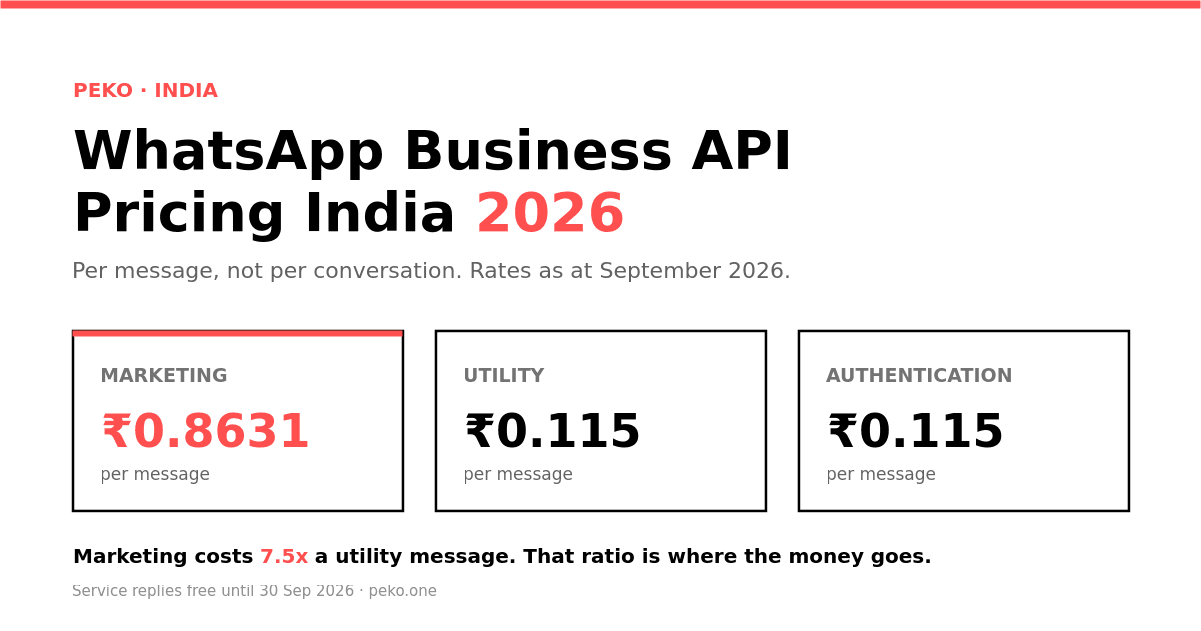
WhatsApp Business API pricing in India 2026 showing marketing, utility and authentication message rates
What WhatsApp Business API costs in India right now
A marketing message costs ₹0.8631 and a utility or authentication message costs ₹0.115. Service messages, meaning your replies to a customer inside the 24-hour window, are free until 30 September 2026. Inbound messages from customers are always free.
All rates are before GST. See the GST section below for what you actually pay.
Rates as reported by MyOperator (updated 31 August 2026) and Whautomate (verified against Meta's rate card, May 2026), which agree to four decimal places. Meta publishes its own INR rate card as a downloadable CSV and PDF on its pricing documentation, rather than as a public web table, so confirm your exact rate with your provider before you budget.
The gap between categories is the thing to notice. A marketing message costs about 7.5 times what a utility message costs. That ratio, not the absolute numbers, is where the money is won or lost.
Authentication-international messages
Meta charges a separate, higher rate for authentication messages that cross borders, and India is one of the markets affected. Meta's documentation lists a "higher authentication-international rate" for India effective 1 January 2026, and notes the number of markets carrying these rates roughly doubled on 1 October 2026.
This matters if your WhatsApp Business Account routes OTP traffic internationally, which is common when the platform sending your OTPs is hosted outside India. The domestic authentication rate does not apply to that traffic. Ask your provider which rate your OTPs are actually billed at, because the difference is not small and it will not be obvious on an invoice.
The model changed: per message, not per conversation
Meta bills per message delivered, and has done since 1 July 2025. Before that date it billed per 24-hour conversation, so one conversation could carry several messages for a single charge.
Meta's own documentation states plainly that "effective July 1, 2025, Meta now charges on a per-message basis."
This matters more than it sounds. Under the old model, a chatty support thread cost the same as a single message. Under the current model, every template message you send is its own line item. Undelivered messages are not charged, which is a small mercy.
A lot of the WhatsApp pricing content ranking in India today still explains conversation-based billing. If a page talks about "conversation categories" and 24-hour billing windows as the current system, it is more than a year out of date.
What changes on 1 October 2026
Two free things become chargeable. From 1 October 2026, Meta charges per message for non-template service replies sent inside the 24-hour customer service window, and for utility templates sent inside that same window. Both are free today.
Meta's non-template message pricing page, last updated 25 August 2026, states: "Effective October 1, 2026 - Meta will charge on a per-message basis for all service messages, consistent with how Meta charges for template messages."
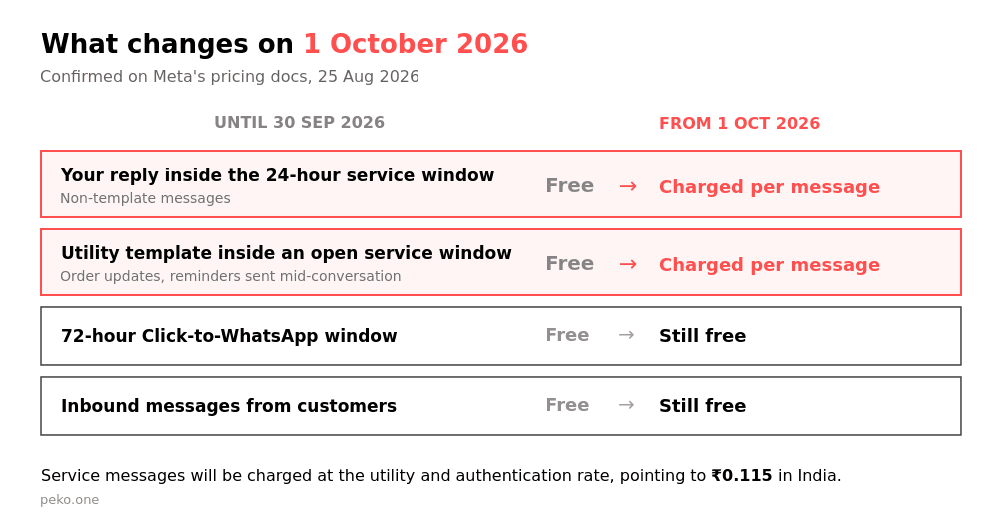
WhatsApp Business API pricing changes from October 1 2026 showing service and utility message charges
Service messages will be charged at the same rate Meta already charges for utility and authentication messages in that market, which points to ₹0.115 in India. Meta published the confirmed October rates on 1 September 2026 through the same CSV and PDF downloads, so ask your BSP for the figure in writing rather than assuming.
Is there a free monthly allowance? The answer is genuinely unclear
Some providers are telling customers that each business phone number gets 1,000 free service messages a month, with billing starting at the 1,001st. Others say there is no allowance at all.
Meta's own documentation does not mention one. The wording is that Meta "will charge on a per-message basis for all service messages", and the page contains no reference to an allowance, a quota or a free tier. At least one provider asserting the 1,000-message figure cites that same Meta page as its source, and the figure is not on it.
So treat the allowance as unconfirmed. Budget as though every service message is billable, and ask your provider in writing whether an allowance applies to your account. If one does, you have a pleasant surprise. If you budget assuming one and it does not exist, you have a problem.
What this costs a support-heavy business
Any business running high-touch support over WhatsApp feels this most. If your agents send 20 replies to resolve a query and you handle 2,000 queries a month, that is 40,000 messages that cost nothing today.
- No allowance: 40,000 × ₹0.115 = ₹4,600 a month
- If a 1,000-message allowance applies: 39,000 × ₹0.115 = ₹4,485 a month
Both figures are before BSP charges and before GST. The allowance, if it exists, changes the number by about 2.5%, which is why the more important planning question is the ₹4,600, not the ₹115.
The 72-hour free window from Click-to-WhatsApp ads survives untouched. That is not free traffic, because you are still paying Meta for the ad click. What it means is that the conversation following that click carries no messaging cost for three days, at the same moment that the conversations around it start carrying one.
Is WhatsApp Business API free?
No. Meta charges no licence fee for access to the API, and that is the technicality every "get WhatsApp Business API FREE" landing page is built on. Your BSP may still charge you to connect, and the messages are what you pay for either way.
What genuinely costs nothing: inbound messages from customers, all messages in the 72-hour window after someone clicks a Click-to-WhatsApp ad, and, until 30 September 2026, your replies inside the 24-hour service window. Meta also removed charges on service conversations entirely back on 1 November 2024.
What you pay for: every marketing, utility and authentication template you send, plus whatever your BSP charges to sit in the middle.
So a business sending only support replies to inbound queries really could run at close to zero cost today. From 1 October 2026, that stops being true. If you are weighing up the free-tier route specifically, that is worth a longer look than this section gives it.
What your BSP adds on top
Meta's rate is the floor, not the price. You buy WhatsApp Business API through a Business Solution Provider, and every BSP adds its own charge in one of three shapes.
- Per-message markup. Roughly ₹0.08 to ₹1.20 added per message, depending on the provider, based on the provider comparison MyOperator published in August 2026. On marketing messages that can mean an effective cost near ₹0.95 rather than ₹0.8631.
- Flat platform fee. Typically ₹999 to ₹9,999 a month, with Meta's rate passed through at cost.
- Hybrid. A smaller monthly fee plus a smaller per-message markup.
Which model is cheaper depends entirely on volume. Working the published markups against the published platform fees, the crossover sits somewhere around 10,000 messages a month: below that a per-message markup usually wins, above it a flat fee usually does. That crossover is our own arithmetic on provider-published figures rather than a number Meta or any BSP publishes, so treat it as a rule of thumb and run your own volumes.
The providers quoting the lowest headline markup are often the ones with the highest platform fee, so compare the total, not the component you were shown.
Volume tiers exist on utility and authentication messages, so genuinely high senders get Meta's rate down. Ask where the tier thresholds sit before you sign anything.
Peko publishes its own WhatsApp Business API pricing on application rather than as a public rate card, so if you want a figure to hold against the three models above, ask us for one against your actual message mix.
Is GST charged on WhatsApp Business API pricing in India?
Yes. Every rate quoted above is before tax. 18% GST applies on top, on both Meta's messaging charges and your provider's platform fee, so the number on your rate card is not the number on your invoice.
That turns the headline rates into:
So a marketing message realistically costs about ₹1.02 before your BSP has added anything at all. Meta's charges to Indian businesses are generally handled as imported services, and your provider's invoice is where the GST usually appears.
If your business is GST-registered, that 18% may be recoverable as input tax credit, which changes the real cost materially. That depends on your registration and how the supply is treated, so check it with your accountant rather than assuming either way. This is not tax advice.
The three layers of what you actually pay
- Meta's messaging charge - ₹0.8631, ₹0.115, and so on.
- Your BSP's charge - a per-message markup, a monthly platform fee, or both.
- GST at 18% - applied on the two layers above.
Most pricing articles stop at layer one. Most invoices do not.
What 10,000 messages a month actually costs
Three businesses, same 10,000 messages, very different bills. The mix is what drives the number, not the volume.
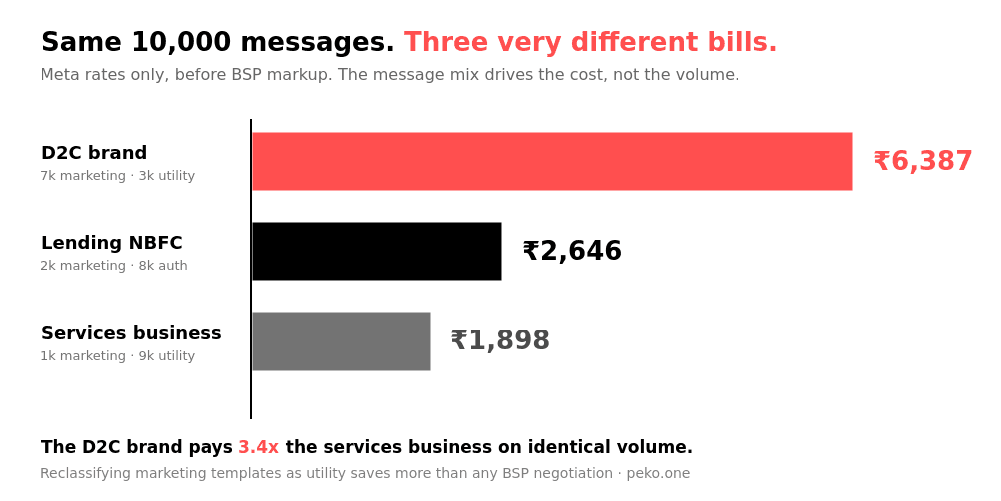
WhatsApp Business API cost comparison for 10,000 messages across D2C, lending and services businesses in India
The D2C brand pays more than three times what the services business pays, on identical volume, purely because its mix leans on the expensive category. Shifting even a fifth of those marketing messages into a genuine utility template would save more than any BSP negotiation will.
How to cut your WhatsApp bill before October
- Use the correct template category. An order update genuinely is a utility message, and if yours is currently going out as marketing you are paying 7.5 times more than you need to. This is the single largest lever available. To be clear about what it is not: do not relabel promotional content as utility to cut the bill. Meta's template category guidelines govern what belongs where, miscategorised templates get rejected or recategorised, and repeat offenders risk their quality rating. Fix genuine misclassification, do not invent it.
- Lean on Click-to-WhatsApp. The 72-hour free window stays free after October. Traffic arriving that way costs nothing to talk to for three days.
- Audit your support volume now. Count the replies your agents send inside the service window this month. That number becomes a bill on 1 October.
- Deflect with templates where it fits. A well-built utility template can answer what three agent replies currently answer, and after October the maths changes in the template's favour.
- Ask your BSP for the October rate in writing. They have had it since 1 September. If they cannot give you a number, that tells you something. Ours is available on request.
WhatsApp Cloud API vs WhatsApp Business API: does pricing differ?
No. The messaging rates are the same. People use the terms interchangeably, but they describe different things: WhatsApp Business API is the product, and WhatsApp Cloud API is Meta's own hosted version of it, which is now how almost everyone connects.
The older On-Premises API is being wound down, so in practice "WhatsApp Cloud API pricing India" and "WhatsApp Business API pricing India" are the same question with the same answer. Where cost does differ is the layer above: a provider running on Cloud API has no hosting to pass on, which is part of why platform fees vary so widely.
Which industries and business types this applies to
The category mix, not the sector, decides the bill, but some patterns hold.
D2C and e-commerce brands feel the marketing rate hardest, because cart recovery and re-engagement are marketing by definition. These are the businesses that should be looking hardest at their template categories and at e-commerce order operations where utility templates carry more of the load.
Lending, insurance and BFSI live in authentication and utility, so their per-message cost is low, but volume is enormous. Volume tiers matter more here than markup negotiation.
Clinics, salons and appointment-led services run on utility reminders and inbound support. This group has been effectively running WhatsApp at near-zero cost, and is the most exposed to the October change.
Logistics and delivery sit almost entirely in utility, and the October in-window change hits them because so many of their updates land while a customer thread is open.
Businesses collecting payments over WhatsApp should model the message cost against what they currently pay for online bill payment and BBPS collection, because a payment reminder that converts pays for a lot of utility messages.
Frequently Asked Questions About WhatsApp Business API Cost
How much does WhatsApp Business API cost in India per message?
A marketing message costs ₹0.8631 and a utility or authentication message costs ₹0.115, per Meta's India rate card as reported by MyOperator and Whautomate in 2026. Your BSP then adds either a per-message markup of roughly ₹0.08 to ₹1.20 or a monthly platform fee of ₹999 to ₹9,999. Service replies inside the 24-hour window are free until 30 September 2026.
How much does WhatsApp Business API cost for 10,000 messages in India?
The mix decides the bill, not the volume. On Meta's rates alone, 10,000 messages costs about ₹6,387 for a D2C brand sending 7,000 marketing and 3,000 utility messages, about ₹2,646 for a lender sending 2,000 marketing and 8,000 authentication messages, and about ₹1,898 for a services business sending 1,000 marketing and 9,000 utility messages. Add your BSP markup and 18% GST and the D2C figure lands near ₹8,614 a month, the services figure near ₹2,832.
Is WhatsApp Business API free in India?
Access to the API is free, but sending template messages is not. Inbound customer messages are free, and all messages in the 72-hour window after a Click-to-WhatsApp ad click are free. Until 30 September 2026 your replies inside the 24-hour service window are also free, which is why "free WhatsApp Business API" offers exist. After that date those replies are charged.
What is the WhatsApp Business API price change in October 2026?
From 1 October 2026, Meta charges per message for non-template service replies sent inside the 24-hour customer service window, and for utility templates sent inside an open service window. Both are free today. Meta stated the change on its non-template message pricing page on 25 August 2026, and service messages will be charged at the same rate as utility and authentication messages. Some providers report a 1,000-message monthly free allowance per business phone number, but Meta's documentation does not mention one, so confirm it with your provider before budgeting on it.
Why did WhatsApp marketing message cost increase in India?
Meta raised the India marketing rate by roughly 10% effective 1 January 2026, listed in its own documentation as a "higher marketing rate" for India. Utility and authentication rates were left unchanged. India was one of a small number of markets singled out for a marketing-specific increase that cycle.
Are WhatsApp Business API prices inclusive of GST in India?
No. Meta's published rates and your provider's platform fee are both before tax, and 18% GST applies on top. That makes a ₹0.8631 marketing message roughly ₹1.02 before your BSP has added anything. If your business is GST-registered the tax may be recoverable as input tax credit, which changes the real cost, so confirm the treatment with your accountant.
How do I reduce WhatsApp Business API costs in India?
Get your template categories right first, since a marketing message costs about 7.5 times a utility message. Then use the 72-hour Click-to-WhatsApp free window, which stays free after October 2026, and check whether your volume qualifies for Meta's utility and authentication volume tiers. Auditing your in-window support replies before 1 October is the most urgent item.
Final Thoughts
The interesting number in WhatsApp pricing is not ₹0.8631. It is 7.5, the multiple between a marketing message and a utility one. Most businesses overpaying for WhatsApp in India are not overpaying because they picked an expensive BSP. They are overpaying because half their templates are classified as marketing when they describe something the customer actually asked for.
The 1 October change makes that worse before it makes it better, and it lands on exactly the businesses that thought WhatsApp support was free. Three weeks is enough time to count your in-window replies and find out what your new baseline is. It is not enough time to rebuild your template library, so start with the counting.
Peko is a business management platform that combines WhatsApp Business API onboarding with the invoicing, payments and payroll systems the messages usually point back to. If you want the October number modelled against your actual message mix rather than a blog's worked example, talk to us about WhatsApp Business API setup and we will run it with you.
For the wider picture on templates, approval and compliance, start with the WhatsApp Business API India guide.