


- Blogs
- Peko Start
- Role of MSME in Indian Economy 2026: GDP, Jobs and Data
Oct 05, 2026
Role of MSME in Indian Economy 2026: GDP, Jobs and Data
Share this article
- Role of MSME in Indian Economy: Why Small Businesses Are India's Growth Engines
- What Is an MSME in India? The 2026 Classification
- Role of MSME in Indian Economy: The Six Jobs the Sector Does
- MSME Contribution to GDP: What the Latest Numbers Say
- Why MSMEs Are the Growth Engines of the Nation's Economy
- MSME Formalisation: From 6.5 Crore to 9.16 Crore Udyam Registrations
- MSMED (Amendment) Bill 2026: What Changes for Delayed Payments
- Government Platforms Every Indian MSME Should Know
- Challenges Facing the MSME Sector in India
- Benefits of Digitisation for Indian MSMEs
- MSME Digitisation Use Cases
- Which Industries and Audiences This Applies To
- Frequently Asked Questions About Role Of MSME In Indian Economy
- Key Takeaways
- Final Thoughts
- Related Reads
- How Peko Supports Indian MSMEs
- References
Role of MSME in Indian Economy: Why Small Businesses Are India's Growth Engines
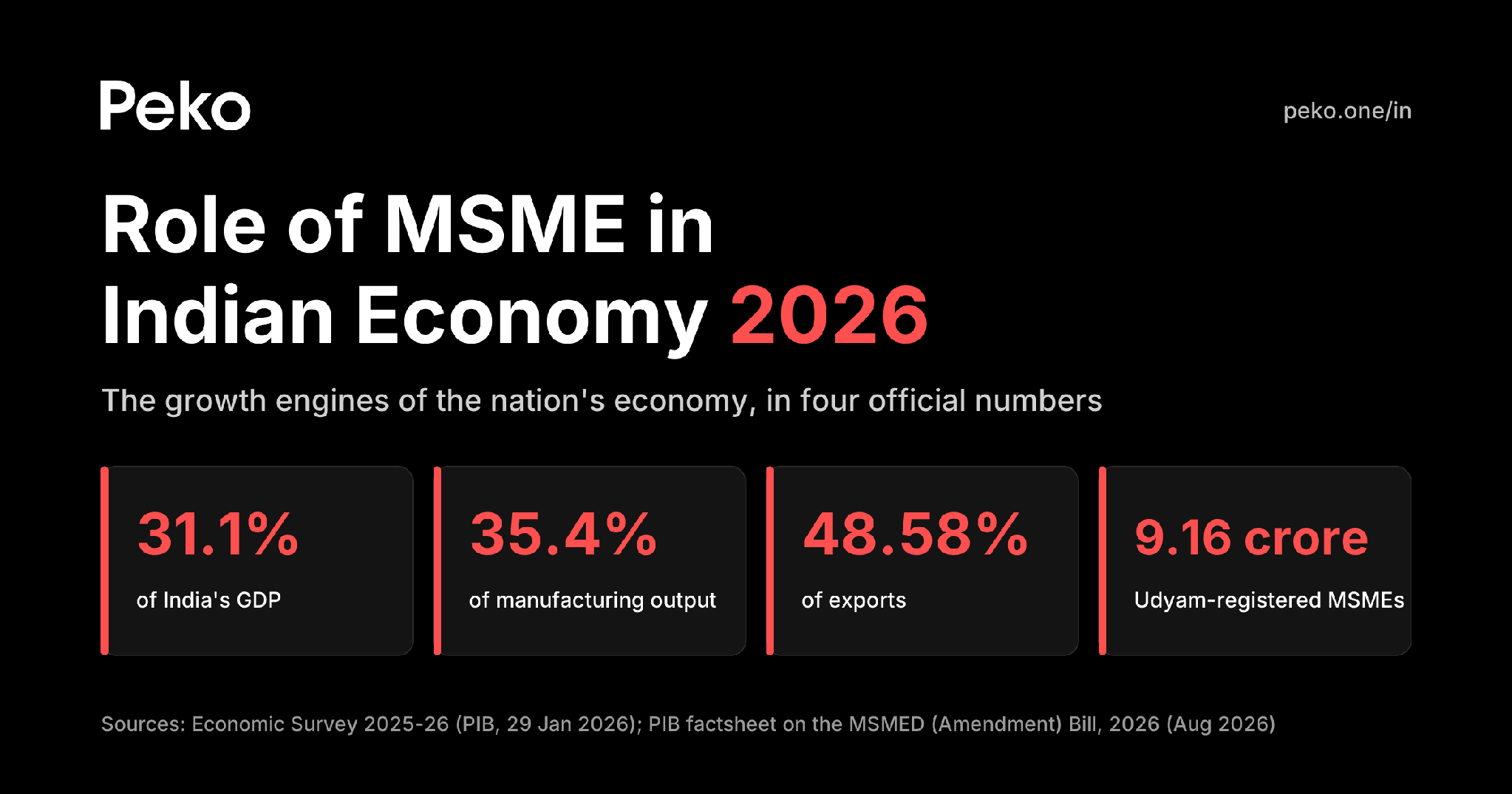
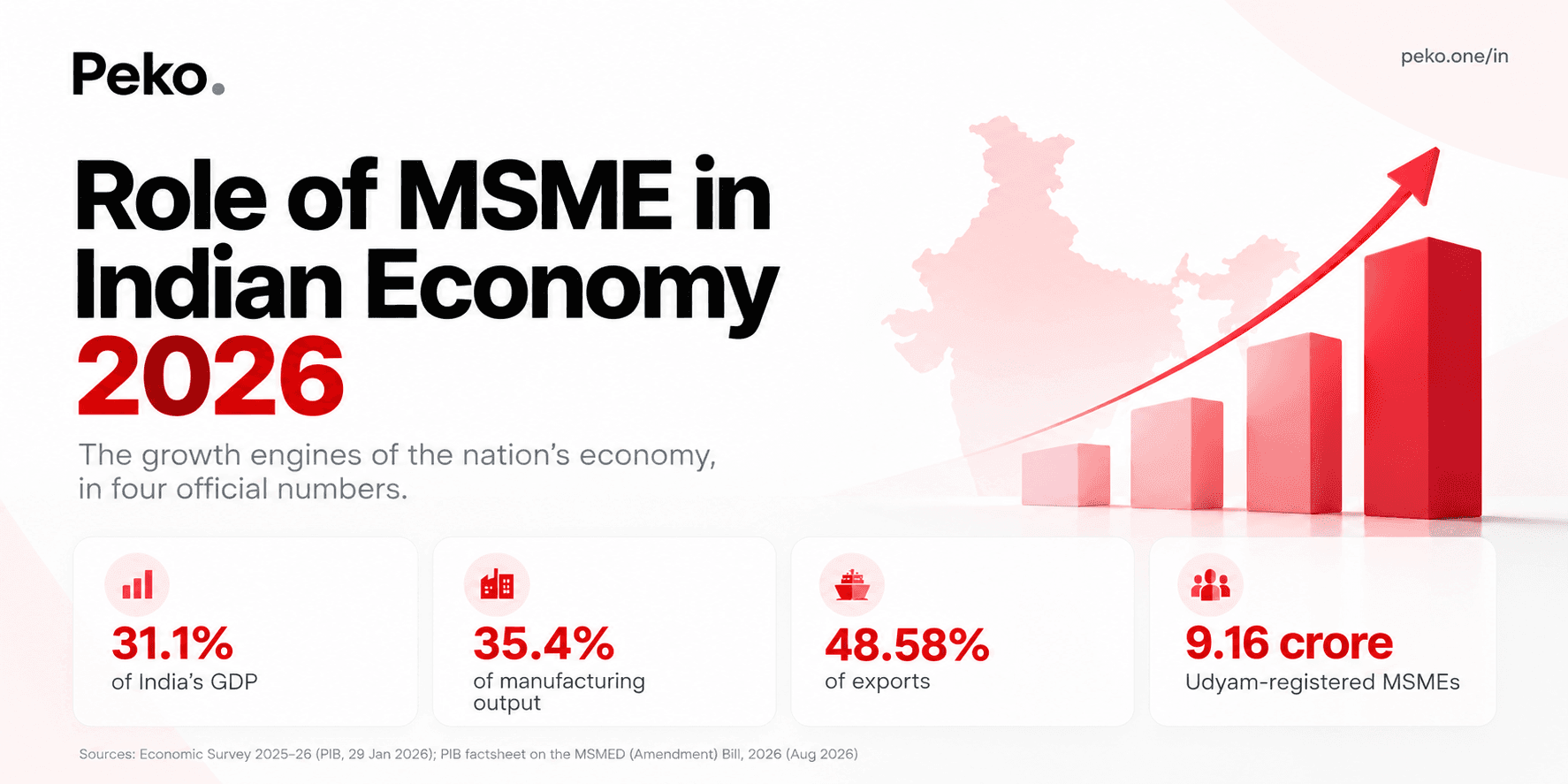
Alt text: Role of MSME in Indian economy 2026: 31.1% of GDP, 35.4% of manufacturing, 48.58% of exports, 9.16 crore Udyam MSMEs
TL;DR:
- India's MSMEs contribute 31.1% of GDP, 35.4% of manufacturing output and 48.58% of exports, according to the Economic Survey 2025-26.
- As of August 2026, 9.16 crore MSMEs are registered on the Udyam platform and they employ more than 40 crore people, per PIB's factsheet on the MSMED (Amendment) Bill, 2026.
- MSMEs are the second-largest employer in India after agriculture, and the main route by which first-generation, rural and women entrepreneurs enter the formal economy.
- The biggest brake on their growth is still cash flow: delayed payments, thin credit and compliance load. The August 2026 amendment to the MSMED Act targets exactly that.
The role of MSME in Indian economy is easiest to understand through one number: roughly one in every three rupees of India's GDP comes from a business small enough that its owner probably still signs the cheques. That is the real meaning behind the old line that SMBs are "the growth engines of the nation's economy", and in 2026 the data finally backs it up with fresh, official figures.
What Is an MSME in India? The 2026 Classification
What is an MSME? An MSME (micro, small or medium enterprise) in India is a business classified by two tests at once: investment in plant, machinery or equipment, and annual turnover. Since 1 April 2025, a micro enterprise can invest up to ₹2.5 crore with turnover up to ₹10 crore; a medium enterprise can go up to ₹125 crore and ₹500 crore.
The definition matters more than it looks. Every scheme, credit guarantee and payment protection in this guide hangs off it, so a business that does not know which bucket it sits in is usually leaving benefits unclaimed.
The Government revised the thresholds through a notification dated 24 March 2025, effective 1 April 2025, as reported by All India Radio's News on AIR. Investment limits rose roughly 2.5 times and turnover limits doubled, which PIB confirmed in its Budget 2025-26 release.
Source: News on AIR, "Govt notifies revised criteria for classifying MSMEs" (notification dated 24 March 2025); verified 5 October 2026.
Two practical points. First, the test is composite: PIB's August 2026 factsheet describes classification by investment in plant and machinery or equipment, together with turnover, so manufacturers and service businesses are measured on the same scale. Second, registration on the Udyam Registration Portal is free. The portal's own homepage states that no costs or fees are to be paid to anyone, so any agent charging you for "MSME registration" is selling a service you do not need.
If you are still choosing a legal structure before you register, our guide on how to register a company in India in 2026 walks through SPICe+ step by step.
Role of MSME in Indian Economy: The Six Jobs the Sector Does
What is the role of MSME in the Indian economy? MSMEs generate about a third of India's GDP, absorb the largest share of non-farm workers, produce over a third of manufacturing output and nearly half of exports. They also spread industry into rural and semi-urban India and serve as the supplier base for large companies.
Most articles list the role of MSMEs as a single block of praise. It is more useful to see it as six distinct jobs, because each one breaks in a different way when MSMEs struggle.
1. Employment at low capital cost
MSMEs are the second-largest employer in India after agriculture, a point made in both the Economic Survey 2025-26 and PIB's June 2026 backgrounder. PIB's Budget 2026-27 explainer credits the sector with generating large-scale employment at relatively low capital cost, which is why it absorbs workers that capital-heavy industry cannot.
2. Manufacturing depth
The Economic Survey 2025-26 credits MSMEs with about 35.4% of India's manufacturing output. Many of these are component makers, job-workers and ancillary units feeding larger brands, so when they slow, the big names slow too.
3. Exports
MSMEs account for around 48.58% of India's exports, per the Economic Survey 2025-26. That share rose from 45.73% cited by the Union MSME Minister in July 2025, a meaningful jump for a sector often described as domestic-focused.
4. Regional balance
MSMEs operate across rural, semi-urban and urban areas. PIB's backgrounder describes the sector as a gateway for first-generation, women-led and youth-led ventures, particularly in semi-urban and rural India. Industry that would never reach a district headquarters through a large plant reaches it through a hundred small ones.
5. Entrepreneurship and formalisation
Every Udyam registration is a business stepping into the formal economy, with access to priority-sector lending, credit guarantees and government procurement. Formalisation is the quiet engine here, and it is the section where the numbers have moved fastest (covered below).
6. The supply chain for everyone else
Large companies buy from MSMEs. CPSEs alone procured goods and services worth ₹31,443.32 crore in FY 2026-27 up to June 2026, with 54.51% of it sourced from micro and small enterprises, according to the MSME Sambandh data in PIB's backgrounder.
MSME Contribution to GDP: What the Latest Numbers Say
What is the MSME contribution to GDP in India? According to the Economic Survey 2025-26, tabled on 29 January 2026, MSMEs contribute 31.1% of India's GDP. The previous widely quoted figure was 30.1%, cited by the Union MSME Minister in July 2025.
The MSME contribution to GDP is the stat most people search for, and it is also the one most often quoted wrongly. Many ranking pages still use 30.1% or older figures. Here is the current, sourced picture.
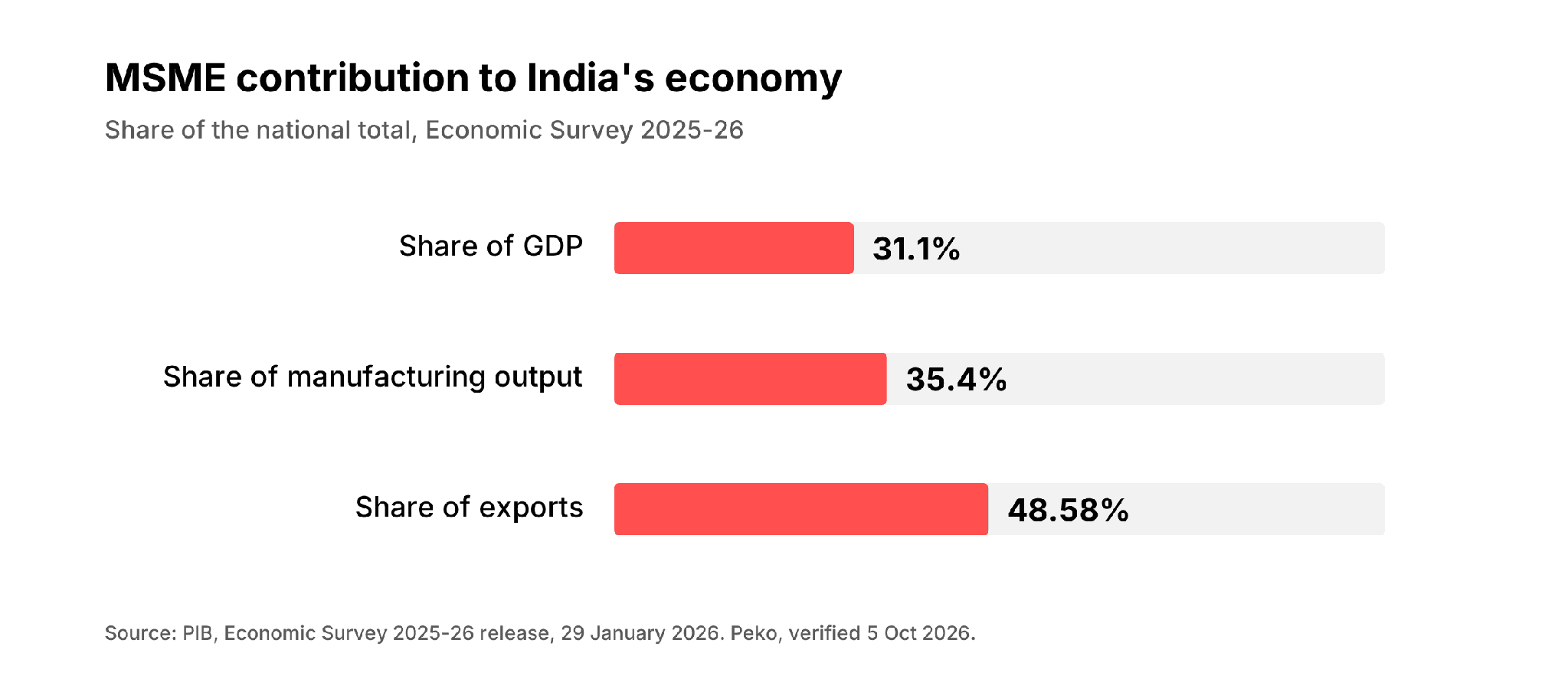
Alt text: Bar chart showing MSME contribution to GDP at 31.1%, manufacturing output at 35.4% and exports at 48.58% in India, Economic Survey 2025-26
A note on employment figures, because they confuse readers. The Economic Survey 2025-26 cited 7.47 crore enterprises employing over 32.82 crore persons. PIB's June 2026 backgrounder put employment above 38.9 crore, and the August 2026 factsheet says more than 40 crore. These are not contradictions. Each figure is a snapshot of Udyam data at a different date, and the base keeps growing as more enterprises register. When you quote one, quote its date.
Globally, the Economic Survey notes, MSMEs make up about 90% of businesses and over 50% of total employment. India's numbers sit in that range, which tells you the sector is not unusually large. What is unusual is how much of it was informal until very recently.
Why MSMEs Are the Growth Engines of the Nation's Economy
Why are MSMEs called the growth engines of the economy? MSMEs are called growth engines because they create jobs faster per rupee invested than large industry, push manufacturing and exports into new regions, and multiply demand through local supply chains. In India, they also carry the bulk of formalisation, which widens the tax and credit base.
Here is the honest version of the "growth engine" argument, including the part brochures skip.
The case for it is strong. A sector producing a third of GDP, a third of manufacturing and half of exports, while employing tens of crores of people, is clearly load-bearing. Credit data supports the momentum too: the Economic Survey 2025-26 says MSME credit was the primary driver of industrial credit growth in the first half of FY26, outpacing large-industry credit year on year.
The part that gets skipped: the GDP share has moved only one percentage point between the two official figures, from 30.1% to 31.1%. Registrations have exploded; share of output has crept. That gap is the productivity problem. Millions of new formal enterprises are micro units with one or two workers, and adding more of them grows employment faster than it grows output.
So the growth-engine claim holds, with a condition. MSMEs drive growth when they scale from micro to small and from small to medium. Policy now reflects that. The Union Budget 2026-27 announced a dedicated ₹10,000 crore SME Growth Fund and an additional ₹2,000 crore for the Self-Reliant India Fund, both aimed at helping enterprises graduate rather than simply exist.
That is also why operational tooling matters more than it used to. A two-person unit can run on a notebook and a phone. A forty-person unit cannot run payroll, statutory deductions, vendor payments and customer communication that way without leaking time and money.
MSME Formalisation: From 6.5 Crore to 9.16 Crore Udyam Registrations
How many MSMEs are registered in India? As of August 2026, 9.16 crore MSMEs are registered on the Udyam platform (the Udyam Registration Portal plus the Udyam Assist Platform), according to PIB. That is up from 6.5 crore in July 2025.
Formalisation is the fastest-moving number in the whole MSME story. Read the official milestones in sequence and the curve is steep.
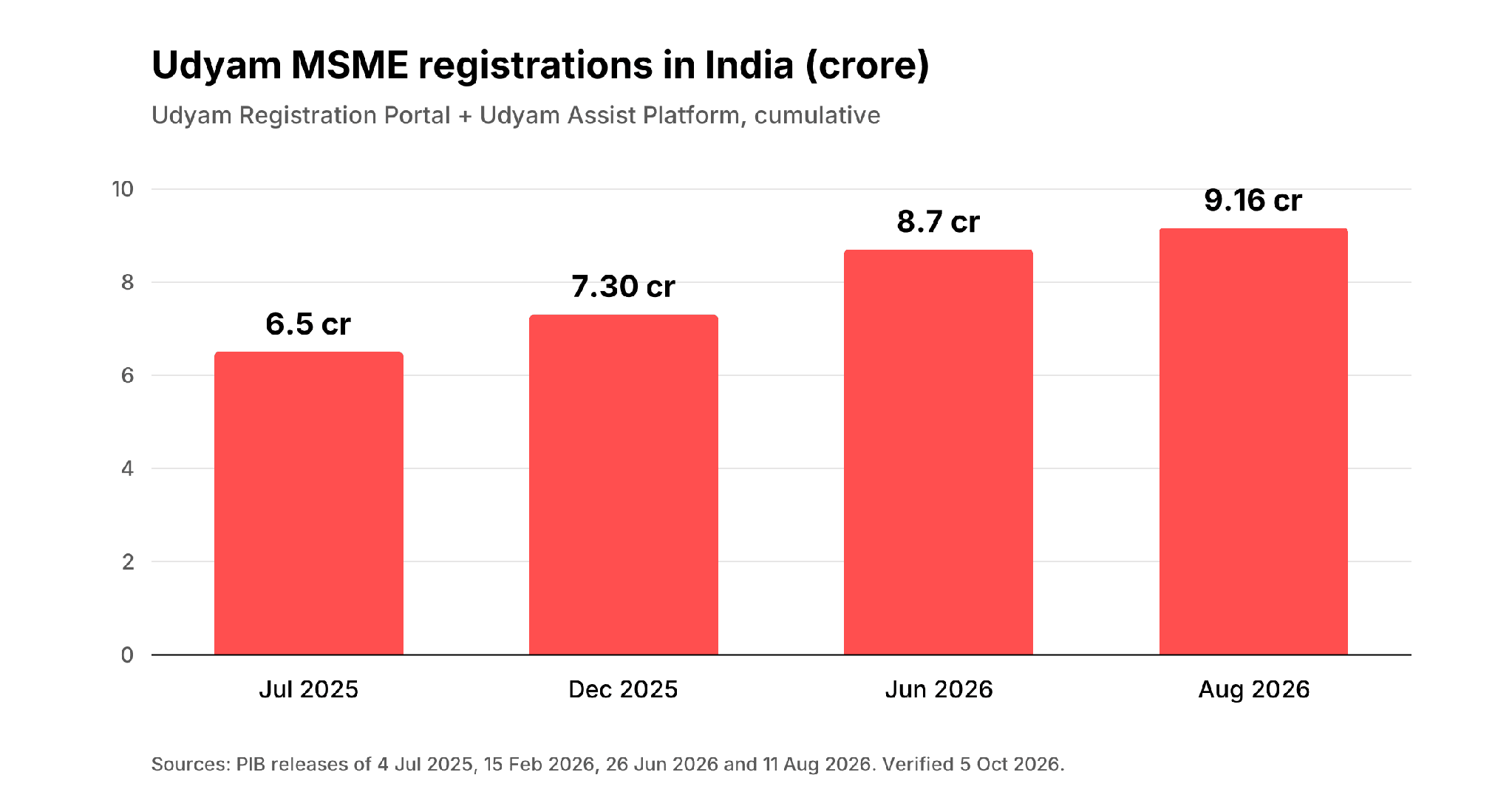
Alt text: Bar chart of Udyam MSME registrations in India rising from 6.5 crore in July 2025 to 9.16 crore in August 2026
Two platforms do the work. The Udyam Registration Portal, launched on 1 July 2020, offers free, paperless, self-declared registration. The Udyam Assist Platform, launched on 11 January 2023, brings informal micro enterprises that have no GST registration or income-tax coverage into the formal fold, so they can access priority-sector lending.
What formalisation buys a business is concrete: eligibility for collateral-free credit under CGTMSE, protection under the MSMED Act's delayed-payment rules, preference in public procurement and access to schemes like PMEGP. What it costs is visibility. A formal business has to keep its compliance calendar, from GST returns to PF and ESI deposits, in order. Our Indian SME compliance calendar for 2026 maps those deadlines month by month.
MSMED (Amendment) Bill 2026: What Changes for Delayed Payments
What is the MSMED (Amendment) Bill, 2026? It is a law updating the Micro, Small and Medium Enterprises Development Act, 2006 to tackle delayed payments. It requires CPSEs to settle MSME invoices through TReDS, sets 90-day timelines for mediation and arbitration, allows dues to be recovered as arrears of land revenue, and decriminalises minor offences.
Late payment is the single most persistent complaint from Indian small businesses, and the numbers show why. As on June 2026, the MSME Samadhaan Portal had received 2,56,892 applications involving claims worth ₹55,244.29 crore, according to PIB's backgrounder. That is working capital locked in other people's ledgers.
Under the MSMED Act, 2006, buyers must pay micro and small suppliers within 45 days of acceptance (or deemed acceptance) of goods or services. Companies that cross that line must report the overdue amounts and reasons in half-yearly returns to the Ministry of Corporate Affairs, as PIB has documented since 2018.
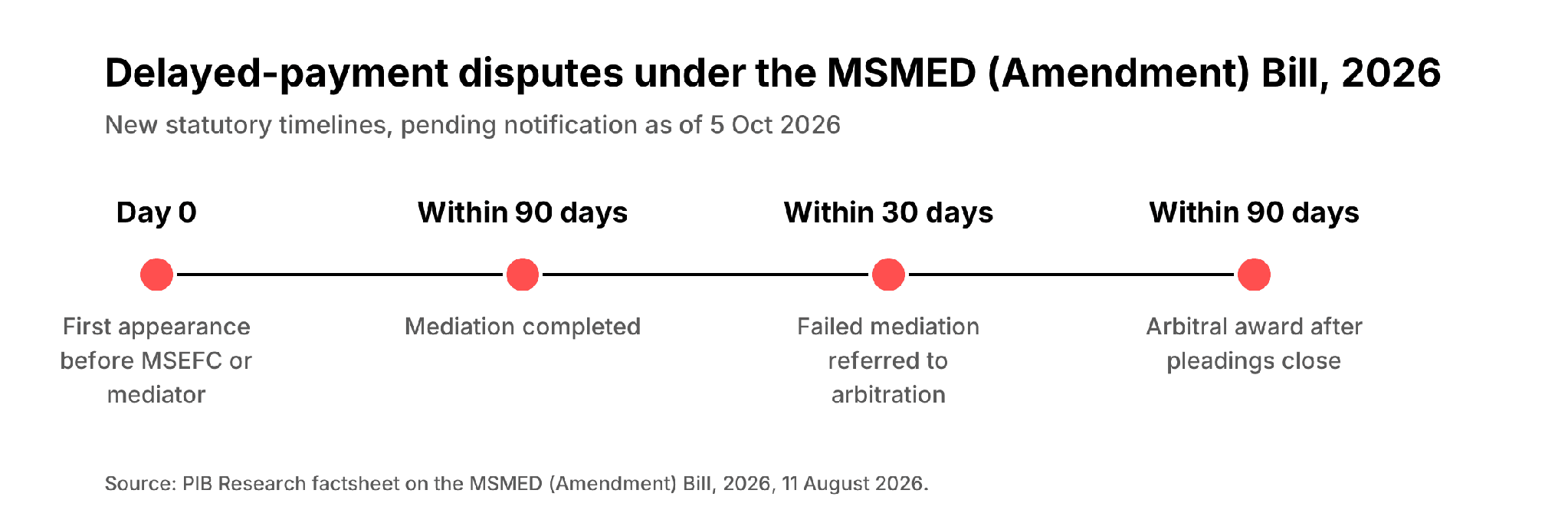
Alt text: Timeline of MSMED Amendment Bill 2026 delayed payment dispute resolution: mediation within 90 days, arbitration referral within 30 days, award within 90 days
The 2026 amendment adds teeth. Per PIB's factsheet dated 11 August 2026, the key changes are:
Status check (as of 5 October 2026): PRS Legislative Research records the Bill as introduced in the Rajya Sabha on 28 July 2026, passed there on 3 August 2026 and passed by the Lok Sabha on 7 August 2026. PRS does not yet list the date of Presidential assent or commencement. Treat the new timelines as pending notification, and check the e-Gazette before relying on them in a dispute.
The practical takeaway for small suppliers is the same either way: register on Udyam, put your payment terms in writing, and keep invoice records clean. Protections only work if you can prove the clock started.
Government Platforms Every Indian MSME Should Know
Which government platforms help MSMEs in India? The core set is Udyam (registration), Udyam Assist (informal micro units), TReDS (invoice discounting), GeM (government procurement), ONDC (open e-commerce), MSME Samadhaan and the ODR Portal (delayed-payment disputes) and CGTMSE (collateral-free credit guarantees).
This is a neutral reference table. Each platform solves a different problem, and most MSMEs only need three or four of them.
A few numbers show which of these are gaining traction. TReDS invoice discounting rose from ₹40,000 crore in 2022-23 to ₹3.47 lakh crore in 2025-26, according to PIB's August 2026 factsheet. CGTMSE approved 29.03 lakh guarantees worth ₹3.77 lakh crore between 1 January and 30 November 2025, and its coverage ceiling has been raised from ₹5 crore to ₹10 crore. The Online Dispute Resolution Portal launched on 27 June 2025, MSME Day.
Challenges Facing the MSME Sector in India
What are the main challenges facing MSMEs in India? The main challenges are delayed payments from buyers, limited access to affordable credit and equity, compliance load relative to business size, low productivity in micro units, and patchy adoption of digital tools for operations like payroll, payments and customer communication.
Policy reports tend to list challenges in a polite order. Ranked by how often they actually stall a business, the list looks more like this.
- Cash stuck in receivables. The Samadhaan figures above are the visible tip. Most delayed-payment cases never get filed, because a supplier does not want to lose its biggest customer.
- Credit that does not fit the business. Collateral-backed loans suit asset-heavy manufacturers. Service businesses, which own laptops and goodwill, struggle. Guarantee schemes and TReDS help, but only once a business is registered and its paperwork is clean.
- Compliance load. A ten-person company in India deals with GST, TDS, PF, ESI, professional tax and annual ROC filings. None is hard alone. Together they eat founder time. The Union Budget 2026-27 acknowledged this by proposing a cadre of "Corporate Mitras", accredited para-professionals trained through ICAI, ICSI and ICMAI to help MSMEs meet compliance at affordable cost.
- The micro trap. Most enterprises stay micro. Moving to small means more staff, more statutory obligations and more process, and many owners choose not to cross that line.
- Digital adoption that stops at UPI. Collecting money digitally is now normal. Running payroll, paying vendors, managing bills and talking to customers through structured digital tools is still not.
Our view: the fifth challenge is the most fixable and the one with the fastest payback, because it reduces the drag from the first three. A business with clean digital records gets credit faster, proves delayed payments more easily and files compliance on time.
Benefits of Digitisation for Indian MSMEs
What are the benefits of digitisation for MSMEs? Digitisation cuts the time founders spend on admin, reduces compliance errors and penalties, speeds up collections, creates the records lenders and platforms like TReDS need, and lets small teams serve customers at a scale that used to require large staff.
The benefits are not abstract. They show up in specific places on the profit and loss account.
- Fewer compliance penalties. Automated payroll calculates PF, ESI, TDS and professional tax correctly every month. For a deeper look, see our guide to payroll software for small businesses in India.
- Faster collections. Payment reminders and invoice links reach customers on channels they actually read, instead of email inboxes they ignore.
- Bankable records. Clean digital books, invoices and payroll history are what lenders, CGTMSE-backed loans and TReDS financiers ask for.
- Lower cost of bills and vendor payments. Consolidating utility and vendor bill payments into one workflow saves hours each month; our BBPS buyer's guide for business bill payments explains how that works in India.
- Customer reach without headcount. Structured messaging, from order updates to catalogues, lets a five-person team handle the volume of a fifteen-person one. Our WhatsApp Business API playbook for India covers the setup.
- Faster paperwork. Legally valid electronic signatures remove courier delays from contracts, offer letters and vendor agreements.
MSME Digitisation Use Cases
These are the workflows where small Indian businesses typically see the quickest return.
- Monthly payroll with automatic PF, ESI, TDS and professional tax deductions
- Salary slips and annual TDS certificates issued digitally to staff
- Utility, telecom and vendor bill payments from one dashboard
- Order confirmations, delivery updates and payment reminders sent on WhatsApp
- Lead capture from click-to-WhatsApp ads, routed to a sales team
- Offer letters, NDAs and vendor contracts signed electronically
- Udyam certificate and invoice records kept ready for TReDS or a CGTMSE-backed loan
- Compliance due dates tracked against a single calendar
Which Industries and Audiences This Applies To
The role of MSMEs looks different sector by sector. These are the segments where the data and the digitisation argument hit hardest.
- Manufacturing and job-work units: component makers, auto ancillaries and engineering units that supply larger brands and live on 45 to 90 day payment cycles.
- Textile, apparel and handloom clusters: labour-intensive, export-linked and often rural; heavy users of Udyam Assist and cluster schemes.
- Food processing and packaged foods: small brands moving from local distribution to D2C and ONDC.
- Retail and D2C brands: businesses that need structured customer communication, catalogues and payment links.
- Professional services: CA firms, agencies and consultancies, where payroll and compliance load grows faster than revenue.
- Healthcare clinics and diagnostic labs: appointment reminders and report delivery at volume.
- Education and coaching centres: admissions, fee reminders and parent communication.
- Logistics and transport operators: driver payroll, fuel and toll bills, and delivery notifications.
- Hospitality and restaurants: high staff turnover, daily payments and repeat-customer messaging.
- Artisans and traditional trades: PM Vishwakarma beneficiaries entering digital sales and payments for the first time.
The audience for this guide also includes students and researchers studying the role of MSME in Indian economy for UPSC or university papers. The figures here are sourced to PIB and dated, so they can be cited directly.
Frequently Asked Questions About Role Of MSME In Indian Economy
What is the role of MSME in Indian economy in 2026?
MSMEs contribute 31.1% of GDP, 35.4% of manufacturing output and 48.58% of exports, per the Economic Survey 2025-26. With 9.16 crore enterprises on Udyam as of August 2026, they are India's second-largest employer after agriculture and the main channel for formalisation and regional industrial growth.
What is the MSME contribution to GDP in India in 2026?
The latest official figure is 31.1% of GDP, from the Economic Survey 2025-26 tabled on 29 January 2026. The earlier figure of 30.1% was cited by the Union MSME Minister in July 2025. Always quote the source and date, because these shares are revised with each survey.
What are the new MSME classification limits in India?
From 1 April 2025, micro enterprises can have investment up to ₹2.5 crore and turnover up to ₹10 crore; small, up to ₹25 crore and ₹100 crore; medium, up to ₹125 crore and ₹500 crore. The same limits apply to manufacturing and services businesses.
How many MSMEs are registered on the Udyam portal?
As of August 2026, 9.16 crore MSMEs are registered across the Udyam Registration Portal and the Udyam Assist Platform, employing more than 40 crore people, according to PIB. Registration on the official Udyam portal is free and paperless.
What is the 45-day payment rule for MSMEs?
Under the MSMED Act, 2006, buyers must pay micro and small suppliers within 45 days of accepting goods or services. Suppliers owed money beyond that can file on the MSME Samadhaan Portal. The MSMED (Amendment) Bill, 2026 adds fixed mediation and arbitration timelines and TReDS settlement for CPSEs.
Is MSME registration mandatory for small businesses in India?
Udyam registration is voluntary, but most MSME benefits depend on it, including priority-sector lending, CGTMSE credit guarantees and delayed-payment protection. Under the 2026 amendment, filing becomes free and voluntary for all MSMEs through a notified national platform.
Key Takeaways
- MSMEs contribute 31.1% of India's GDP, 35.4% of manufacturing and 48.58% of exports (Economic Survey 2025-26).
- Udyam registrations reached 9.16 crore by August 2026, up from 6.5 crore in July 2025.
- The GDP share has risen more slowly than registrations, which points to productivity and scale-up as the real growth constraint.
- Delayed payments remain the biggest cash-flow risk; the MSMED (Amendment) Bill, 2026 sets new timelines but awaits notification.
- Registration, written payment terms and clean digital records are the cheapest ways for a small business to access the support already on offer.
Final Thoughts
The phrase "growth engines of the nation's economy" used to be a slogan. In 2026 it is a measurable claim: a third of GDP, half of exports and more than 9 crore registered enterprises. What the numbers also show is that the engine runs below its potential when most units stay micro and spend their owners' time on admin instead of growth.
If you run a small business, the useful question is not whether MSMEs matter to India. It is which part of your operations still runs on paper, memory and follow-up calls. Fix that first, then let the schemes and platforms do the rest.
Related Reads
This guide is the hub for Peko's India MSME cluster. Topics planned or published in this cluster:
- How to register a company in India in 2026
- Indian SME compliance calendar 2026
- Best payroll software for small businesses in India
- Online bill payment for business in India: BBPS guide
- WhatsApp Business API India playbook
- Aadhaar eSign in India
How Peko Supports Indian MSMEs
Peko is a business operations platform for Indian small and growing businesses. It brings payroll and HR, business bill payments, WhatsApp Business API messaging and eSign into one account, so a founder can run statutory payroll, pay bills and talk to customers without switching between five tools. Plans start with a free tier for teams under 10 employees; see Peko pricing for India for current plans.
References
- PIB (Ministry of Finance), "MSMEs form the backbone of India's industrial economy: Economic Survey 2025-26", 29 January 2026: https://www.pib.gov.in/PressReleasePage.aspx?PRID=2219984
- PIB Research, "The Micro, Small and Medium Enterprises Development (Amendment) Bill, 2026" factsheet, 11 August 2026: https://www.pib.gov.in/FactsheetDetails.aspx?Id=150826
- PIB Backgrounder, "From Enterprise to Empowerment: The MSME Story", 26 June 2026: https://www.pib.gov.in/PressReleasePage.aspx?PRID=2278107
- PIB Explainer, "Union Budget 2026-27: Building Champion MSMEs for a Global India", 15 February 2026: https://www.pib.gov.in/PressNoteDetails.aspx?NoteId=157367
- PIB (Ministry of MSME), "MSME sector accounts for 30.1% of India's GDP", 4 July 2025: https://www.pib.gov.in/PressReleasePage.aspx?PRID=2142170
- PIB (Ministry of Finance), "Several measures taken to ensure timely payments to MSMEs", 25 November 2019: https://www.pib.gov.in/PressReleasePage.aspx?PRID=1593420
- News on AIR, "Govt notifies revised criteria for classifying MSMEs": https://newsonair.gov.in/govt-notifies-revised-criteria-for-classifying-msmes/
- PRS Legislative Research, MSMED (Amendment) Bill, 2026 bill track: https://prsindia.org/billtrack/the-micro-small-and-medium-enterprises-development-amendment-bill-2026
Udyam Registration Portal, Ministry of MSME: https://udyamregistration.gov.in/
By Adil Rashid Lone, SEO Manager, Peko | Last updated: 5 October 2026 | All figures verified against Press Information Bureau (PIB) and Ministry of MSME sources on 5 October 2026. See the References section.
This article is for general information and is not legal, tax or financial advice. Verify scheme terms and legal timelines with the Ministry of MSME, your bank or a chartered accountant before acting.