- Blogs
- Company Formation
- Aadhaar eSign India 2026: Legal Validity, Cost & Providers
Sep 08, 2026
Aadhaar eSign India 2026: Legal Validity, Cost & Providers
Share this article
- Aadhaar eSign in India 2026: How It Works, Legal Validity, Providers & Cost
- TL:DR;
- What Is eSign and Is It Legally Valid in India?
- What Does eSign Mean? (Definition, Full Form and Hindi Meaning)
- What is an Aadhaar Digital Signature?
- Electronic Signature vs Digital Signature in India
- How Does Aadhaar-Based eSign Work? (Step-by-Step)
- How to Sign Documents Online in India
- How to eSign a PDF Document in India (Step by Step)
- DSC vs eSign: The Difference Between eSign and Digital Signature
- Benefits of eSign for Indian Businesses
- Industries Using eSign in India
- Top Use Cases for eSign
- eSign Adoption Statistics in India
- Security: Is eSign Safer Than a Wet Signature?
- Best eSign Service Providers in India
- eSign API Providers in India
- Cost of eSign in India (Pricing Tiers)
- Can You eSign for Free in India?
- How to Implement eSign in Your Business - 6-Step Playbook
- Key Takeaways
- Frequently Asked Questions About eSign
- How Peko's eSign Fits WhatsApp-First SMEs
- Sources & References
Aadhaar eSign in India 2026: How It Works, Legal Validity, Providers & Cost
Last updated 08 September 2026
TL:DR;
What is Aadhaar eSign?
Aadhaar eSign is India's government-regulated electronic signature service, operated by CCA-licensed Certifying Authorities under the Information Technology Act, 2000. It lets any Aadhaar holder sign a PDF online using their Aadhaar number and an OTP sent to their Aadhaar-linked mobile, with the same legal validity as a handwritten signature. No USB token, no software install.
For Indian SMEs, D2C brands and service businesses still approving contracts on paper, Aadhaar eSign is the single biggest workflow upgrade of the decade. This guide to eSign in India explains how it works, where it stands legally, how it differs from DSC, who is using it, what it costs, and how to roll it out — with vendor-neutral comparison tables, use cases by industry and a cluster roadmap for further reading.
What Is eSign and Is It Legally Valid in India?
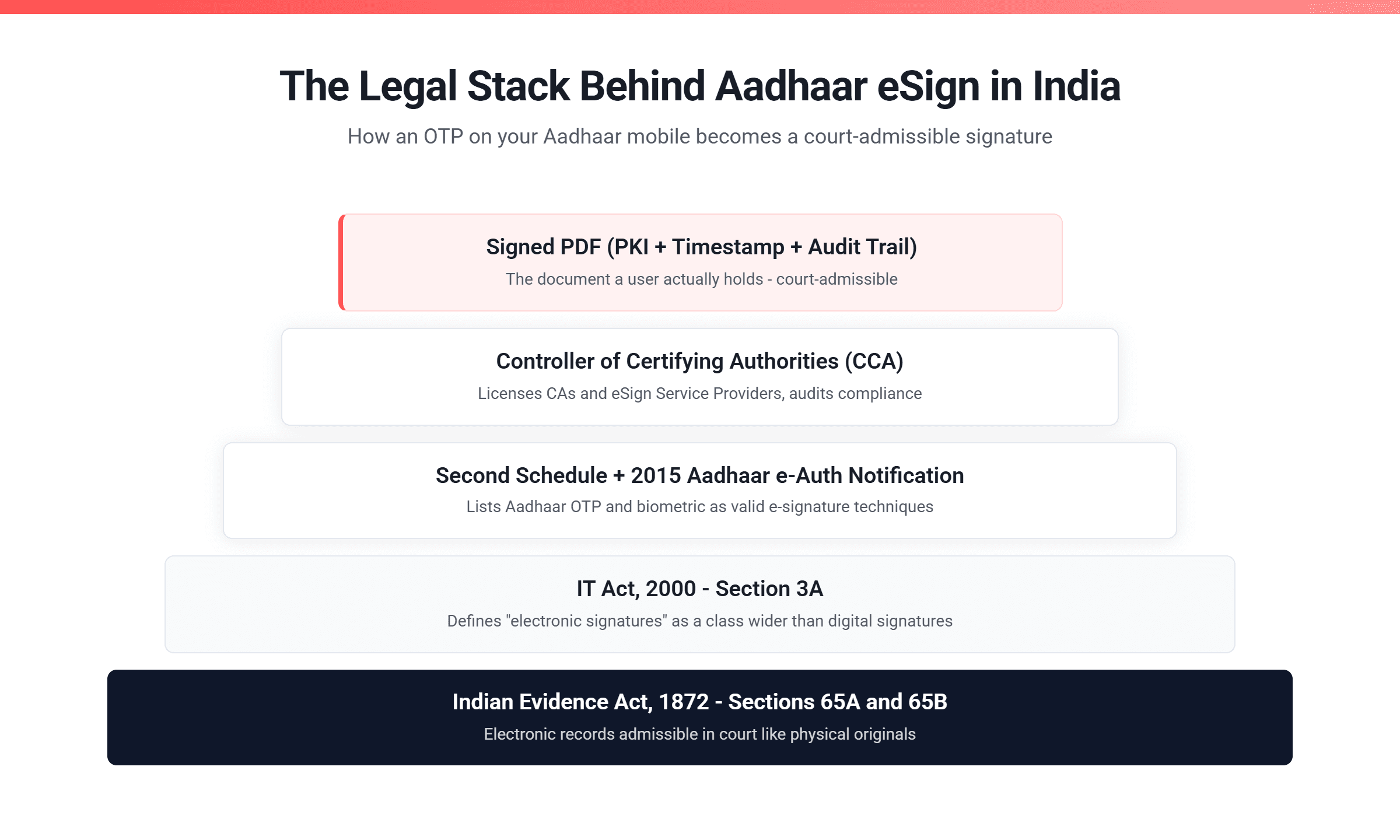
Is eSign legal in India? Yes. eSign is legally recognised under Section 3A of the Information Technology Act, 2000, and is enforceable in Indian courts under Sections 65A and 65B of the Indian Evidence Act, 1872. For almost every commercial document, an Aadhaar eSign carries the same legal weight as a handwritten signature.
The Indian legal stack behind eSign rests on three pillars:
- IT Act 2000 — Section 3A introduced "electronic signatures" as a class wider than the older "digital signatures," giving statutory recognition to Aadhaar eSign. (meity.gov.in)
- Second Schedule of the IT Act (notified via the e-authentication technique using Aadhaar, 2015) specifically lists Aadhaar OTP and biometric authentication as a valid e-signature method. (CCA — eSign Service)
- Indian Evidence Act, 1872 (65A & 65B) makes electronic records admissible in court the same way as physical originals, with a proper certificate.
Narrow exceptions remain in the First Schedule of the IT Act - wills, trusts, negotiable instruments (except cheques), powers of attorney for property, and the actual sale-deed registration. Everything else contracts, NDAs, vendor POs, HR letters, customer consents, loan agreements is fair game for eSign.
What Does eSign Mean? (Definition, Full Form and Hindi Meaning)
What does eSign mean?
eSign means an electronic signature applied to a digital document instead of a pen-and-paper signature. In India specifically, "eSign" is the name of a government-regulated service that lets a person sign a PDF online by authenticating with their Aadhaar number and a one-time password, producing a legally valid, cryptographically sealed signature.
There is no formal full form — eSign is simply short for "electronic signature." In everyday Indian usage the word carries a narrower, more specific meaning than it does globally:
- Globally, "e-sign" describes any electronic mark of assent — a typed name, a drawn squiggle, a tick-box, a click on "I Agree."
- In India, "eSign" almost always means the Aadhaar eSign service governed by the Controller of Certifying Authorities under the IT Act, 2000. The signature is backed by a real signing certificate from a licensed Certifying Authority, not just a picture of a signature.
That distinction matters commercially. A drawn squiggle pasted onto a PDF is an electronic signature in the loose sense, but it carries none of the evidentiary weight of an Aadhaar eSign, because nothing links the mark to a verified identity.
In Hindi, eSign is commonly written as ई-हस्ताक्षर (e-hastakshar) or simply ई-साइन, and the phrase eSign kya hota hai is one of the most common ways Indian users search for this topic. The answer is the same: a digital signature applied through Aadhaar OTP verification, legally equal to a handwritten one.
A few related terms you will run into:
| Term | What it actually means |
|---|---|
| eSign | The Aadhaar-based electronic signature service regulated by the CCA |
| ESP (eSign Service Provider) | A CCA-authorised entity that operates the eSign gateway |
| DSC | Digital Signature Certificate — a multi-year, token-based certificate |
| eKYC | Aadhaar-based identity verification, often bundled with eSign |
| e-Stamping | Paying stamp duty digitally; separate from eSign, often used together |
What is an Aadhaar Digital Signature?
An Aadhaar digital signature is a one-time, cryptographic signing certificate issued by a CCA-licensed Certifying Authority (CA) at the moment a signer authenticates with UIDAI using their Aadhaar number and OTP (or biometric). It is the most common form of eSign used in India today.
It differs from a traditional Class 3 DSC in three important ways:
- It is issued instantly, per transaction - not bought as a 1–3 year token.
- It uses UIDAI as the identity backbone, not a separate in-person KYC.
- It is delivered entirely online, with no USB token or smart card.
Because the underlying certificate is issued by a licensed CA and the identity is verified by UIDAI in real time, the resulting signature is treated as a "secure electronic signature" under 15 of the IT Act - meaning the burden of proof in a dispute shifts to whoever is challenging it. (CCA — eSign Service)
Electronic Signature vs Digital Signature in India
The two terms are often used interchangeably in India, but the IT Act treats them differently — and the distinction matters for compliance.
| Term | Legal basis | What it covers |
|---|---|---|
| Digital Signature | IT Act §3 | A specific PKI-based signature, applied using a Digital Signature Certificate (DSC) issued by a licensed CA. Originally token-bound. |
| Electronic Signature | IT Act §3A | A broader category. Any authentication technique listed in the Second Schedule — including Aadhaar OTP eSign, biometric eSign, and other notified methods. |
So every Indian digital signature is an electronic signature, but not every electronic signature is a digital signature. eSign sits inside the wider §3A bucket. In practice:
- Use digital signature (DSC) when a statute or portal specifically demands a Class 3 DSC - MCA, GST, ITR, customs, e-tenders.
- Use electronic signature (eSign) for everything else - contracts, HR, vendor, customer journeys, lending KYC.
How Does Aadhaar-Based eSign Work? (Step-by-Step)
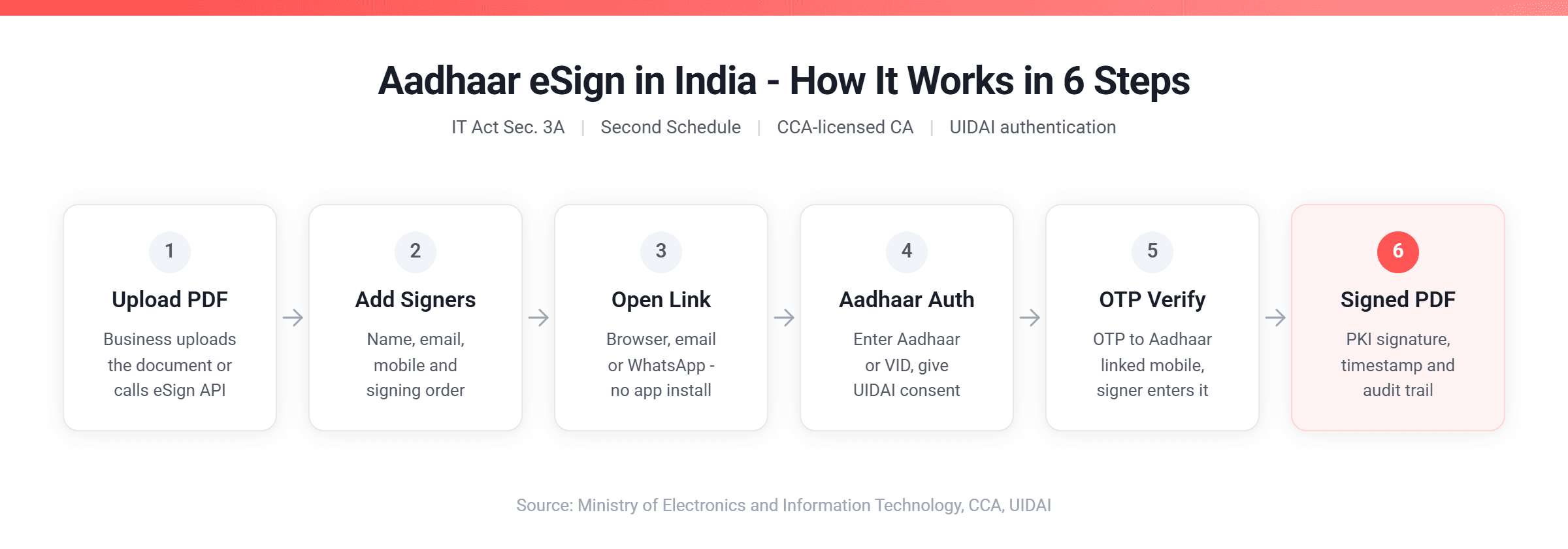
The Aadhaar eSign flow is deliberately simple — most signers finish it in under 60 seconds.
- Upload the document. The business uploads the PDF to an eSign platform (or calls the eSign API from inside an existing CRM, ERP or HRMS).
- Add signatories. Each signer's name, email and mobile number is added. Signing order can be sequential or parallel.
- Signer receives a link. The signatory opens the document in a browser, WhatsApp message or email, no app install needed.
- Aadhaar authentication. The signer enters their 12-digit Aadhaar (or Virtual ID) and consents to UIDAI verification.
- OTP verification. A one-time password is sent to the Aadhaar-linked mobile. The signer enters it.
- Signature applied. The licensed CA issues a one-time signing certificate; the PDF is crypto-graphically signed using PKI; a trusted timestamp is embedded; and a tamper-evident audit trail is locked into the file.
The whole transaction is logged with UIDAI (for authentication) and with the CA (for the signing certificate). Both records can be produced in court as evidence.
How to Sign Documents Online in India
If you are an individual signer (not a business owner), the practical answer to "how do I sign a document online in India?" is:
- Through a business that has sent you a link. Most B2C signing - loan agreements, telecom bills, insurance forms, tele-medicine consents - comes as an Aadhaar OTP link. You don't need any account; just your Aadhaar and Aadhaar-linked SIM.
- Through DigiLocker. The Government of India's Digi-Locker app lets citizens self-sign documents using their Aadhaar. Useful for forms you initiate yourself. (DigiLocker)
- Through a workflow SaaS. If you want to send your own contract for someone else to sign, sign up on any eSign workflow platform, upload your PDF, add the signer's email/mobile, and the platform will run the Aadhaar OTP flow for them.
For businesses, the right answer is to embed eSign into the system where the document is born, your CRM, HRMS, or, increasingly, WhatsApp. See the implementation playbook below.
How to eSign a PDF Document in India (Step by Step)
How do I eSign a PDF document in India?
Upload the PDF to an eSign platform or DigiLocker, enter your 12-digit Aadhaar number or Virtual ID, receive a one-time password on your Aadhaar-linked mobile, and enter it. A licensed Certifying Authority then applies a cryptographic signature to the PDF and returns the signed file. The whole process takes under a minute and needs no software installation.
Most searches for "eSign PDF" fall into one of two jobs. They are not the same job, and the tools differ.
Job 1 - You need to sign a PDF someone sent you.
1. Open the signing link from the email, SMS or WhatsApp message.
2. Review the document in the browser. Nothing to install.
3. Enter your Aadhaar number or Virtual ID and tick the UIDAI consent box.
4. Enter the OTP sent to your Aadhaar-linked mobile.
5. The signed PDF is generated and sent back to you, usually on the same channel.
Job 2 - You need to send a PDF for someone else to sign.
1. Sign up on an eSign workflow platform, or use your existing CRM/HRMS if it has eSign built in.
2. Upload the PDF and drag signature fields onto the pages where signatures are needed.
3. Add each signer's name, mobile number and email, and set the signing order.
4. Send. Each signer gets a link and completes the Aadhaar OTP flow.
5. Download the signed PDF plus its audit-trail certificate, and file both together.
What a properly eSigned PDF contains. Open the signed file in any PDF reader and check the signature panel. You should see the signer's name as held by UIDAI, the name of the issuing Certifying Authority, a trusted timestamp, and a statement that the document has not been modified since signing. If the signature panel is empty, what you have is an image of a signature, not an eSign — and it will not stand up the same way in a dispute.
A note on Adobe Acrobat, Word and free online tools. Acrobat, Word, Smallpdf and similar tools let you draw or type a signature onto a PDF. That is useful for informal documents, but it is not an Aadhaar eSign and it carries no CA-issued certificate. For anything you may one day need to enforce, use a CCA-backed eSign flow.
DSC vs eSign: The Difference Between eSign and Digital Signature
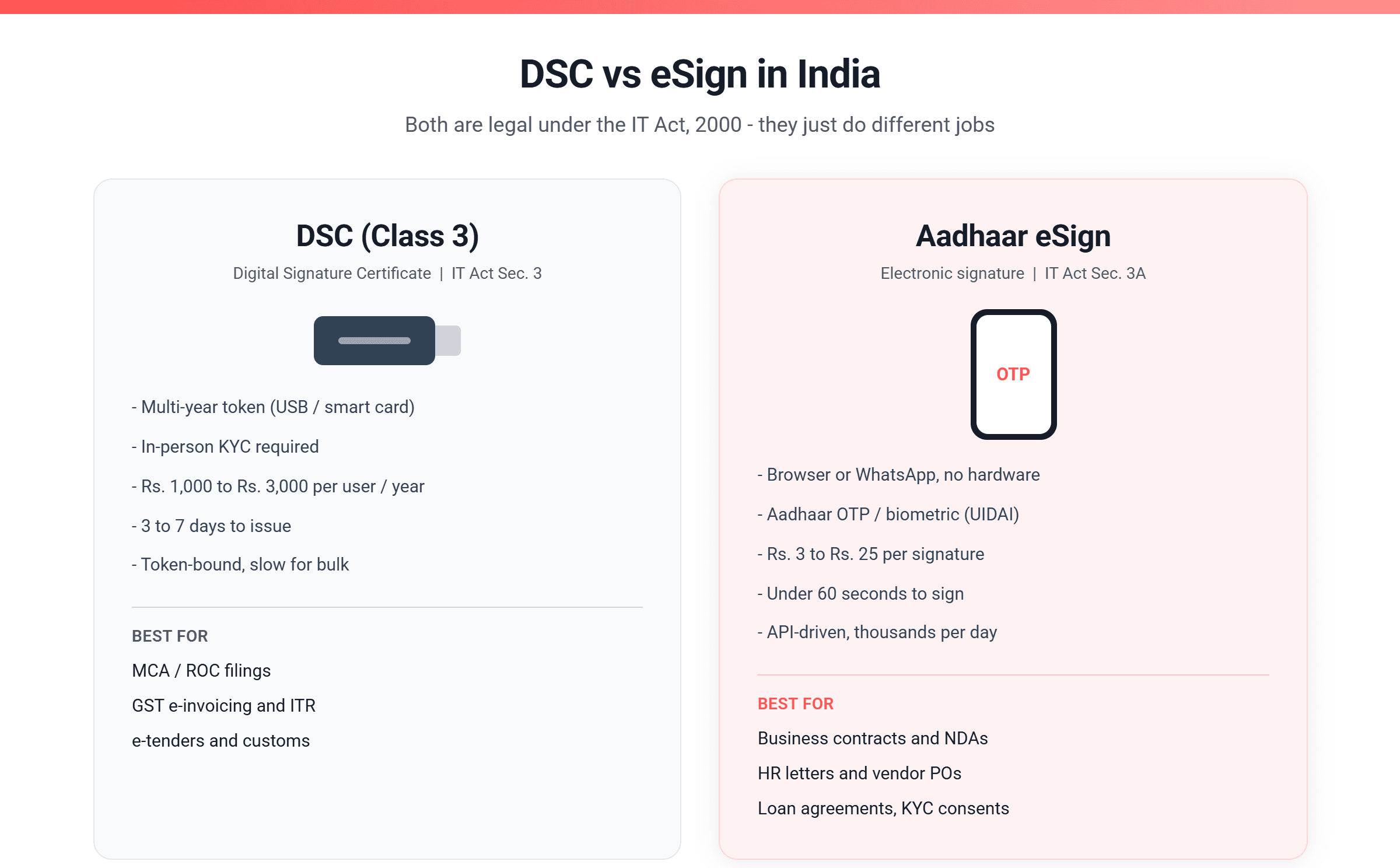
Both DSC and eSign are legal under the IT Act, but they serve very different jobs.
| Parameter | DSC (Class 3) | Aadhaar eSign |
|---|---|---|
| Legal basis | IT Act §3 (digital signature) | IT Act §3A (electronic signature) |
| Issued by | Licensed CA, valid 1–3 years | Licensed CA, valid for one transaction |
| Identity proof | KYC + in-person verification | Aadhaar OTP / biometric (UIDAI) |
| Hardware needed | USB token / smart card | None — browser or WhatsApp |
| Cost | ₹1,000–₹3,000 per user per year | ₹3–₹25 per signature (volume pricing) |
| Time to first signature | 3–7 days | Under 60 seconds |
| Best for | MCA / ROC filings, GST e-invoicing, ITR, tenders, customs | Business contracts, NDAs, HR offers, vendor POs, loan agreements |
| Remote signing | Possible but token-bound | Native — works from any device |
| Bulk signing | Slow | API-driven, thousands per day |
Short version: keep a DSC for statutory filings; move every other contract, agreement and approval to eSign.
Benefits of eSign for Indian Businesses
eSign is not a digital version of a pen, it changes the economics of contracting:
- Faster deal cycles. Sales contracts that took 5–10 days of courier and signature collection close in hours. This directly improves cash flow and sales velocity.
- Lower operational cost. No paper, no printing, no courier, no physical storage. A typical 100-employee company spends a meaningful share of its admin budget on contract logistics, most of which disappears.
- Audit-ready compliance. Every signature carries a UIDAI-verified identity, a timestamp and an IP trail - exactly what RBI, SEBI, IRDAI and internal auditors ask for.
- Remote-first hiring and selling. Offer letters, NDAs and vendor agreements can be closed the same evening they're drafted, with someone in another city.
- Higher completion rates. Removing the print–scan–email loop reduces contract drop-off sharply.
- Greener footprint. Useful for ESG reporting many listed Indian companies and their suppliers are scored on paper consumption.
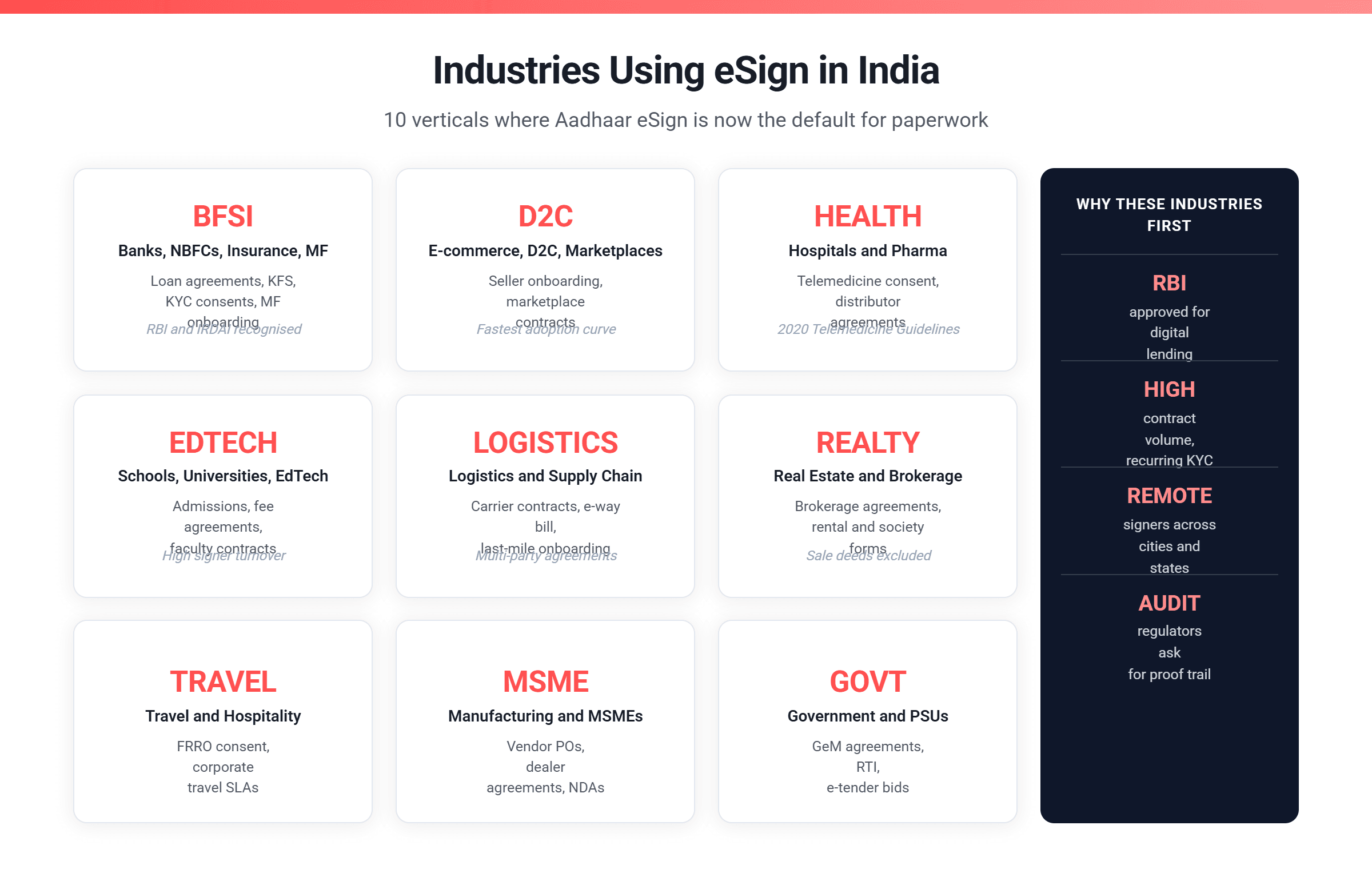
Industries Using eSign in India
| Industry | Common eSign Documents |
|---|---|
| BFSI (Banks, NBFCs, Insurance, MF) | Loan agreements, KFS, insurance proposals, MF onboarding, KYC consent |
| E-commerce & D2C | Seller onboarding, marketplace contracts, brand licensing, return-policy acknowledgements |
| Healthcare | Telemedicine consent (2020 Guidelines), hospital empanelment, pharma distributor agreements |
| Education & EdTech | Admission forms, fee agreements, internship offers, faculty contracts, refunds |
| Travel & Hospitality | Vendor agreements, guest registration (FRRO), corporate travel SLAs |
| Logistics & Supply Chain | Carrier contracts, e-way bill consent, last-mile partner onboarding |
| Restaurants, Cloud Kitchens, Franchises | Franchise agreements, aggregator listings, supplier POs |
| Real Estate | Brokerage agreements, builder–partner contracts, society resolutions, rental forms |
| Manufacturing & MSMEs | Vendor POs, dealer agreements, compliance attestations, NDAs |
| Government & PSUs | GeM vendor agreements, e-tender bids, departmental approvals, RTI responses |
Top Use Cases for eSign
Within each industry, the high-volume documents that move first to eSign are remarkably consistent:
- Sales contracts, MSAs and SOWs
- NDAs and confidentiality undertakings
- Vendor onboarding forms and purchase orders
- Employee offer letters, appointment letters and PIPs
- Lease and rental agreements
- Loan agreements, sanction letters and consent forms
- KYC / re-KYC consent for BFSI customers
- Board resolutions and shareholder consents
- Distributor and channel-partner agreements
- Insurance proposal forms and policy acceptances
- Service-level agreements with logistics or BPO partners
- Refund, settlement and grievance closure letters
For most Indian businesses, HR + Sales + Procurement are the three first departments to eSign-enable.
eSign Adoption Statistics in India
- UIDAI reports more than 142 crore Aadhaar holders as of 2024, giving eSign an addressable base larger than any other identity rail in the world. (UIDAI Dashboard)
- CCA publishes monthly eSign transaction volumes; aggregate eSign transactions in India crossed multi-crore-per-month volumes by 2023, with consistent YoY growth. (CCA Statistics)
- DigiLocker, India's government-run document wallet integrated with eSign, has been used by over 25 crore citizens. (DigiLocker)
- UPI processed 18+ billion monthly transactions by late 2024 — the same trust rails that power eSign have made India the world's largest real-time payments market. (NPCI — UPI Statistics)
- RBI and the Government of India's Digital India dashboard track eSign, DigiLocker and UPI as one paperless-economy KPI. (RBI · Digital India)
- MeitY lists multiple licensed eSign Service Providers (ESPs) — (e)Mudhra, NSDL e-Gov / Protean, Capricorn and others. (CCA — Licensed CAs)
For board decks and business cases, pull the latest figures directly from the CCA, UIDAI, NPCI and Digital India dashboards rather than from secondary sources - numbers shift every quarter.
Security: Is eSign Safer Than a Wet Signature?
Yes — by every measurable criterion. A wet ink signature has no inherent way to prove who signed, when they signed, or whether the underlying document was altered after signing. Handwriting forgery is the most common dispute in Indian commercial litigation.
Aadhaar eSign layers four security mechanisms on top of every signature:
- UIDAI biometric / OTP authentication :- the signer must control the Aadhaar-linked SIM.
- PKI (Public Key Infrastructure) :- the signature is a cryptographic hash. Changing even one character in the PDF after signing invalidates the signature instantly.
- Trusted timestamp :- embedded by the CA, not by the signer's device.
- Tamper-evident audit trail :- captures IP, device, geo-location (if permitted), and every action.
This is why Indian courts increasingly accept eSign documents as primary evidence under Sections 65A and 65B of the Indian Evidence Act.
Best eSign Service Providers in India
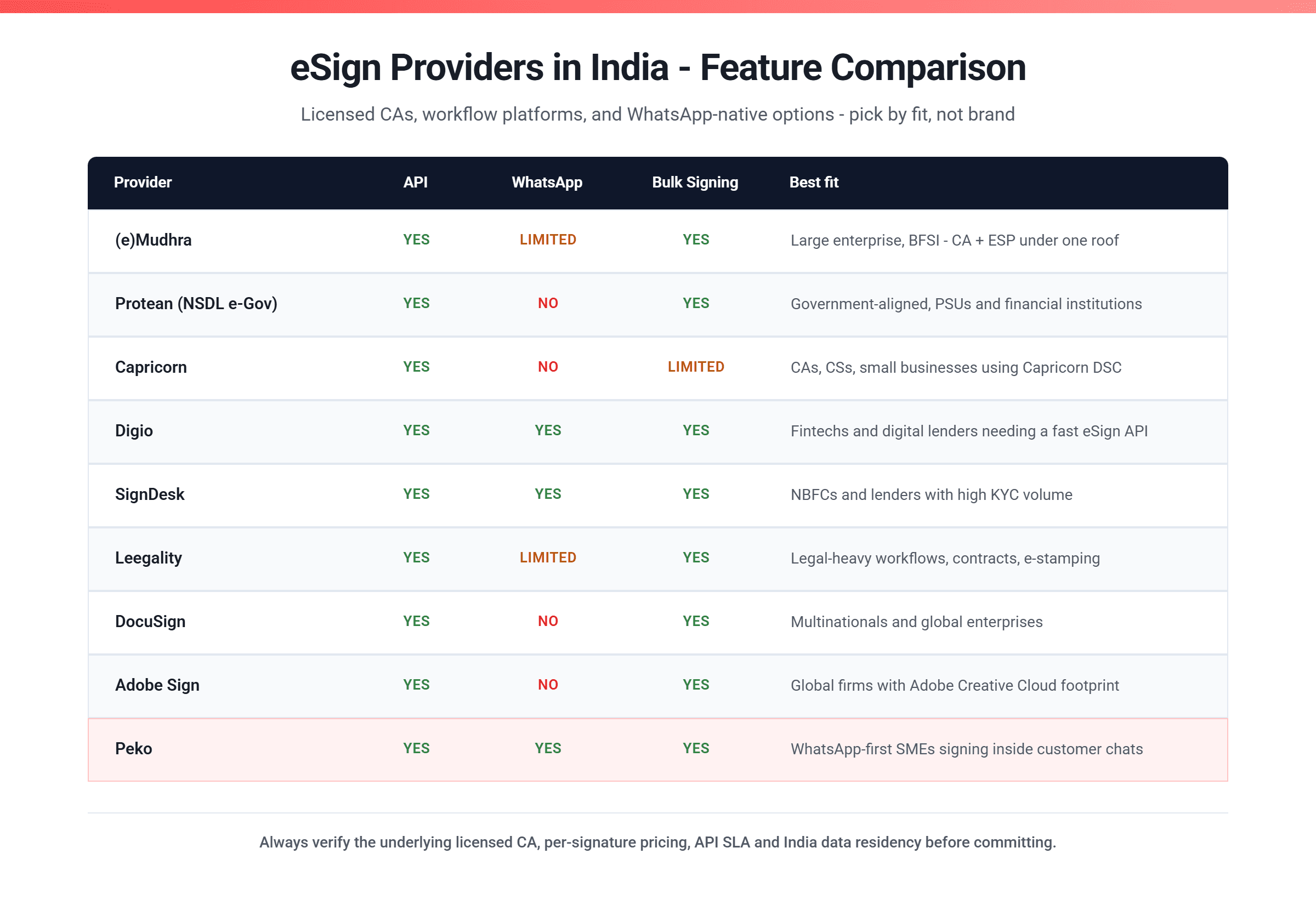
The market is layered: at the bottom sit licensed Certifying Authorities (CAs) and eSign Service Providers (ESPs) authorised by the CCA — they issue the actual signing certificates. On top sit eSign workflow platforms that handle uploads, signer flows, dashboards and integrations. A neutral, fit-for-purpose view:
| Provider | API | WhatsApp Delivery | Bulk Signing | Best For |
|---|---|---|---|---|
| (e)Mudhra | Yes | Limited | Yes | Large enterprises and BFSI wanting CA + ESP under one roof |
| Protean (NSDL e-Gov) | Yes | No | Yes | Government-aligned use, PSUs and financial institutions |
| Capricorn | Yes | No | Limited | CAs, CSs and small businesses already using Capricorn DSC |
| Digio | Yes | Yes | Yes | Fintechs and digital lenders needing a fast eSign API |
| SignDesk | Yes | Yes | Yes | NBFCs and lending platforms with high KYC volume |
| Leegality | Yes | Limited | Yes | Legal-heavy workflows (contracts, e-stamping, lending docs) |
| SignYu | Yes | No | Yes | Indian SMBs who want to pay-per-use Aadhaar OTP eSign (₹15) without a DSC token |
| DocuSign | Yes | No | Yes | Multinationals and global enterprises already standardised |
| Adobe Sign | Yes | No | Yes | Global firms with Adobe / Creative Cloud footprints |
| Peko | Yes | Yes | Yes | WhatsApp-first SMEs and D2C brands signing inside customer chats |
When shortlisting, ask each vendor for: (1) name of the underlying licensed CA, (2) per-signature pricing at your projected volume, (3) API documentation, (4) data residency (must be India for BFSI), and (5) a sample audit-trail PDF.
eSign API Providers in India
For businesses building eSign into a product, a lending app, an HR portal, a vendor on-boarding flow. The integration layer matters more than the brand. Look for these capabilities in any eSign API in India:
- REST + webhook architecture for asynchronous signer flows.
- Bulk eSign endpoint for monthly statements, KYC re-verification, and HR documents at scale.
- White-label signing UI so the signer never leaves your brand.
- WhatsApp / SMS / email delivery channels for the signing link.
- Aadhaar Offline KYC + eSign in one call for fintechs operating under RBI's digital lending guidelines.
- Audit-trail download API for compliance pulls.
Providers offering eSign APIs in India include Digio, SignDesk, Leegality, (e)Mudhra, NSDL/Protean and Peko. Each with different pricing, SLA, and India data-residency commitments. Match the API to your use case (lending vs HR vs commerce) rather than picking on brand recall.
Cost of eSign in India (Pricing Tiers)
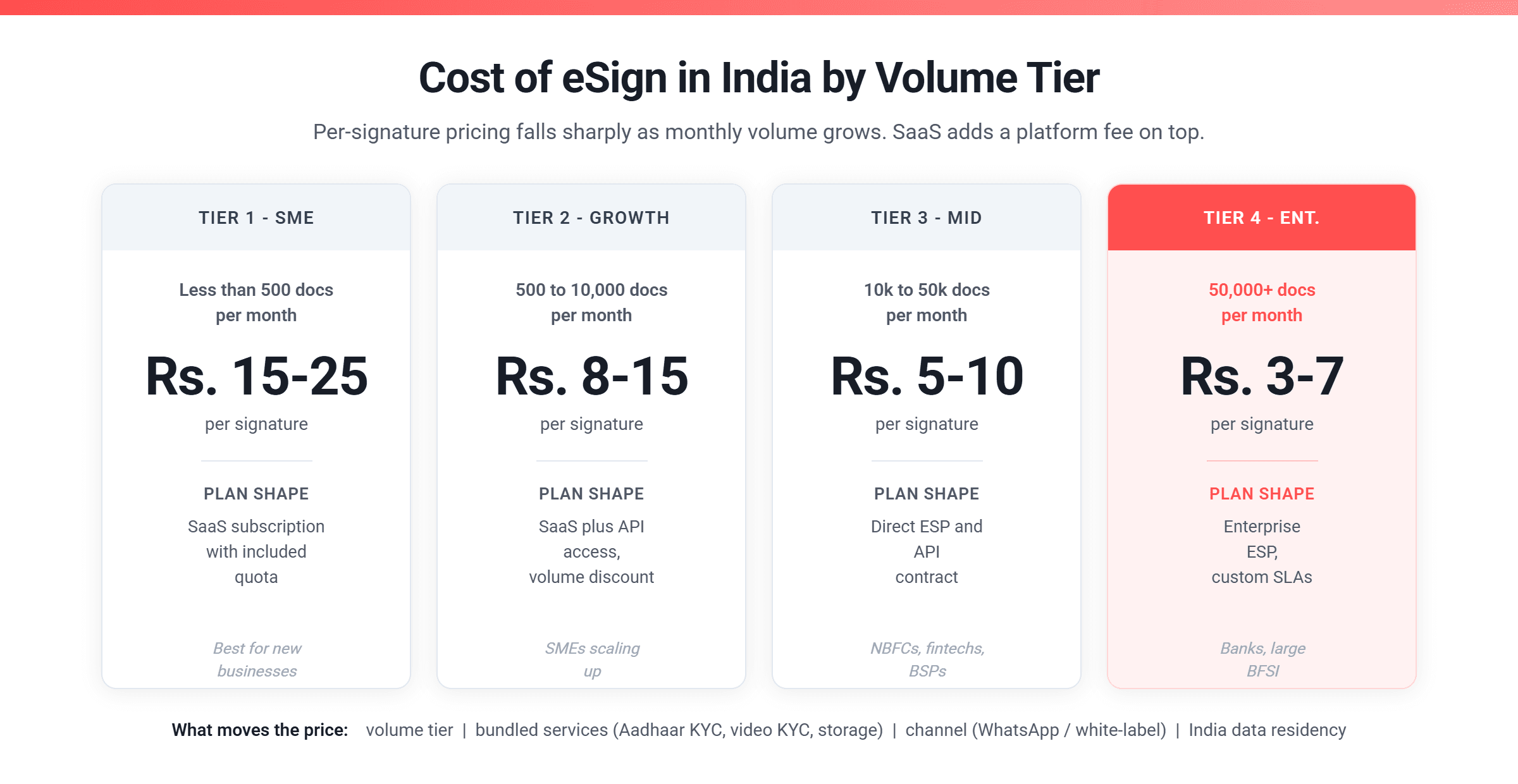
How much does eSign cost in India? eSign pricing in India typically ranges from ₹3 to ₹25 per signature, depending on monthly volume, workflow features, and whether the provider includes API access, white-labelling, KYC and storage. High-volume enterprise contracts can land below ₹3. Workflow SaaS platforms also charge platform/seat fees on top of per-signature pricing.
eSign Pricing by Volume Tier
| Monthly Volume | Typical Per-Signature Cost | Common Plan Shape |
|---|---|---|
| < 500 docs | ₹15 – ₹25 | SaaS subscription with included quota |
| 500 – 10,000 docs | ₹8 – ₹15 | SaaS + API, volume discount |
| 10,000 – 50,000 docs | ₹5 – ₹10 | Direct ESP / API contract |
| 50,000+ docs | ₹3 – ₹7 | Enterprise ESP contract, custom SLAs |
Three things move the per-signature price the most:
- Volume tier. Above 50,000 signatures a month, per-signature pricing drops sharply.
- Bundled services. Aadhaar KYC, name-match, video-KYC and PDF storage are often add-ons.
- Channel. WhatsApp-delivered signing links and white-label UI may sit at a slight premium but typically pay back through higher completion rates.
Can You eSign for Free in India?
Is eSign free in India?
Self-signing is free through DigiLocker, the Government of India's document wallet, where any Aadhaar holder can eSign their own documents at no cost. Sending a document to someone else for signature is not free — a CCA-licensed Certifying Authority has to issue a signing certificate for each transaction, which costs money, so business eSign is priced at roughly ₹3 to ₹25 per signature.
This is the single most misunderstood point about eSign in India, so it is worth being precise about what "free" covers.
Genuinely free:
- DigiLocker self-signing. Upload your own document, authenticate with Aadhaar, sign it. No charge. Best for forms and applications you are submitting yourself.
- Free trial credits. Most Indian eSign platforms give 5–25 free signatures during a trial so you can test the flow end to end.
- Draw-and-paste tools. Acrobat Reader, Word, Smallpdf and iLovePDF will place a drawn signature on a PDF for free — but as noted above, that is not an Aadhaar eSign and carries no certificate.
Not free, and cannot be:
- Sending documents for others to sign. Every Aadhaar eSign transaction consumes a certificate issued by a licensed CA, and the CA charges for it. Any platform advertising unlimited free business eSign is either running on trial credits or is not issuing real certificates.
- API access, bulk signing, white-labelling and audit-trail storage. These sit on top of the per-signature cost.
The practical rule: if you sign a handful of your own documents a year, DigiLocker covers you at zero cost. If you send contracts to customers, employees or vendors, budget per signature using the pricing tiers above — at low volume the realistic floor is around ₹15 per signature including the platform.
How to Implement eSign in Your Business - 6-Step Playbook
A repeatable roll-out that works for most Indian SMEs:
- Map your top 5 document flows. List the contracts your business sends most often, typically offer letters, NDAs, vendor agreements, sales contracts, customer consents.
- Pick the right legal mode. Confirm with your CA/CS that eSign is acceptable for each flow (it is for almost everything except wills, trusts, NIs and sale deeds).
- Shortlist 2 providers. Use the criteria in the providers table. Run a 30-document pilot with each.
- Integrate where it hurts most. Push eSign into the system where the contract is born your CRM (sales), HRMS (HR), or ERP (procurement). Don't make signing a separate portal trip.
- Train signers and SPOCs. A 15-minute walk-through is enough. Most drop-offs come from confusion about Aadhaar OTP, not from the platform itself.
- Audit monthly. Pull the audit-trail PDF for a random 5% sample every month and store it with your contracts. This single habit clears most internal-audit and RBI inspections.
Most businesses go from kick-off to first signed contract in under 7 days.
Key Takeaways
- eSign is fully legal in India under IT Act §3A and the Second Schedule; admissible in court under Indian Evidence Act §§65A/B.
- Digital signature ≠ electronic signature in Indian law — DSC sits under §3, eSign under §3A.
- Use DSC for statutory filings (MCA, GST, ITR, customs) and eSign for everything else (contracts, HR, vendor, customer consents).
- The biggest ROI from eSign is cycle-time reduction, not paper savings — deals close in hours instead of days.
- Industries leading adoption: BFSI, e-commerce, healthcare, EdTech, logistics, real estate, manufacturing, government.
- Pricing typically lands between ₹3 and ₹25 per signature, with the per-unit cost falling sharply above 50,000 signatures a month.
- Pick a provider based on licensed-CA backing, API quality and where the document is born — not on brand familiarity.
- Businesses whose customers already live on WhatsApp may benefit from embedded signing experiences rather than separate signing portals; standalone tools work well where the workflow already lives in email or a SaaS dashboard.
Frequently Asked Questions About eSign
1. Is eSign legally valid in India?
Yes. Aadhaar-based eSign is recognised under §3A and the Second Schedule of the IT Act, 2000, and is enforceable in Indian courts the same way as a handwritten signature for almost all commercial documents.
2. What is the difference between DSC and eSign?
A DSC is a multi-year certificate stored on a USB token, used mainly for government and tax filings. eSign is an instant, Aadhaar-OTP-based electronic signature used mainly for business contracts. Both are legal — they serve different document types.
3. What is an Aadhaar digital signature?
An Aadhaar digital signature is a one-time PKI signing certificate issued by a CCA-licensed CA at the moment a signer authenticates with UIDAI via Aadhaar OTP. It is the most common form of eSign used in India and qualifies as a "secure electronic signature" under §15 of the IT Act.
4. How does Aadhaar-based eSign work?
The signer enters their Aadhaar number, receives an OTP on their Aadhaar-linked mobile, and consents. A licensed CA then issues a one-time signing certificate, applies a PKI signature on the PDF, embeds a timestamp, and locks the audit trail.
5. Is Aadhaar mandatory for eSign?
For the Aadhaar OTP/biometric eSign flow defined in the Second Schedule of the IT Act, yes — Aadhaar is the identity rail. However, other electronic-signature methods (e.g. PAN-based or DSC-based) exist under the broader §3A definition, and businesses can choose those if a signer does not have or does not wish to use Aadhaar.
6. Can foreigners use eSign in India?
The Aadhaar eSign flow is only available to people with a valid Aadhaar number. Foreigners typically use either a DSC issued to them after KYC, or a non-Aadhaar electronic signature method on enterprise platforms (such as DocuSign), and for cross-border contracts most parties simply rely on a click-to-accept electronic signature under §3A.
7. Can multiple people sign one document?
Yes. eSign platforms support unlimited signatories on a single PDF, with sequential or parallel signing flows, automated reminders, and a unified audit trail. This makes eSign ideal for board resolutions, multi-party MSAs, consortium agreements and lender-borrower-guarantor documents.
8. Does eSign work on WhatsApp?
Yes. Several Indian providers (Digio, SignDesk, Peko and others) can deliver the signing link inside a WhatsApp message. The signer opens the link, completes Aadhaar OTP verification, and the signed PDF is returned to the same WhatsApp thread. This is increasingly used for BFSI, D2C and SME journeys.
9. Is eSign accepted by banks and NBFCs?
Yes. RBI permits Aadhaar eSign for loan agreements, Key Fact Statements, sanction letters and KYC consents under the digital lending guidelines. Some high-value or specific products may still ask for DSC or wet signatures — confirm with the institution.
10. Can I sign PDFs online for free in India?
For occasional self-signing, DigiLocker lets citizens eSign their own documents using Aadhaar at no cost. For business signing — sending a PDF to someone else for signature — there is no enduring free option, because a CCA-licensed CA must issue the signing certificate; expect per-signature pricing of ₹3–₹25.
11. Can eSign be used for government documents?
Many government workflows (GeM vendor agreements, departmental letters, RTI responses, EPFO consents, DigiLocker-issued certificates) accept eSign. Statutory filings (MCA, ITR, GST) still need DSC.
12. Which are the best eSign providers in India?
CCA-licensed CAs like (e)Mudhra, Protean (NSDL e-Gov) and Capricorn; workflow platforms like Digio, SignDesk and Leegality; DocuSign and Adobe Sign for global enterprises; and Peko for WhatsApp-first SMEs. See the providers table above for a feature-by-feature view.
13. What is the best eSign API in India?
The right eSign API depends on your use case: Digio and SignDesk are popular with fintechs and lenders; Leegality is strong on contract-heavy and e-stamping flows; (e)Mudhra and Protean give you direct ESP access; and Peko bundles the eSign API with WhatsApp Business API for SMEs running customer journeys on chat.
14. How do I implement eSign in my business?
Map your top 5 document flows, confirm legal fit with your CA/CS, shortlist 2 providers, run a pilot, integrate eSign into the system where contracts originate (CRM/HRMS/ERP), train signers, and audit a 5% sample monthly.
15. Is eSign safer than a handwritten signature?
Yes. eSign carries UIDAI-verified identity, PKI encryption, a trusted timestamp and a tamper-evident audit trail, none of which a wet signature provides.
16. What does eSign cost in India?
Per-signature pricing typically ranges from ₹3 to ₹25 in India, depending on volume, workflow features and API access. See the pricing tier table for typical bands.
17. How do I sign a document online in India?
If a business sent you a link, just open it, enter your Aadhaar and OTP, and you're done. If you want to send your own document for signing, use Digi-Locker for self-signing, or any eSign workflow platform.
18. What does eSign mean?
eSign means an electronic signature applied to a digital document rather than a signature written by hand. In India the word refers specifically to the CCA-regulated Aadhaar eSign service, where the signer authenticates with their Aadhaar number and a one-time password and a licensed Certifying Authority issues the signing certificate. There is no formal full form — it is simply short for "electronic signature."
19. How do I eSign a PDF document in India?
Open the signing link, enter your Aadhaar number or Virtual ID, give UIDAI consent, and enter the OTP sent to your Aadhaar-linked mobile. The signed PDF comes back within a minute. To send a PDF for someone else to sign, upload it to an eSign workflow platform, place signature fields, add signer details and send the link.
20. Is eSign free in India?
Self-signing through DigiLocker is free for any Aadhaar holder. Sending documents to others for signature is not free, because a CCA-licensed Certifying Authority has to issue a certificate for each transaction. Business eSign is priced at roughly ₹3 to ₹25 per signature.
21. What is the difference between eSign and digital signature?
Under Indian law a digital signature (IT Act Sec. 3) is a specific PKI signature applied with a Digital Signature Certificate, traditionally stored on a USB token. An electronic signature (Sec. 3A) is the wider category that includes Aadhaar eSign. Every digital signature is an electronic signature; not every electronic signature is a digital signature.
How Peko's eSign Fits WhatsApp-First SMEs
Peko is a Meta-authorised WhatsApp Business Solution Provider (BSP) built for Indian SMEs and D2C brands. eSign is one part of Peko's broader stack — useful specifically when the customer journey already lives on WhatsApp.
A representative Peko-powered flow looks like this:
- A lead comes in via a WhatsApp ad or a WhatsApp Business API chatbot.
- The bot collects KYC details and runs an Aadhaar + PAN KYC check on WhatsApp — same chat window.
- The contract or consent form is auto-generated and pushed for eSign inside WhatsApp.
- Post-signature, the signed PDF is delivered back on WhatsApp, stored in the merchant dashboard, and (optionally) pushed into the merchant's CRM.
- Follow-ups, payment links and broadcast campaigns are then run through the same Peko stack.
Internal links for further reading:
- WhatsApp Business API for Indian SMEs
- WhatsApp chatbot automation
- Aadhaar + PAN KYC on WhatsApp
- WhatsApp commerce: catalog, cart, checkout
- Broadcast campaigns on WhatsApp
- Peko eSign service
Ready to evaluate? Talk to Peko about an eSign flow that lives inside WhatsApp alongside your KYC, onboarding and commerce journeys - at peko.one.
Sources & References
- Ministry of Electronics and Information Technology - IT Act 2000: https://www.meity.gov.in/content/information-technology-act-2000
- Controller of Certifying Authorities (CCA) - eSign Service: https://cca.gov.in/eSign.html
- Controller of Certifying Authorities - Licensed CAs: https://cca.gov.in/licensed_ca.html
- UIDAI Aadhaar Dashboard: https://uidai.gov.in/aadhaar_dashboard/
- NPCI - UPI Product Statistics: https://www.npci.org.in/what-we-do/upi/product-statistics
- DigiLocker - About: https://www.digilocker.gov.in/
- Reserve Bank of India: https://www.rbi.org.in/
- Digital India: https://www.digitalindia.gov.in/
- (e)Mudhra: https://emudhra.com/
- Protean (NSDL e-Gov): https://www.proteantech.in/
- Peko India: https://peko.one/in
About this guide
Written by Adil Rashid Lone, SEO Lead, Peko India
Reviewed by Compliance & Product Team, Peko India
Published 16 June 2026 · Last updated 26 August 2026
Every legal and statistical claim in this guide is cited to a primary source. See Sources & References below.