- Blogs
- Company Formation
- How to Register a Company in India in 2026: Step-by-Step SPICe+ Guide
May 12, 2026
How to Register a Company in India in 2026: Step-by-Step SPICe+ Guide

Share this article
- What is the easiest type of company to register in India in 2026?
- Private Limited vs LLP vs OPC: A 2026 comparison
- What documents do I need to register a company in India?
- Step-by-step: How to register a company in India through MCA in 2026
- How much does it cost to register a company in India in 2026?
- Can NRIs and foreign nationals register a company in India?
- How to register your startup under Startup India / DPIIT in 2026
- What happens after you receive your Certificate of Incorporation?
- What is the cheapest legal way to register a company in India?
- Which state should you register your Indian company in?
- Common mistakes to avoid in 2026
- How Peko Start makes company registration in India effortless
- Ready to register your India company with Peko Start?
- Register Your Companywith Peko Start
- See All-InclusivePeko India Pricing
📖 12-min read · Updated 12 May 2026 · By Peko Start India Team · Talk to a Peko Start advisor
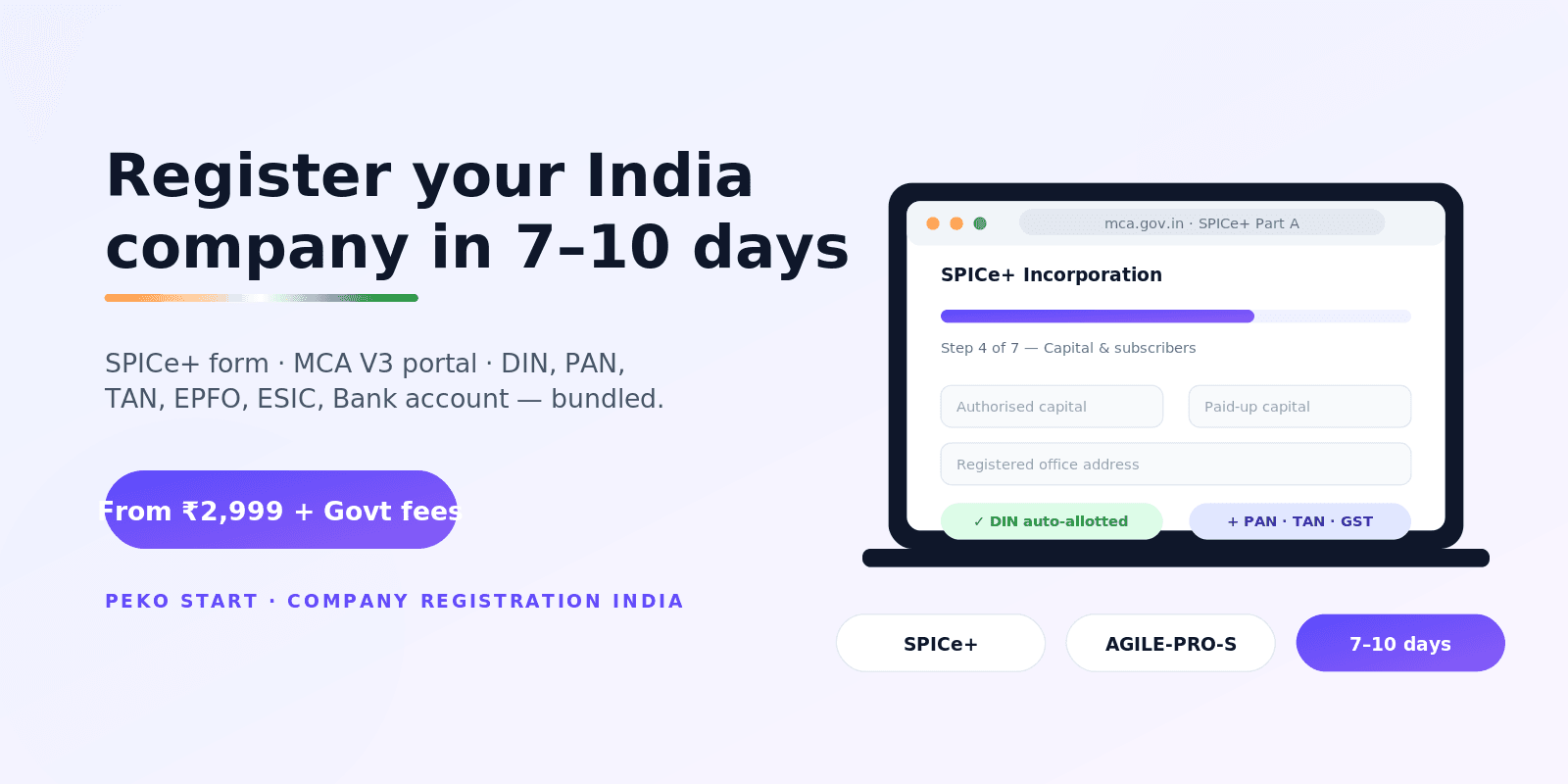
| Quick answer: If you're wondering how to register a company in India in 2026, the modern playbook is simple : choose a structure (Private Limited, LLP, or OPC), get a Class 3 Digital Signature Certificate (DSC) for each director, and file the SPICe+ web form on the MCA V3 portal. SPICe+ bundles name approval, incorporation, DIN allotment (for up to 3 directors), PAN, TAN, GSTIN, EPFO, ESIC, and a bank account opening into a single application. The full company registration in India 2026 process now takes 7–10 working days and costs between ₹7,000 and ₹25,000 for most startups, depending on state stamp duty and authorised capital. |
TL;DR for 2026
• Form used: SPICe+ (Part A + Part B), linked with INC-33 (e-MoA), INC-34 (e-AoA), and AGILE-PRO-S (INC-35)
• Timeline: 7–10 working days (vs 25–30 days a few years ago)
• Government fee: ₹0 for authorised capital up to ₹15 lakh (stamp duty extra; state-dependent)
• All-inclusive cost: ₹7,000–₹25,000 (DSC + stamp duty + professional fee)
• Resident director: At least 1 director must have stayed ≥182 days in India in the previous financial year
• Auto-issued at incorporation: DIN, PAN, TAN, Bank Account, EPFO, ESIC, GSTIN (optional)
What is the easiest type of company to register in India in 2026?
Before you file anything, the most important decision is which legal structure fits your business. The three structures that account for over 90% of new incorporation's are Private Limited, LLP, and OPC.
A Private Limited Company is the default choice for any business that plans to raise funding, hire equity-eligible staff, sell on marketplaces, or scale beyond a single founder. It needs a minimum of 2 directors and 2 shareholders, has limited liability, and is the most respected structure when dealing with banks, investors, and large customers.
A Limited Liability Partnership (LLP) is a smart pick for professional services firms - chartered accountants, consultants, agencies, law practices, doctors, and architects. It combines partnership flexibility with limited liability and has lighter annual compliance than a Pvt Ltd. LLPs cannot issue equity, so they are rarely a fit for venture-funded startups.
A One Person Company (OPC) is built for solo Indian founders who want corporate status without a co-founder. Only a resident Indian citizen can register an OPC - NRIs and foreign nationals are not eligible. OPCs convert to Private Limited automatically once paid-up capital crosses ₹50 lakh or turnover crosses ₹2 crore.
| Peko Start tip: |
If you're undecided, default to Private Limited. It scales the furthest, signals credibility from day one, and Peko Start can switch your structure later if needed. |
Private Limited vs LLP vs OPC: A 2026 comparison
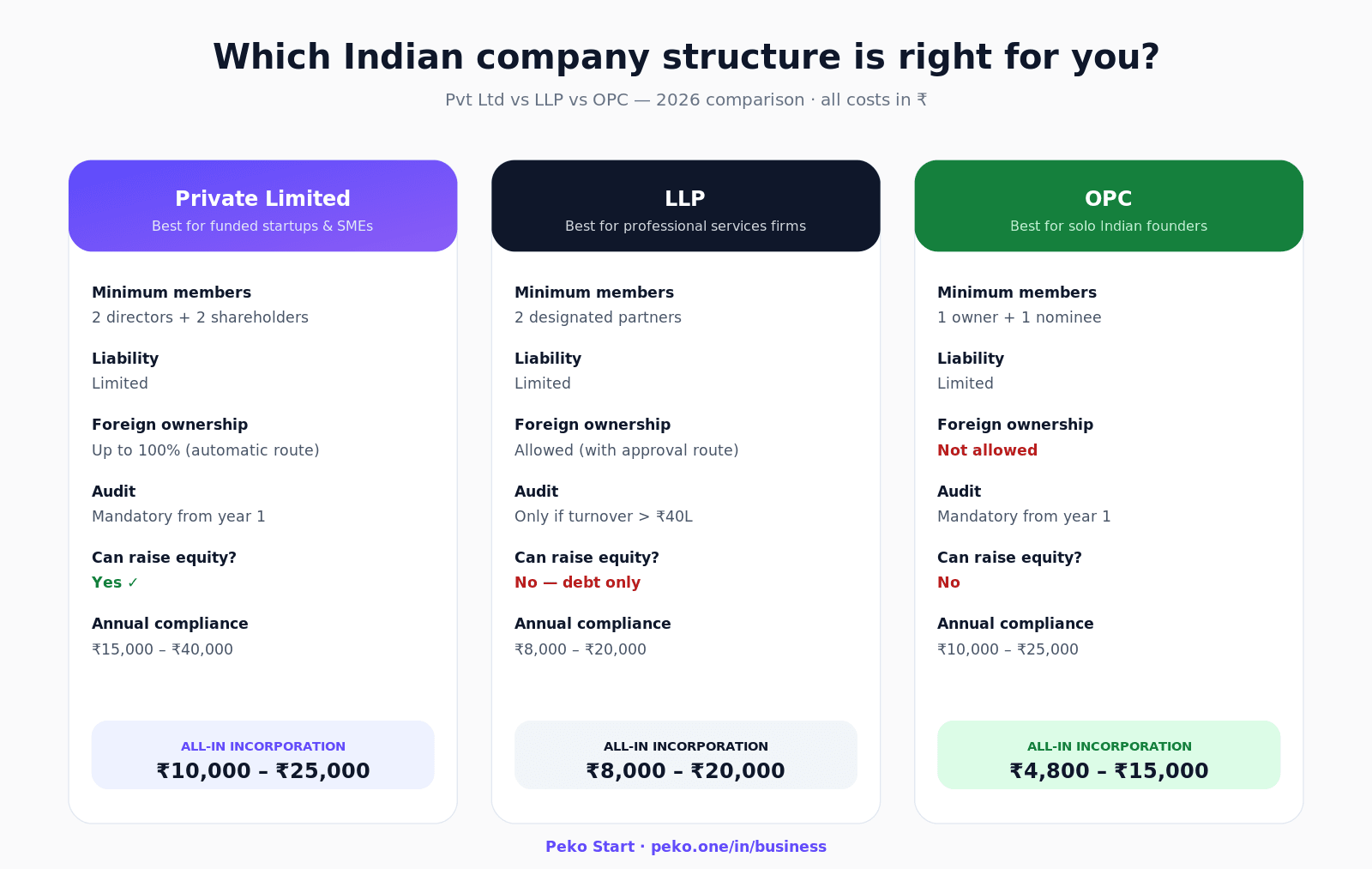
Choosing the right structure saves you from costly conversions later. Whether you're searching for Pvt Ltd company registration India, LLP registration India, or OPC registration India information, here's how the three popular options stack up in 2026:
| Parameter | Private Limited | LLP | OPC |
|---|---|---|---|
| Best for | Funded startups, SMEs, growth businesses | Professional firms, services | Solo Indian founders |
| Minimum members | 2 directors + 2 shareholders | 2 designated partners | 1 owner + 1 nominee |
| Minimum capital | No minimum | No minimum | No minimum |
| Liability | Limited | Limited | Limited |
| Foreign ownership | Up to 100% (automatic route, most sectors) | Up to 100% under automatic route in sectors where 100% FDI is permitted without performance conditions | Not allowed |
| Annual compliance cost | ₹15,000–₹40,000 | ₹8,000–₹20,000 | ₹10,000–₹25,000 |
| Audit requirement | Mandatory from year 1 | Only if turnover > ₹40 lakh or capital > ₹25 lakh | Mandatory from year 1 |
| Can raise equity? | Yes | No (debt only) | No |
| Conversion | Stays as Pvt Ltd | Can convert to Pvt Ltd | Auto-converts after capital/turnover thresholds |
| Incorporation cost (all-in) | ₹10,000–₹25,000 | ₹8,000–₹20,000 | ₹6,500–₹15,000 |
What documents do I need to register a company in India?
For 2026 SPICe+ filings, you need three buckets of documents. Keep clear scans (PDF, less than 1 MB each) ready before you start the form.
Identity & address of directors and shareholders - PAN card of each Indian director and shareholder - Aadhaar card of each Indian director (linked to mobile) - Passport (mandatory for foreign nationals and NRIs) - Latest bank statement, electricity bill, or telephone bill (less than 2 months old) as address proof - Recent passport-size photo
Registered office proof - Latest utility bill of the office address (electricity, gas, or telephone) not older than 60 days - No Objection Certificate (NOC) from the owner if it's a rented property - Rent agreement/sale deed copy
Company-specific declarations - INC-9 declaration (auto-generated inside SPICe+) - Subscriber sheet for the MoA and AoA - Consent letter from the nominee (only for OPC) - DPIN/DIN application data (auto-allotted inside SPICe+ for up to 3 first directors)
| NRI / Foreigner Note |
Passport and address proof must be notarised in your home country and apostilled under the Hague Convention. Countries outside the Convention require attestation at the Indian Consulate.
|
Step-by-step: How to register a company in India through MCA in 2026
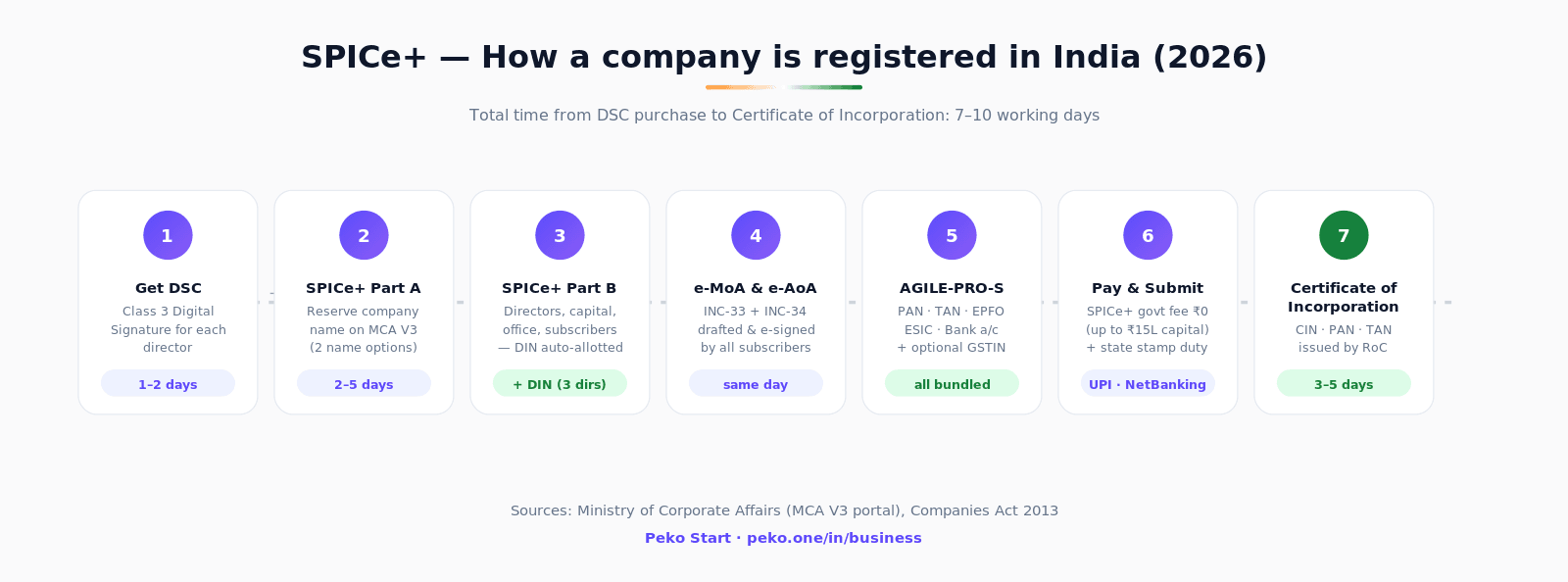
The Ministry of Corporate Affairs has consolidated everything into a single integrated form the SPICe+ form for company incorporation (Simplified Proforma for Incorporating Company Electronically Plus), filed on the MCA V3 portal. Here is the exact 7-step flow we run inside Peko Start.
Step 1 : Get a Class 3 Digital Signature Certificate (DSC) for every director and subscriber
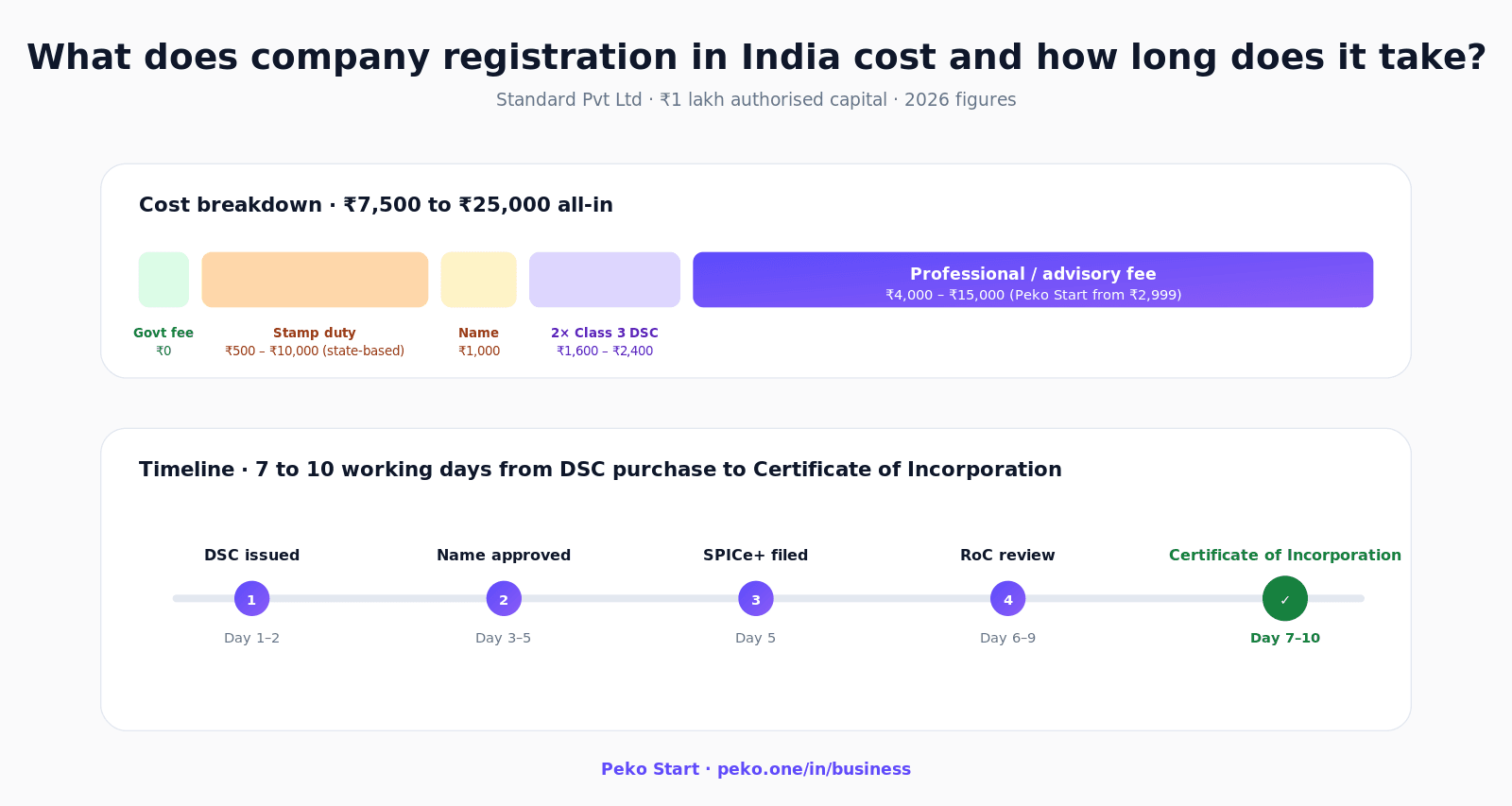
A Class 3 DSC is mandatory for signing all MCA filings. You can buy a 1-year DSC for ₹800–₹1,200 or a 2-year DSC for ₹1,200–₹1,800 per person from a licensed Certifying Authority (eMudhra, Sify, Capricorn). Timeline: 1–2 working days.
Step 2 : File SPICe+ Part A to reserve the company name
Log in to the MCA V3 portal, open SPICe+, and submit Part A. You can propose up to 2 names per application. The RoC checks them against the trademark database and the existing CIN registry. Name reservation costs ₹1,000 and is valid for 20 days once approved. Timeline: 2–5 working days.
Name approval rule of thumb: Make the name distinctive (avoid generic terms like "India Technologies"), avoid words that are restricted under Rule 8A (e.g., "Bank", "Insurance", "Stock Exchange" without regulator approval), and check the IP India trademark search first.
Step 3 : Fill SPICe+ Part B with company details
Once the name is approved, complete Part B with the registered office address, capital structure, directors' particulars, and shareholding pattern. Part B also auto-generates DIN for up to 3 first directors at zero extra cost.
Step 4 : Attach e-MoA (INC-33) and e-AoA (INC-34)
The Memorandum of Association captures your main and ancillary objects. The Articles of Association define internal governance rules. Both are filled directly inside SPICe+ as INC-33 and INC-34 for Private Limited and OPC companies. For LLPs the equivalent is the FiLLiP form with a separate LLP Agreement filed within 30 days of incorporation.
Step 5 : Submit AGILE-PRO-S (INC-35) for bundled registrations
AGILE-PRO-S is the single form that auto-creates your GSTIN (optional), EPFO, ESIC, profession tax (in eligible states), bank account, and the Shops & Establishments registration (in Maharashtra) at the same time as incorporation. This is the single biggest 2026 time-saver — what used to take 30+ days now happens with one form.
Step 6 : Pay government fee, stamp duty, and submit
For an authorised capital up to ₹15 lakh, the SPICe+ government fee is ₹0. Stamp duty is paid to the state where the registered office sites, it varies from ₹100 (Jammu & Kashmir) to ₹10,000+ (Madhya Pradesh) for a Pvt Ltd with ₹1 lakh capital. Payment is via UPI, net banking, or card on the MCA portal.
Step 7 : Receive your Certificate of Incorporation (COI)
The RoC reviews your application and, assuming no re-submission, issues the Certificate of Incorporation with your CIN, PAN, and TAN attached. The bank account is opened automatically with one of the partner banks selected in AGILE-PRO-S. Total elapsed time: 7–10 working days from DSC purchase to COI.
| Want all 7 steps handled for you? |
Peko Start runs the full SPICe+ filing, KYC, MoA/AoA drafting, and bank account setup from ₹2,999 + government fees. Start your Pvt Ltd registration →
|
How much does it cost to register a company in India in 2026?
Company registration cost in India has three layers, government fee + stamp duty + DSC + professional fee. Here is the realistic 2026 cost range for a standard 2-director, ₹1 lakh authorised capital company.
Stamp duty is the most variable cost. Maharashtra, Madhya Pradesh, and Punjab are on the higher side; Karnataka, Delhi, Jammu & Kashmir, and Tamil Nadu are on the lower side. If you have flexibility on where the registered office sits, Peko Start can show you a side-by-side state comparison. |
| See Peko's all-inclusive registration pricing → peko.one/in/pricing |
Can NRIs and foreign nationals register a company in India?
Yes. NRIs, OCIs, and foreign nationals can register a Private Limited company or an LLP in India, but not an OPC. They can hold up to 100% equity in most sectors under the FDI automatic route, which means no prior approval from the Government of India or RBI is required before investing.
There are three non-negotiable rules to remember:
- At least one director must be a resident of India, defined under Section 149(3) of the Companies Act as someone who has stayed in India for 182 days or more in the previous financial year.
- Form FC-GPR must be filed with RBI within 30 days of allotting shares to the foreign shareholder.
- The Indian company must file the FLA Return (Foreign Liabilities and Assets) with RBI by 15 July every year.
Sectors with caps or government route (defence, broadcasting, print media, multi-brand retail) need prior approval. A recent change on 2 May 2026 brought insurance companies and insurance intermediaries under the 100% FDI automatic route, subject to IRDAI compliance, a useful signal that India is actively widening the automatic-route net.
| Setting up your India entity from Dubai, Singapore, or the US? |
Peko Start handles apostille coordination, resident director sourcing, FC-GPR filing, and post-incorporation FEMA compliance end-to-end. Talk to a Peko India expert →
|
How to register your startup under Startup India / DPIIT in 2026
Once your company has its Certificate of Incorporation, you can apply for DPIIT Startup Recognition on the Startup India portal. Recognition is free and unlocks several material benefits:
- Section 80-IAC tax holiday: 100% deduction of profits for any 3 consecutive years in the first 10 years from incorporation (extended to first 20 years for Deep Tech startups under the new G.S.R. 108(E) notification dated 4 February 2026).
- Angel tax exemption under Section 56(2)(viib) - investments from registered investors are not treated as taxable income.
- 80% rebate on patent filing fees and 50% rebate on trademark fees.
- Self-certification under 9 labour laws and 3 environmental laws for the first 5 years.
- GeM access: Sell to government departments via the Government e-Marketplace without prior turnover or experience requirements.
- Fast-track winding up in 90 days if needed.
Eligibility (2026):
- Incorporated as a Pvt Ltd, LLP, or registered partnership firm
- Less than 10 years old from incorporation (12 years for biotech)
- Annual turnover under ₹200 crore (₹300 crore for Deep Tech)
- Working on innovation, improvement, scalability, or job/wealth creation
- Incorporated on or before 1 April 2030 to claim the 80-IAC benefit
Application processing target: 120 days for full review.
What happens after you receive your Certificate of Incorporation?
The COI is the start of the compliance calendar, not the end. In the first 30 days post-incorporation, you should:
- Open the company's current account (auto-initiated via AGILE-PRO-S, confirm with the partner bank)
- Issue share certificates and pay stamp duty on them (Form SH-1)
- Appoint a statutory auditor within 30 days (Form ADT-1)
- Hold the first board meeting within 30 days
- Apply for Professional Tax registration (if your state mandates it)
- Apply for MSME / Udyam registration (free, online, gives access to lower-rate loans and TReDS)
- Apply for GSTIN if you didn't bundle it in AGILE-PRO-S and turnover will exceed the threshold
GST threshold reminder (2026):
E-commerce sellers and inter-state suppliers must register from rupee one, there is no threshold for them.
| Peko Start's incorporation package includes the first year of Peko+ free - invoicing, payroll, expenses, compliance reminders, and statutory filings in one dashboard. See what's included → |
What is the cheapest legal way to register a company in India?
If your priority is the lowest cash outlay, here's the smart playbook:
- Pick OPC if you're a solo Indian founder : total cost can drop below ₹6,000 because there's only one director, one DSC, and lower stamp duty in many states.
- Use a virtual registered office : many co-working operators and Peko partners rent compliant addresses from ₹999/month, so you skip a long-term lease.
- Skip optional GSTIN: at AGILE-PRO-S if your turnover will stay below the threshold for year one, you can register the moment you cross it.
- Get DPIIT recognition early: to unlock the 80-IAC tax holiday, angel tax exemption, and 80% patent rebate.
Stick with a single-bundle service: like Peko Start so DSC, name search, MoA/AoA, SPICe+, AGILE-PRO-S, bank account, and PAN/TAN all happen for one transparent fee.
The lowest realistic, fully-legal all-in cost in 2026 for an Indian founder is about ₹4,800–₹6,500 (OPC) or ₹7,500–₹10,000 (Pvt Ltd) in low-stamp-duty states like Karnataka or Delhi.
Which state should you register your Indian company in?
The state where your registered office sits decides three things: stamp duty on your MoA/AoA, professional tax liability, and the RoC jurisdiction you'll deal with throughout the company's life. Stamp duty alone can swing the all-in cost by ₹5,000–₹8,000 between the cheapest and most expensive states for a Pvt Ltd with ₹1 lakh authorised capital.
The traditionally lower-stamp-duty states for new incorporations are Delhi, Karnataka, Tamil Nadu, and Jammu & Kashmir. Maharashtra, Madhya Pradesh, and Punjab tend to charge higher. If you're a remote-first founder, picking the registered office state strategically is a one-time decision that compounds over years. Peko Start runs a side-by-side state comparison as part of the onboarding call so you can lock in the cheapest legitimate option.
A second factor to weigh is post-incorporation ecosystem access: Karnataka and Telangana have active state-startup policies, Gujarat has GIFT City for IFSC entities, and Tamil Nadu runs StartupTN. The right state choice plus DPIIT recognition together can unlock state-level grants, fee waivers, and faster regulatory approvals.
Common mistakes to avoid in 2026
- Picking the wrong structure. A late conversion from LLP to Pvt Ltd because an investor demands equity will cost more than starting with Pvt Ltd in the first place.
- Skipping the trademark check. Names approved by MCA can still be blocked by a trademark holder later. Always cross-check at ipindia.gov.in before SPICe+ Part A.
- Ignoring the resident director rule. Foreign founders sometimes appoint a foreign-only board; the company then gets a Section 149 violation notice within months.
- Not paying stamp duty on share certificates. A ₹500 oversight, but it invalidates share ownership during due diligence.
- Missing FC-GPR or FLA deadlines. Each delayed day attracts FEMA penalty of up to 3× the contravention amount.
How Peko Start makes company registration in India effortless
Peko Start is the company registration service inside Peko, India's all-in-one business platform. We handle the entire SPICe+ flow - DSC, name approval, MoA/AoA, AGILE-PRO-S, bank account setup, and post-incorporation compliance, for one transparent fee starting at ₹2,999 + government fees.
What's bundled in every Peko Start incorporation:
- DSC for 2 directors
- SPICe+ Part A and Part B filing
- e-MoA (INC-33) and e-AoA (INC-34) drafting
- AGILE-PRO-S submission (PAN, TAN, EPFO, ESIC, bank account, optional GSTIN)
- Certificate of Incorporation collection
- First-year compliance calendar inside Peko+
- Invoicing, expense, and payroll modules unlocked for 12 months
- Dedicated incorporation advisor on WhatsApp
Result: Most Peko Start applications receive their Certificate of Incorporation in 7–10 working days, with bank account and PAN/TAN already attached. Once incorporated, the same Peko dashboard runs your day-to-day finance, payroll, invoicing, and compliance, so you never juggle 8 logins again.
| Ready to register your India company? |
| Get started with Peko Start → |
| See pricing → |
crosses
Ready to register your India company with Peko Start?
You've now seen the full SPICe+ flow, costs, timeline, and post-incorporation map. The smart next step is to talk to Peko Start, we'll pick the structure, file SPICe+, drop a clean Certificate of Incorporation in your inbox in 7–10 days, and pre-load your dashboard with everything you need to run the business from day one.
Sources: Ministry of Corporate Affairs (MCA V3 portal); Startup India — DPIIT Recognition; Section 80-IAC application; SPICe+ Part A & Part B guide; GST registration thresholds — ClearTax; FEMA Non-debt Instruments Amendment Rules 2026 — TaxGuru; DPIIT 80-IAC framework PIB release.