


Apr 01, 2026
WPS Salary Transfer Process UAE - Complete Guide 2026

Share this article
- What Is the Wage Protection System (WPS)?
- Who Needs to Register for WPS in the UAE?
- How Does the WPS Salary Transfer Process Work?
- Step 1: Employer Registration with MOHRE
- Step 2: Selecting a WPS Agent
- Step 3: Generating the Salary Information File (SIF)
- Step 4: Submitting the SIF to the WPS Agent
- Step 5: Salary Disbursement to Employee Accounts
- Step 6: MOHRE Confirmation and Record
- What Is a SIF File and How Is It Generated?
- WPS Approved Agents and Financial Institutions
- WPS Salary Transfer Deadlines and Compliance
- Penalties for WPS Non-Compliance
- How to Simplify WPS Payroll with Automation
- WPS and Corporate Tax Compliance
- Frequently Asked Questions About WPS In UAE
- What is WPS in the UAE?
- Is WPS mandatory for all companies in the UAE?
- How does the WPS salary transfer process work?
- What is a SIF file in WPS?
- What are the penalties for WPS non-compliance?
- How long does the WPS salary transfer take?
- Can small companies with few employees use WPS?
- What are the fees associated with WPS salary transfer?
- Conclusion
Quick Summary:
WPS isn’t optional in the UAE. It’s how salaries must be paid.
To stay compliant, businesses need to generate a SIF file, submit it through an approved bank or exchange, and ensure employees are paid accurately and on time. Every transaction is tracked by MOHRE, so errors or delays don’t go unnoticed.
Miss deadlines or submit incorrect data?
You’re looking at penalties, restrictions, and payroll chaos.
That’s why businesses are moving away from manual payroll and switching to automated systems that handle SIF generation, salary processing, and compliance, all in one place.
Every employer operating in the UAE's private sector is required to pay employee salaries through the Wage Protection System, commonly known as WPS. Introduced by the Ministry of Human Resources and Emiratisation (MOHRE), the WPS salary transfer process is an electronic system designed to bring transparency, accuracy, and timeliness to how wages are disbursed across the country.
Whether you are setting up a new company in the UAE or managing payroll for an established business, understanding how WPS works is not optional, it is a regulatory requirement. Non-compliance can lead to penalties, operational disruptions, and reputational risk.
This guide walks you through the complete WPS salary transfer process, from registration and SIF file generation to approved agents, deadlines, penalties, and how payroll automation can simplify compliance for UAE businesses in 2026.
What Is the Wage Protection System (WPS)?
The Wage Protection System (WPS) is an electronic salary transfer system mandated by the UAE government. It requires private-sector employers to pay employee wages through approved banks, financial institutions, and exchange houses rather than through cash or informal channels.
The system was introduced by MOHRE to protect workers' rights and ensure that salaries are paid in the correct amount, on time, and in accordance with employment contracts. It is governed by Ministerial Resolution No. (598) of 2022 Regarding the Wages Protection System and Its Amendments, along with Ministerial Resolution No. (675) of 2022, which expanded the scope of WPS to cover specific domestic worker categories on a mandatory basis, with optional application to remaining occupations within the domestic workers category.
In practical terms, WPS creates a verifiable digital record every time an employer transfers salaries. MOHRE monitors these records to identify late payments, underpayments, or non-payments and can take enforcement action accordingly.
For businesses, this means salary disbursement is no longer just an internal payroll function. It is a regulated, auditable process that directly affects your company's compliance standing with UAE labour authorities.
Who Needs to Register for WPS in the UAE?
WPS applies to companies registered with the Ministry of Human Resources and Emiratisation (MOHRE), subject to applicable exemptions and regulatory scope. This includes businesses operating across mainland and free zone structures, though specific requirements may vary based on the licensing authority and jurisdiction.
A common misconception is that WPS only applies to large employers. That is not the case. WPS is mandatory for all registered companies where applicable, regardless of size. Whether you have five employees or five hundred, if your company falls under MOHRE's regulatory scope, salary payments must go through the WPS channel.
The system also extends to specific domestic worker categories on a mandatory basis, following Ministerial Resolution No. (675) of 2022, with optional application to remaining occupations within this category.
If you are in the process of forming a new company, WPS registration becomes part of your post-formation compliance checklist alongside obtaining your trade license, processing visas, and ensuring your documentation is in order.
How Does the WPS Salary Transfer Process Work?
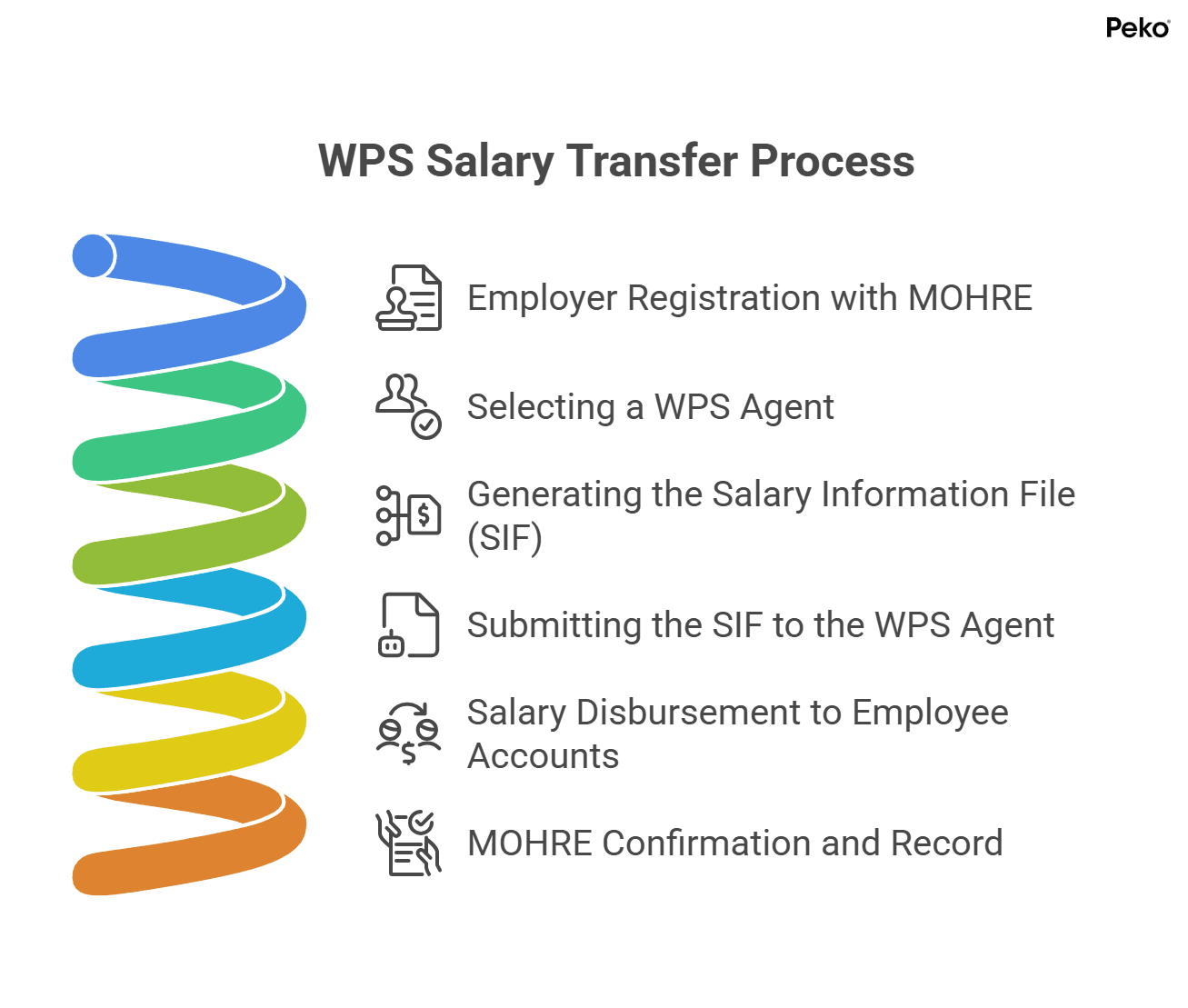
The WPS salary transfer process follows a structured sequence that connects the employer, an approved financial institution (the WPS agent), and MOHRE. Here is how the process works, step by step.
Step 1: Employer Registration with MOHRE
Before using WPS, the employer must be registered with the Ministry of Human Resources and Emiratisation. This registration links the company's labour card and employee records to the WPS system, enabling MOHRE to monitor salary payments.
Step 2: Selecting a WPS Agent
The employer selects an approved WPS agent, a bank, financial institution, or exchange house authorised by the UAE Central Bank and MOHRE to process salary transfers. The choice of agent depends on factors such as fees per employee, processing timelines, and service coverage.
Step 3: Generating the Salary Information File (SIF)
The employer prepares a Salary Information File (SIF), which is a structured data file that contains salary details for each employee. This includes employee identification numbers, salary amounts, bank account details, and the payment period. The SIF file is the core document that drives the WPS transfer.
Step 4: Submitting the SIF to the WPS Agent
The completed SIF file is submitted to the chosen WPS agent. The agent validates the file, checks for formatting accuracy and completeness, and initiates the salary transfers to employee bank accounts.
Step 5: Salary Disbursement to Employee Accounts
Once the WPS agent processes the SIF, salaries are transferred to each employee's designated bank account. Processing timelines depend on submission accuracy, cut-off times, and the bank or service provider's schedules.
Step 6: MOHRE Confirmation and Record
After the transfers are completed, the WPS agent reports the transaction data back to MOHRE. This creates a verifiable record that the employer has fulfilled its salary obligations for that payment period. MOHRE uses this data to track compliance and identify any delays or discrepancies.
What Is a SIF File and How Is It Generated?
The Salary Information File (SIF) is the standardised data file that employers submit to their WPS agent to initiate salary transfers. Think of it as the payroll instruction sheet that tells the financial institution exactly how much to pay each employee and where to send the funds.
A SIF file typically contains the employee's labour card number or identification, the salary amount to be transferred, the employee's bank account or financial card details, and the payment period. The file must follow a specific format recognised by the WPS system, and any formatting errors or data mismatches can delay processing.
For businesses managing payroll manually, generating a SIF file each month involves compiling salary data from multiple sources: HR records, attendance systems, overtime calculations, deductions, and reimbursements. This is where errors tend to occur, and where automated accounting and payroll tools can make a measurable difference.
Platforms like Peko support SIF file maintenance as part of their WPS payroll processing workflows. By centralising employee data, salary information, and calculation rules in one system, the process of generating accurate SIF files becomes significantly more streamlined reducing the risk of rejection or delay at the agent level.
Get started with WPS payroll on Peko Apply for free
WPS Approved Agents and Financial Institutions
Not every bank or exchange house can process WPS salary transfers. Only institutions approved by the UAE Central Bank and listed as strategic partners by MOHRE are authorised to act as WPS agents.
As listed on the official MOHRE Wages Protection System page, the current approved partner financial institutions include Al Ansari Exchange, LuLu Money (LuLu Exchange), GCC Exchange, Botim (Astra Tech), M Bank, and Etisalat, among others. Each of these agents has its own fee structures, processing schedules, and support channels.
When choosing a WPS agent, employers should consider the per-employee transaction fees, processing speed and cut-off times, customer support availability for payroll-related issues, and compatibility with the employer's existing payroll system or platform.
It is worth noting that fees vary depending on the service provider or bank partner, and are typically charged on a per-employee basis. Employers should evaluate these costs as part of their overall payroll operations budget, particularly SMEs managing costs carefully during their early growth stages.
WPS Salary Transfer Deadlines and Compliance
UAE labour law requires private-sector employers to pay employee wages on a monthly basis, in the amount and at the time agreed upon in the employment contract, through the Wage Protection System. This means WPS is not simply a recommended channel, it is the legally mandated method of salary disbursement.
The actual processing timeline for each salary transfer depends on several factors: the accuracy of the submitted SIF file, the WPS agent's cut-off times, and the bank or service provider's internal processing schedules. Employers should note that processing timelines are not guaranteed and can vary from cycle to cycle.
To maintain compliance, employers should establish a consistent payroll calendar that accounts for these variables. Submitting the SIF file well ahead of the agent's cut-off window reduces the risk of delays. Keeping employee records updated particularly bank account details and salary changes also helps prevent file rejections.
Employers remain responsible for reviewing payroll submissions and resolving any issues related to salary processing. Where discrepancies arise, early identification and correction are critical to avoiding escalation.
Penalties for WPS Non-Compliance
Failing to pay salaries through WPS, or consistently paying late, carries consequences. MOHRE actively monitors WPS records and can take enforcement action against employers who do not meet their obligations.
The specific nature of penalties can include restrictions on new work permit applications, suspension of company services through MOHRE, and in serious cases, referral to judicial authorities. The severity of consequences typically escalates based on the duration and extent of non-compliance; isolated late payments are treated differently from systematic non-payment.
Beyond regulatory action, WPS non-compliance also affects employer reputation. Employee disputes, labour complaints, and public records of enforcement actions can damage a company's standing with clients, partners, and prospective employees.
For growing businesses and SMEs, the simplest way to avoid these risks is to embed WPS compliance into a structured payroll workflow rather than treating it as a last-minute monthly task. This is where payroll automation becomes not just a convenience, but a compliance safeguard.
How to Simplify WPS Payroll with Automation
Managing WPS manually, compiling salary data from spreadsheets, calculating overtime and deductions by hand, formatting SIF files, and chasing agent deadlines is time-consuming and prone to errors. For SMEs without dedicated payroll teams, this monthly cycle can consume hours that would be better spent on core business operations.
Payroll automation addresses these challenges by centralising the entire process. Peko's WPS Payroll & HR platform is designed to support businesses through the WPS salary transfer process with tools and workflows that help align payroll operations with applicable regulations.
Here is what the platform offers, based on its published features:
Automated salary calculations: Peko supports automated calculations for salaries, overtime, bonuses, increments, reimbursements, deductions, and end-of-service benefits, based on employer inputs and configured rules. Employers remain responsible for reviewing calculations, including statutory entitlements.
WPS compliance support: The platform provides tools and workflows designed to support alignment with applicable WPS regulations. This includes salary record maintenance through SIF files and salary status tracking for employees.
Employee management: Add and manage employee profiles, salary information, leave tracking, documents, and allocated assets from one centralised dashboard.
Getting started on Peko is straightforward: Log in, navigate to Payroll or WPS under More Services, complete the company verification process, add your company and employee details, and begin managing payroll.
According to Peko's published estimates, businesses can save up to 10+ hours monthly on payroll processing alone. That is time redirected from administrative overhead to business operations and growth.
For a deeper look at optimising your payroll workflows, see: Best practices for WPS Payroll and employee management and Streamlining payroll and HR processes for SMEs with Peko's smart workflows.
WPS and Corporate Tax Compliance
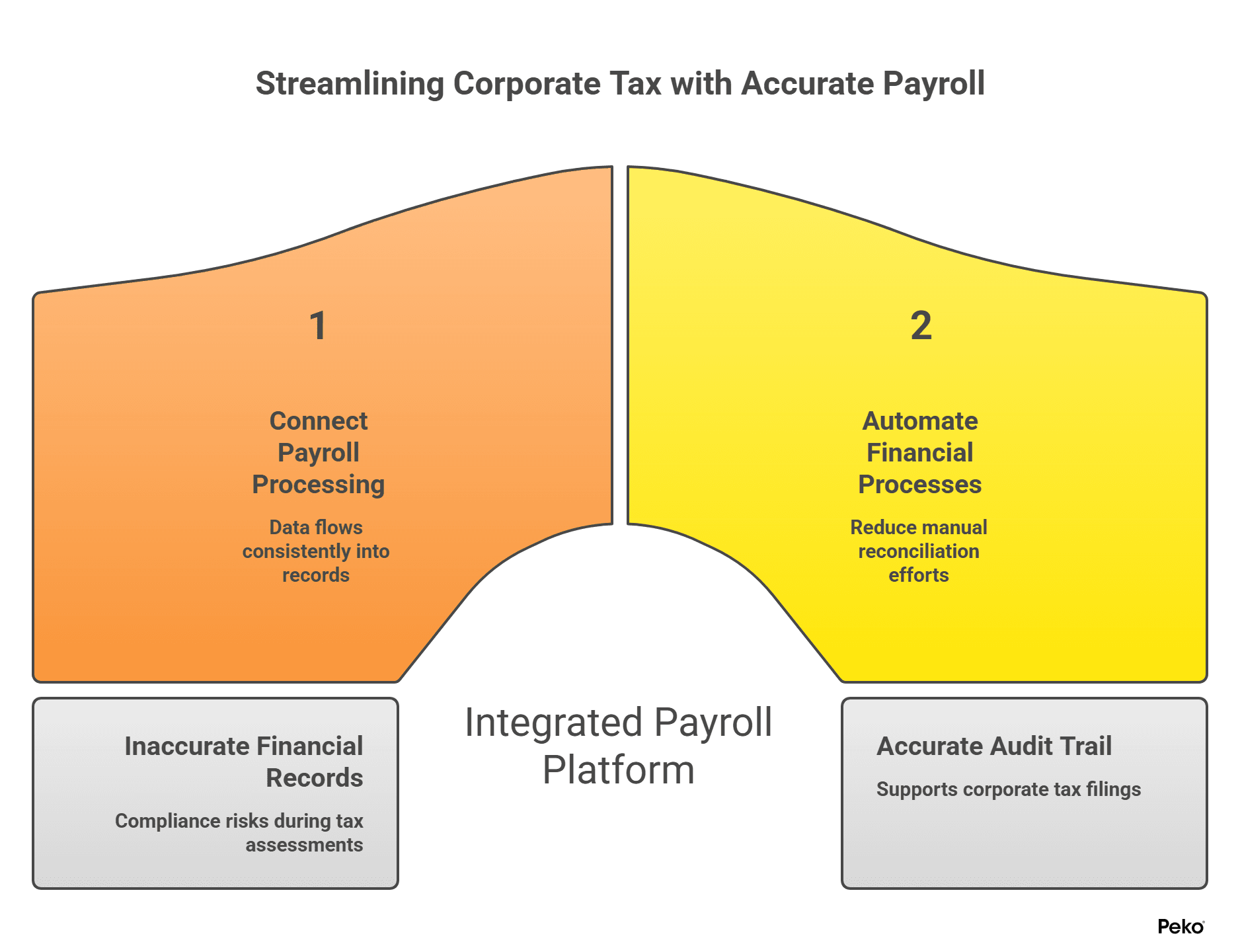
Since the introduction of the UAE's 9% corporate tax, maintaining accurate financial records has become more important than ever. Payroll is one of the largest operating expenses for most businesses, and the records generated through WPS directly feed into financial reporting and tax obligations.
Accurate WPS payroll records including salary amounts, deductions, end-of-service provisions, and overtime provide a clear audit trail that supports corporate tax filings. Discrepancies between payroll records and financial statements can create compliance risks during tax assessments.
By using an integrated platform that connects payroll processing with accounting and financial automation, businesses can ensure that salary data flows consistently into their financial records without manual reconciliation.
For a complete guide on registering for and managing corporate tax obligations, see: Corporate Tax Registration UAE: 25 Questions Every Business Owner Asks.
Frequently Asked Questions About WPS In UAE
What is WPS in the UAE?
The Wage Protection System (WPS) is an electronic salary transfer system mandated by MOHRE. It requires UAE private-sector employers to pay employee wages through approved banks, financial institutions, and exchange houses, ensuring transparency and timely payment in line with employment contracts.
Is WPS mandatory for all companies in the UAE?
WPS applies to companies registered with MOHRE, subject to applicable exemptions and regulatory scope. It is mandatory for all registered companies where applicable, regardless of company size. The system has also been expanded to cover specific domestic worker categories.
How does the WPS salary transfer process work?
The process involves six steps: employer registration with MOHRE, selecting an approved WPS agent, generating a Salary Information File (SIF) with employee salary details, submitting the SIF to the agent, salary disbursement to employee bank accounts, and MOHRE confirmation of the transaction records.
What is a SIF file in WPS?
A SIF (Salary Information File) is a standardised data file that contains each employee's identification, salary amount, bank account details, and payment period. Employers submit this file to their WPS agent to initiate salary transfers. Payroll platforms like Peko can help streamline SIF file generation and maintenance.
What are the penalties for WPS non-compliance?
Consequences for failing to pay salaries through WPS can include restrictions on new work permit applications, suspension of MOHRE services, and in serious cases, referral to judicial authorities. The severity depends on the duration and extent of non-compliance.
How long does the WPS salary transfer take?
Processing timelines depend on the accuracy of the submitted SIF file, the WPS agent's cut-off times, and bank or service provider schedules. Timelines are not guaranteed and can vary between payment cycles.
Can small companies with few employees use WPS?
Yes. WPS is mandatory for all MOHRE-registered companies where applicable, regardless of the number of employees. Whether a business has five employees or five hundred, the salary transfer obligation through WPS remains the same.
What are the fees associated with WPS salary transfer?
Fees vary depending on the WPS agent or bank partner selected and are typically charged on a per-employee basis. Employers should compare agent fee structures as part of their payroll cost planning.
Conclusion
The WPS salary transfer process is a foundational compliance requirement for every private-sector employer in the UAE. From understanding what WPS is and who it applies to, through the step-by-step process of generating SIF files and working with approved agents, to staying ahead of deadlines and avoiding penalties, each element of this process directly affects your business's operational and legal standing.
The good news is that WPS compliance does not have to be a manual, time-consuming burden. With the right payroll platform in place, businesses can automate salary calculations, streamline SIF file generation, track payment status, and maintain the structured records that support both WPS and corporate tax obligations.
Peko's WPS Payroll & HR platform is built to help UAE businesses from startups to scaling enterprises navigate payroll and employee management with greater clarity and efficiency.
Ready to simplify your WPS payroll process? Book a demo with Peko and see how the platform supports your payroll and HR operations.