


Jul 24, 2026
Manufacturing Companies in UAE: Complete Guide (2026)
Share this article
- UAE Industrial Guide 2026: Manufacturing Companies by Sector
- The State of Manufacturing in the UAE Right Now
- Key Manufacturing Free Zones in the UAE
- Manufacturing Companies in UAE by Sector
- Top Manufacturing Companies in UAE and Dubai
- Which Industries and Audiences This Applies To
- Workforce and Payroll Compliance for Manufacturing Employers in UAE
- Why the UAE Leads in Global Manufacturing
- FAQ About Manufacturing Companies In The UAE
- Final Thoughts
UAE Industrial Guide 2026: Manufacturing Companies by Sector
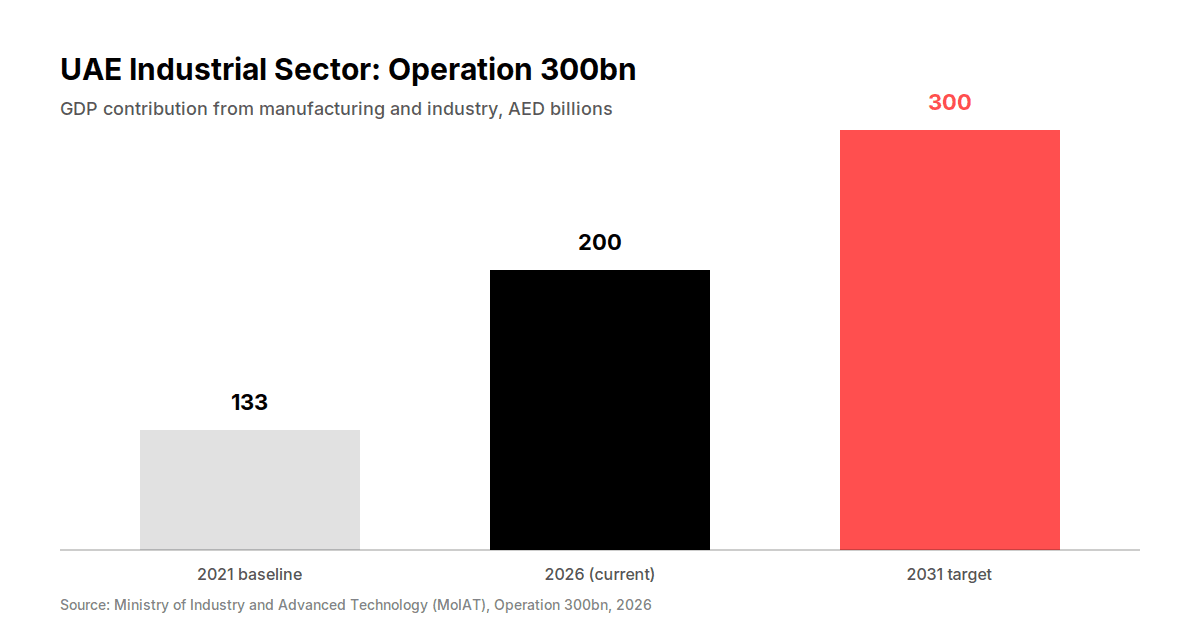
UAE industrial GDP contribution: AED 133bn (2021 baseline) to AED 200bn (2026) toward a AED 300bn target by 2031. Source: MoIAT, Operation 300bn.
The UAE's industrial base has quietly become one of the most active manufacturing hubs outside East Asia. Search "manufacturing companies in UAE" and you'll mostly find company databases and Wikipedia categories; what's missing is a clear picture of who's actually building what, where they're doing it, and what running a manufacturing workforce here now requires. This guide covers all three.
The State of Manufacturing in the UAE Right Now
The UAE's industrial sector contributed AED 200 billion to GDP in 2026, a jump of roughly 70% since Operation 300bn launched in 2021 with a target of AED 300 billion by 2031. Industrial exports have climbed alongside it, hitting AED 262 billion, with AED 92 billion of that coming from advanced manufacturing categories like electronics and precision components.
That growth didn't happen by accident. The Ministry of Industry and Advanced Technology built Operation 300bn around direct financing: the Emirates Development Bank set aside AED 30 billion specifically for priority industrial sectors, targeting 13,500 SMEs and 25,000 new jobs. Add the “Make it in the Emirates” campaign, which pushes local sourcing and import substitution, and you get a policy environment that's unusually aggressive about building manufacturing capacity rather than just talking about diversification.
For a small manufacturer weighing whether to set up here, that AED 30 billion figure matters more than the headline GDP number. It's real, allocated capital chasing specific sectors: petrochemicals, plastics, machinery, electrical equipment, pharmaceuticals, and food security. If your business sits in one of those categories, you're not competing for attention in a vague “growth story”, you're inside a funded national priority.
The “Make it in the Emirates” campaign runs alongside Operation 300bn and does something slightly different: it pushes government and large private buyers to actually source locally, not just fund local production. That distinction matters. A subsidy gets a factory built; a procurement mandate gets that factory's output bought. Together, they explain why industrial exports have climbed to AED 262 billion rather than staying a domestic-only story.
Key Manufacturing Free Zones in the UAE
Most manufacturing companies in UAE set up inside one of a handful of purpose-built industrial zones, and the right one depends more on which port you need than on cost alone. JAFZA serves Jebel Ali Port and Dubai's shipping volumes; KEZAD serves Khalifa Port and Abu Dhabi's heavy industry base.
Jebel Ali Free Zone (JAFZA) anchors Dubai's manufacturing and logistics activity, built around direct access to Jebel Ali Port, one of the busiest container ports in the world. It suits manufacturers who need fast export routes to Europe, Africa, and South Asia.
Khalifa Economic Zones Abu Dhabi (KEZAD), formerly known as Khalifa Industrial Zone Abu Dhabi (KIZAD), was formed in 2022 when KIZAD merged with ZonesCorp under AD Ports Group. It now spans roughly 550 square kilometres and remains the anchor for heavy industry: steel, aluminium, and petrochemicals cluster there because of its proximity to Khalifa Port and Abu Dhabi's energy assets. Both names, KIZAD and KEZAD, still show up interchangeably in commercial use.
Dubai Industrial City targets mid-size manufacturers in food processing, building materials, and machinery, with lower entry costs than JAFZA and a location built specifically around industrial rather than mixed-use operations.
Choosing between them usually comes down to what you're shipping and to whom. A heavy industrial exporter feeding steel or aluminium into Asian and African markets fits KEZAD's port access and existing supplier cluster better than fighting for space in Dubai. A consumer goods or food brand selling into the GCC retail market, by contrast, often gets more value from JAFZA's logistics density and Dubai's distribution networks than from Abu Dhabi's heavier industrial focus.
Manufacturing Companies in UAE by Sector
No single company defines UAE manufacturing the way, say, a national carrier defines aviation here. It's a genuinely broad base, and the useful way to look at it is sector by sector, since that's also how the government's own funding priorities are structured.
Steel and Metal Manufacturing Companies in UAE
The metals sector is the most consolidated part of UAE manufacturing, dominated by a small number of large, state-backed producers. EMSTEEL (rebranded from Emirates Steel Arkan in 2024, itself the 2021 merger of Emirates Steel and Arkan Building Materials) now operates through two divisions, Emirates Steel and Emirates Cement, and is the country's largest publicly listed steel and building materials company. Emirates Global Aluminium (EGA) runs one of the largest single-site aluminium smelting operations anywhere, supplying automotive, aerospace, and construction industries worldwide. Ducab, founded in 1979 and jointly owned by the Investment Corporation of Dubai and Senaat, manufactures copper and aluminium cable across six UAE facilities and exports to more than 75 countries.
Aerospace and Defense Manufacturing
Strata Manufacturing, based in Al Ain, produces composite aircraft components for Airbus and Boeing, positioning the UAE inside the actual supply chain of two of the world's largest aircraft makers rather than just assembling finished imports. It's a rare case of a Gulf manufacturer competing on precision engineering, not just scale or cheap inputs.
Food and Beverage Manufacturing Companies in UAE
Agthia Group produces bottled water, dairy, and packaged foods across the region and has been actively acquiring smaller regional food brands to build out its portfolio. National Food Products Company (NFPC) and regional dairy producers round out a sector that Operation 300bn explicitly targets under its food security priority, since the UAE imports a large share of its food and has real strategic reasons to grow domestic processing capacity.
Pharmaceutical Manufacturing Companies in UAE
Julphar (Gulf Pharmaceutical Industries), headquartered in Ras Al Khaimah, is one of the region's oldest and largest pharmaceutical manufacturers, producing generic medicines for markets across the Middle East and Africa. Pharma sits on the Operation 300bn priority list too, which is worth knowing if you're scouting where UAE industrial incentives concentrate next.
Chemicals and Plastics Manufacturing
Borouge, a joint venture between ADNOC and Borealis, is the UAE's largest petrochemical and plastics manufacturer, producing polyolefins used in everything from packaging to construction materials. The chemicals sector benefits directly from the UAE's upstream oil and gas base, giving it a feedstock advantage that food or electronics manufacturers don't have.
FMCG and Electronics Manufacturing in UAE
FMCG manufacturing in the UAE tends to be smaller-scale and more fragmented than steel or petrochemicals, built around packaging, personal care, and household goods production feeding both the domestic market and re-export trade through Jebel Ali. Electronics manufacturing is thinner still, mostly component assembly and cable production (Ducab again shows up here) rather than the semiconductor-scale manufacturing you'd find in East Asia. Neither sector produces a single dominant national champion the way steel or aluminium does, which is itself telling: it's where new entrants have the most realistic shot at building genuine market share rather than competing against an entrenched, state-backed incumbent.
Top Manufacturing Companies in UAE and Dubai
Which Industries and Audiences This Applies To
This breakdown is most useful for a specific set of readers, not just anyone curious about the UAE economy. Industrial investors scoping where to set up a new facility need the free zone and sector data. Finance and HR leads inside existing manufacturing companies in UAE need the compliance section below, since payroll rules changed materially in mid-2026. Procurement teams sourcing from UAE-based suppliers benefit from knowing which companies are genuinely large-scale producers versus smaller regional players. And investors or analysts tracking Operation 300bn progress get a sector-by-sector view that a Wikipedia category page won't give them.
Workforce and Payroll Compliance for Manufacturing Employers in UAE
Manufacturing employs a large blue-collar and shift-based workforce in the UAE, which makes Wage Protection System compliance a bigger operational risk here than in office-based industries, and the rules just changed. MOHRE's Ministerial Resolution No. 340 of 2026, effective 1 June 2026, replaced the previous 2022 framework and tightened several things manufacturing employers need to know now, not later.
The new resolution sets a unified wage due date on the first day of each Gregorian month for the previous month's work, and it removed the old 30-day grace period that used to apply to new employees. An establishment is only considered compliant if it transfers at least 85% of total wages due by that date. Miss the threshold and penalties escalate fast, as shown below.
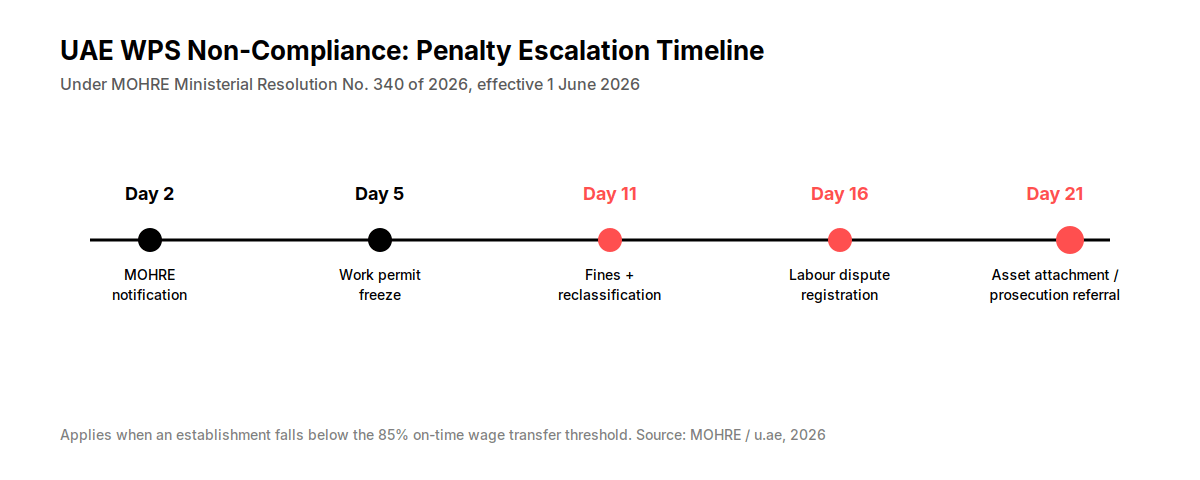
UAE WPS penalty escalation timeline under MOHRE Ministerial Resolution No. 340 of 2026. Source: MOHRE / u.ae.
For a manufacturing company running three shifts and a workforce heavy on visa-sponsored labour, that timeline leaves very little room for a payroll error to quietly resolve itself. A single missed SIF submission during a production ramp-up, an ERP migration, or a busy quarter-end can trigger the whole escalation chain before anyone notices. This is exactly where payroll infrastructure built for UAE compliance, rather than adapted from a generic global system, earns its cost. Peko's payroll and WPS tools are built around this specific resolution and its deadlines, which matters more for manufacturing employers than almost any other sector given the workforce size involved.
This section reflects MOHRE Ministerial Resolution No. 340 of 2026 as of publication. Wage and labour regulations change; confirm current requirements against MOHRE's official guidance or a UAE employment lawyer before making compliance decisions.
Why the UAE Leads in Global Manufacturing
Three things explain the UAE's rise as a manufacturing base faster than most competitors in the region: funded government incentives rather than tax breaks alone, deep-water port infrastructure at both JAFZA and KEZAD, and an early, serious push into Industry 4.0 automation and robotics. None of this is unique in isolation. Singapore has ports, Saudi Arabia has funding, Vietnam has labour costs. The UAE's advantage is running all three at once, inside a single, small, easy-to-navigate regulatory environment.
That combination is also why Operation 300bn's numbers keep climbing rather than plateauing after an initial burst. A funded pipeline of SME support, plus infrastructure that's already built, tends to compound in ways a pure tax-incentive strategy doesn't.
Two examples make this concrete. E7 Group started as a printing press and has rebuilt itself into a diversified industrial player making secure passports, SIM cards, and pharmaceutical packaging, explicitly framing its own transformation as an Operation 300bn case study. ROX, an electric vehicle manufacturer, has set a 2030 production target it says will account for roughly 10% of the entire Operation 300bn goal on its own. Neither company existed in its current industrial form five years ago. That's a faster pace of new-entrant manufacturing capacity than most regional competitors are producing right now.
FAQ About Manufacturing Companies In The UAE
What is the largest manufacturing company in the UAE?
EMSTEEL, formerly Emirates Steel Arkan, is the UAE's largest publicly listed steel and building materials manufacturer, formed from the 2021 merger of Emirates Steel and Arkan Building Materials and rebranded under its current name in 2024.
How many manufacturing companies are there in the UAE?
There's no single official count, since the figure depends on how narrowly “manufacturing” is defined and whether small workshops and contract manufacturers are included. Government data ties the sector to over 13,500 SMEs targeted for support under Operation 300bn's Emirates Development Bank financing alone, which gives a sense of scale beyond the large, well-known names.
What are the main manufacturing sectors in Dubai versus Abu Dhabi?
Dubai's manufacturing base, concentrated in JAFZA and Dubai Industrial City, leans toward logistics-linked and consumer-facing production: food processing, building materials, and general goods. Abu Dhabi, centred on KEZAD, hosts the UAE's heavy industry: steel, aluminium, and petrochemicals, largely because of its proximity to energy assets and Khalifa Port.
Do manufacturing companies in the UAE need to comply with WPS?
Yes. Wage Protection System compliance applies to all private-sector mainland employers registered with MOHRE, with no size exemption remaining as of the 2026 update, and most free zones align with or run parallel versions of the same requirement.
How is Operation 300bn changing the UAE's manufacturing sector?
Operation 300bn is directing real allocated capital, including a AED 30 billion Emirates Development Bank fund, toward priority manufacturing sectors like pharmaceuticals, food processing, and advanced electronics, rather than relying on general tax incentives alone. The sector has already grown 70% toward its 2031 target since the strategy launched in 2021.
Final Thoughts
The manufacturing companies in UAE that actually matter, EMSTEEL, EGA, Ducab, Strata, Agthia, Julphar, Borouge, aren't hiding. What's harder to find is the connection between who they are and what running a manufacturing workforce here actually requires in 2026, especially on payroll. That gap is where most of the existing content on this topic stops short, and it's the part worth getting right if you're actually operating in this sector rather than just researching it from outside.
If you're setting up or already running a manufacturing operation in the UAE, the compliance side isn't optional reading. It's worth a direct look at how your current payroll setup handles the new WPS deadlines before the next pay cycle, not after a notification shows up from MOHRE.