


- Blogs
- WPS Payroll and HR
- Best Payroll Software for Small Businesses in India: A Complete 2026 Guide
May 20, 2026
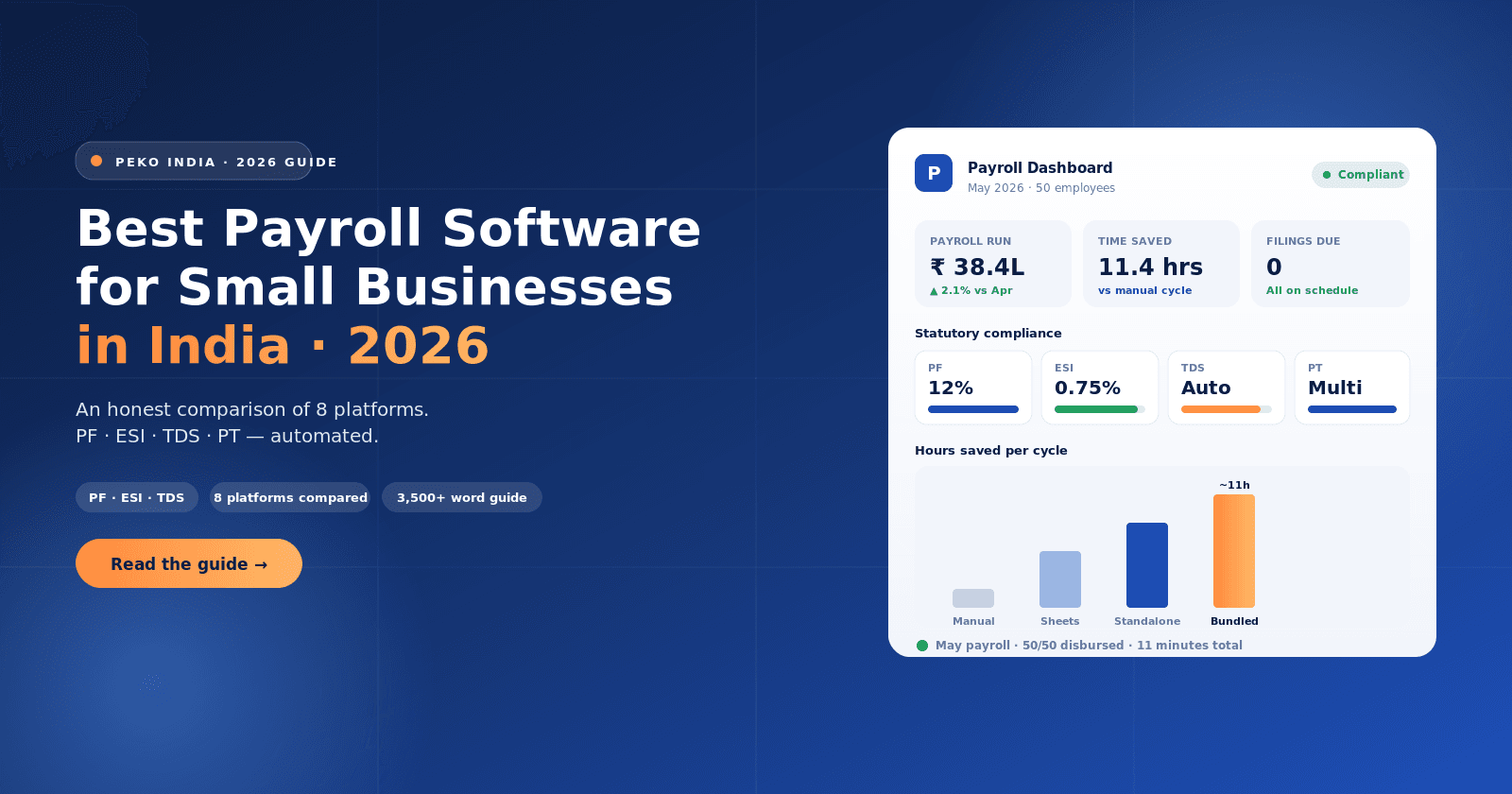
Best Payroll Software for Small Businesses in India: A Complete 2026 Guide

Share this article
- Quick Answer (TL;DR)
- The Payroll Mistake That Costs Indian SMEs Thousands
- Why Indian SMEs Need Modern Payroll Software in 2026
- What to Look For in Payroll Software for Indian SMEs
- Top 8 Payroll Software for Small Businesses in India (2026)
- Payroll Software India — Comparison Table (2026)
- How Payroll Software Handles PF, ESI, TDS, and PT Compliance in India
- Free resource - Indian Payroll Compliance Calendar 2026
- Manual Payroll vs Automated Software: When Does the Switch Pay Off?
- Payroll Outsourcing vs Payroll Software: Which Makes Sense for Your SME?
- How to Choose: A Decision Framework
- Real-World Payroll Pain Points: What Indian HR Leaders Actually Tell Us
- Migrating from Manual or Spreadsheet Payroll
- Frequently Asked Questions About Payroll
- Further Reading
- A Final Note on Trust and Methodology
By the Peko Payroll & Compliance Team | Last updated: May 2026 | Reading time: 14 minutes
Disclosure: We build a business platform for Indian SMEs that includes payroll. We've made our scoring criteria explicit below so you can judge the comparison on its merits. We've tried to describe each competitor the way one of their actual customers would - what they're genuinely good at, and where they struggle.
Quick Answer (TL;DR)
There is no single "best payroll software for small businesses in India" that fits every SME. The right answer depends on your team size, whether you're office-based or desk-less, your existing finance stack, and whether you want payroll as a standalone product or part of a broader operations platform.
For most Indian SMEs in the 5–250 employee range, the strongest options in 2026 are:
- GreytHR: best for SMEs that want a mature, dedicated payroll engine. Free under 25 employees.
- Zoho Payroll: best if you're already on Zoho Books or Zoho One.
- RazorpayX Payroll: best for early-stage startups that already bank with Razorpay.
- Keka: best for office-based tech teams that value HRMS UX.
- SalaryBox: best for MSMEs with deskless or field workforces.
- HROne and factoHR: strong mid-market and manufacturing picks respectively.
- Peko: best for SMEs that want payroll bundled with payments, bill payments, travel, and operations on one platform.
Methodology, pricing, compliance depth, and use-case fit are laid out below, along with the kinds of real-world payroll incidents that actually push Indian SMEs to make the switch.
The Payroll Mistake That Costs Indian SMEs Thousands
Before getting into the comparison, a story we hear with surprising regularity.
A 32-person services company in Pune. The HR lead manages payroll on a meticulously maintained Excel workbook. Mid-November, she's on annual leave for a week. Diwali bonuses are running. By the time she's back, the PF challan deadline of the 15th has passed by four days. The challan is filed late on the 19th.
What that one missed deadline actually costs:
- Interest under Section 7Q of the EPF & MP Act, currently 12% per annum on the delayed contribution.
- Damages under Section 14B - between 5% and 25% per annum depending on the length of delay.
- EPFO notice, which lands on the founder's desk, not the HR lead's.
- Audit-trail follow-up, three months of EPFO correspondence and two compliance reviews.
- An indirect cost the founder didn't budget for, the partnership shortlist they were on at a large client requires a clean EPFO compliance certificate for the prior 12 months. They miss the cut.
This is not a worst-case scenario. It is a Tuesday in Indian SME payroll. Different versions of the same story play out every month, especially around holiday cycles, bonus periods, and the financial year-end TDS rush. The trigger is almost always the same: payroll lives in one person's head, in one person's spreadsheet, and breaks the moment that person is unavailable.
Modern payroll software exists primarily to remove this single point of failure. Statutory deadlines are surfaced weeks in advance. Challans are pre-generated. Filings are automated. The HR lead can go on leave without payroll going on leave with her.
That's the real reason teams adopt it. Compliance is the framework; not having to think about it is the product.
Why Indian SMEs Need Modern Payroll Software in 2026
According to a 2024 CII survey, 67% of Indian SMEs still run payroll on spreadsheets or manual systems, a model that becomes increasingly risky once a team crosses 10 employees. India's statutory framework is one of the world's most layered: Provident Fund (PF), Employee State Insurance (ESI), Tax Deducted at Source (TDS) under Section 192, Professional Tax (PT) varying by state, and the consolidated Labour Codes which several states are progressively preparing to implement.
As India moves toward Labour Code implementation and wage-definition changes that are expected to impact PF calculations, the practical takeaway for SMEs is to ensure your payroll software is updated regularly and that you have a relationship with a tax advisor who can flag when changes come into effect in your operating states. Verify the current state of implementation with the Ministry of Labour & Employment and PIB before making structural compensation changes.
A delayed PF challan past the 15th of the month attracts interest. ESI errors at the ₹21,000 wage threshold can create reimbursement liabilities. TDS miscalculations under Section 192 can trigger Income Tax Department notices. Penalties vary by section and can be significant on a per-instance basis.
Original data: Manual vs. automated payroll time
The table below shows time-spent estimates gathered from observing payroll cycles across hundreds of Indian SME teams. Times are mean-of-cycle for an experienced operator; first-time runs take significantly longer. Methodology: time includes data entry, statutory calculation, validation, challan preparation, and salary disbursement, but excludes exception handling like back-dated joinings or pay revisions.
| Team size | Manual payroll (hrs/cycle) | Automated payroll (hrs/cycle) | Time saved |
|---|---|---|---|
| 10 employees | 4–6 hrs | 0.5–1 hr | 80% |
| 50 employees | 12–18 hrs | 2–3 hrs | 83% |
| 100 employees | 26–34 hrs | 3–5 hrs | 85% |
| 250 employees | 60–80 hrs | 6–9 hrs | 88% |
Source: Peko internal benchmarks based on customer payroll cycles observed during 2025. Your numbers will vary by industry, salary-structure complexity, and the maturity of your data hygiene.
The compounding effect matters. For a 50-person team, 12–15 hours recovered each month is the equivalent of a part-time HR resource over the year, without the leave, attrition, or training overhead.
What to Look For in Payroll Software for Indian SMEs
Use this checklist as a buyer's framework. It also doubles as an internal scoring rubric.
- Automated PF, ESI, TDS, and Professional Tax calculations - with software updates as statutory rates change.
- Multi-component salary structures - Basic, DA, HRA, conveyance, medical, LTA, special allowances, and custom components with flexible rules.
- Statutory reporting - auto-generated Form 16, Form 24Q, ESIC ECR, PF ECR, and PT challans.
- Bank integration - direct salary disbursement via NEFT, RTGS, or IMPS with major Indian banks.
- Attendance & leave management - integrated, so Loss of Pay (LOP) flows automatically into payroll.
- Expense and reimbursement workflows - for travel, meals, mobile, and other allowances.
- Employee self-service portal - payslip access, investment declarations (Section 80C), Form 16 downloads.
- Mobile app - for managers approving on the go and employees checking attendance.
- Role-based access controls and audit logs - required for ISO 27001 and SOC 2 audits.
- Accounting integration - with Tally, Zoho Books, QuickBooks, or your ERP.
- Modern automation - anomaly detection, contractor classification, and notification rails.
The eight platforms below score differently against each criterion. The right pick depends on your specific context.
Top 8 Payroll Software for Small Businesses in India (2026)
1. GreytHR - Best for SMEs that want a mature, dedicated payroll engine
Best for: Compliance-first HR teams who want a battle-tested payroll engine.
Pricing: Free starter plan up to 25 employees; approximately ₹40–₹100 per employee per month above that.
Why it's a strong pick. GreytHR has been refining its statutory engine for over 20 years and is one of the most trusted payroll platforms in the Indian SME segment. Compliance depth is excellent multi-state PT, branch-wise PF codes, and contract labour are handled cleanly. The free tier for under-25 teams is genuinely useful, not a marketing gimmick. Workflow automation for performance reviews, attendance, and leave is solid.
Honest trade-offs. The interface feels older compared to newer entrants. It's a focused payroll-and-HR product, so you'll still need separate tools for payments, expenses, and corporate travel.
Verdict: A reliable, mature pick if dedicated payroll depth is your single biggest priority.
2. Zoho Payroll - Best for businesses already on the Zoho ecosystem
Best for: SMEs already running Zoho Books, Zoho People, or Zoho One.
Pricing: Free up to 3 employees; approximately ₹40–₹60 per employee per month for paid tiers.
Why it's a strong pick. Zoho Payroll is one of the strongest SME payroll options for businesses already using Zoho Books or Zoho One because of its ecosystem integration and pricing flexibility. Payroll journal entries sync automatically with Zoho Books, which removes a meaningful reconciliation burden for finance teams. Setup is fast if you're already in the Zoho universe, and statutory compliance for PF, ESI, TDS, and PT is solid for SMEs under 100 employees.
Honest trade-offs. If you're not in the Zoho ecosystem, the value proposition is weaker, you're paying for integrations you may not use. Customisation depth is moderate; complex shift-based pay or intricate salary structures can feel constrained.
Verdict: A safe, dependable pick for any business that has standardised on Zoho. Excellent ecosystem economics.
3. RazorpayX Payroll - Best for startups wanting bank + payroll in one flow
Best for: Tech startups and DPIIT-recognised companies that already use Razorpay for payments.
Pricing: Starts around ₹30 per employee per month.
Why it's a strong pick. RazorpayX Payroll sits on top of RazorpayX banking, so salaries are disbursed directly from the business account with no manual NEFT files. TDS, PF, ESI, and PT are automated end-to-end including filing. The contractor module is particularly strong: contractor TDS deductions and 26Q filings happen automatically, which solves a real problem for digital-first companies that hire a lot of freelancers.
Honest trade-offs. The tight integration with RazorpayX banking is a strength if you bank there and a constraint if you don't. HR depth, performance management, recruitment, advanced leave policies is shallower than dedicated HRMS platforms.
Verdict: Excellent for early-stage tech startups that want a tight bank-to-payroll loop and a strong contractor module.
4. Keka - Best for mid-sized tech SMBs that value design
Best for: Modern, office-based tech teams of 50–500.
Pricing: Approximately ₹60–₹150 per user per month; roughly ₹5,495–₹15,999 per month for teams up to 100.
Why it's a strong pick. Keka is the design leader in the Indian HRMS space. The UX is genuinely well-thought-out, performance management (OKRs, 1-on-1s, continuous feedback) is strong, and flexi-benefits and ESOP-friendly structures fit modern startup compensation norms. Once configured, monthly payroll runs are one-click clean.
Honest trade-offs. Pricing scales aggressively with seat count and modules. Keka can become expensive fast for growing teams. It's optimised for office-based knowledge workers; blue-collar, deskless, or multi-state factory workforces aren't its sweet spot.
Verdict: Premium pick for tech-forward office teams that value UX.
5. SalaryBox - Best for deskless and blue-collar workforces
Best for: MSMEs with field staff, retail, hospitality, and multi-location operations.
Pricing: Tiered SME pricing; entry-level plans are highly affordable.
Why it's a strong pick. SalaryBox is built for non-desk workforces where laptop-based HR tools simply don't fit. Multiple attendance methods - mobile GPS, selfie check-in, QR code, biometric, solve the actual problem these teams face. The mobile-first experience is one staff actually use, which is often the difference between a tool that gets adopted and one that gets abandoned. Pricing is generous for MSMEs in the 10–100 employee band.
Honest trade-offs. Payroll compliance is solid but not as deep as GreytHR or HROne on edge cases. Less suited to corporate HRMS workflows like performance reviews, ESOPs, or advanced leave policies.
Verdict: The strongest specialist pick for SMEs running deskless or multi-location operations.
6. HROne - Best for compliance-heavy mid-market
Best for: Mid-market firms (100–500 employees) with audit-readiness requirements.
Pricing: Custom pricing typically upper-mid tier.
Why it's a strong pick. HROne's "compliance vault" approach is genuinely useful for teams preparing for SOC 2 or ISO 27001 audits every payroll cycle leaves a clear audit trail. Statutory automation is strong, including handling of Labour Code updates as they roll out. Finance and accounting integrations are mature.
Honest trade-offs. Less brand recognition among smaller SMEs, and onboarding can be more involved than lighter tools.
Verdict: A solid mid-market pick when compliance audit-readiness is non-negotiable.
7. factoHR - Best for manufacturing and contract labour
Best for: Manufacturing, factory operations, and contract-labour-heavy SMEs.
Pricing: Custom; positioned for mid-market manufacturing.
Why it's a strong pick. factoHR genuinely understands manufacturing payroll, contract labour, multi-shift, overtime calculations, and Factories Act compliance are all handled with the depth this segment needs. Complex wage structures common in manufacturing aren't an afterthought.
Honest trade-offs. UX is more utilitarian than design-led tools. Less suited to office-based or tech SMEs that don't need shop-floor specifics.
Verdict: Best-in-class for SMEs whose payroll complexity comes from the shop floor.
8. Peko - Best for SMEs that want payroll bundled with full business operations
Best for: SMEs that want payroll, payments, compliance, and operations on a single platform rather than stitched-together point solutions.
Pricing: Get started for free; per-business pricing on request via the pricing page.
Why it's a different kind of pick. Most platforms on this list treat payroll as a standalone product. Peko treats it as one workflow in a broader business operations platform, the same login that runs your monthly salary cycle also handles utility bill payments (via the Bharat Bill Payment System), corporate travel and eSIM bookings (Peko Corporate Travel), eSign, WhatsApp for Business, invoicing, and compliance.
For payroll specifically, the platform delivers automated PF, ESI, TDS, and Professional Tax with statutory rate updates baked in; direct salary disbursement via NEFT/RTGS with major Indian banks; Form 16, Form 24Q, PF ECR, and ESIC challan generation; employee self-service for payslips and Section 80C declarations; mobile apps for iOS and Android; and integrations with Tally, Zoho Books, and other ERPs.
Where the bundled approach wins. For SMEs that today subscribe to four or more separate tools - payroll, attendance, expense management, bill payments, eSign, WhatsApp commerce - the blended economics of a single platform typically come out ahead of point-solution pricing. The data your finance team enters once flows everywhere it needs to. For SME enablers (banks, government entities, telecom, e-commerce platforms), white-labelled deployment is also available.
Where it isn't the right fit. If you only need payroll and nothing else, a dedicated platform like GreytHR will feel lighter. If your compliance complexity comes from manufacturing or contract labour at scale, factoHR may go deeper on that specific axis. If you've standardised on Zoho, Zoho Payroll's ecosystem advantage is real.
Verdict: Strong fit for teams that view payroll as part of a wider operations problem rather than a standalone purchase.
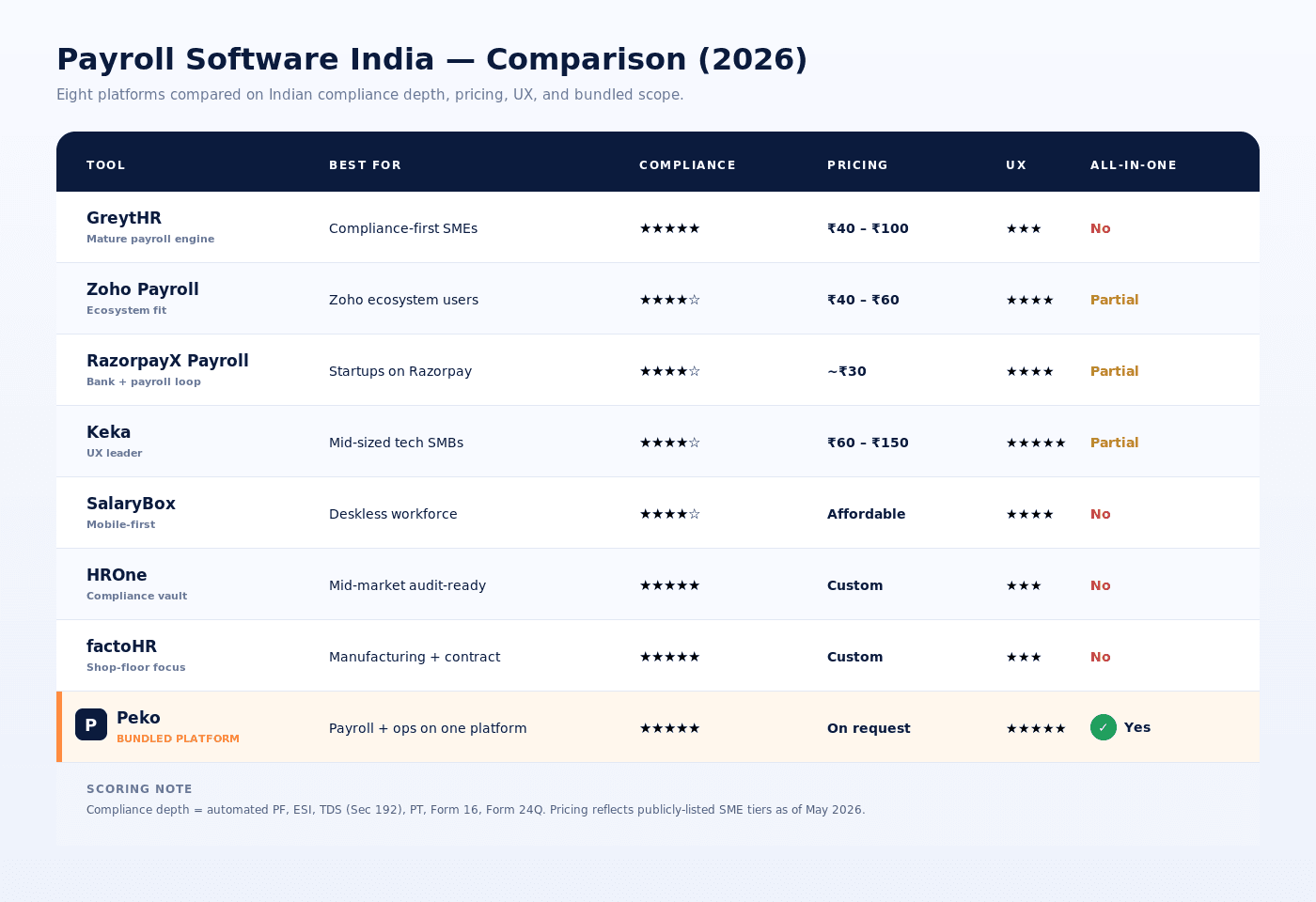
Payroll Software India — Comparison Table (2026)
| Tool | Best For | Compliance Depth | Pricing (₹/emp/month) | Best UX | All-in-One Platform |
|---|---|---|---|---|---|
| GreytHR | Mature payroll engine | ⭐⭐⭐⭐⭐ | ₹40–₹100 | ⭐⭐⭐ | No |
| Zoho Payroll | Zoho ecosystem users | ⭐⭐⭐⭐ | ₹40–₹60 | ⭐⭐⭐⭐ | Within Zoho only |
| RazorpayX Payroll | Startups + banking | ⭐⭐⭐⭐ | ~₹30 | ⭐⭐⭐⭐ | Partial |
| Keka | Tech SMBs (UX) | ⭐⭐⭐⭐ | ₹60–₹150 | ⭐⭐⭐⭐⭐ | Partial |
| SalaryBox | Deskless workforce | ⭐⭐⭐⭐ | Affordable | ⭐⭐⭐⭐ | No |
| HROne | Mid-market audit-ready | ⭐⭐⭐⭐⭐ | Custom | ⭐⭐⭐ | No |
| factoHR | Manufacturing | ⭐⭐⭐⭐⭐ | Custom | ⭐⭐⭐ | No |
| Peko | Bundled business platform | ⭐⭐⭐⭐⭐ | On request (bundled) | ⭐⭐⭐⭐⭐ | Yes |
How Payroll Software Handles PF, ESI, TDS, and PT Compliance in India
Statutory compliance is where any payroll platform earns its keep. Here's what good software actually automates.
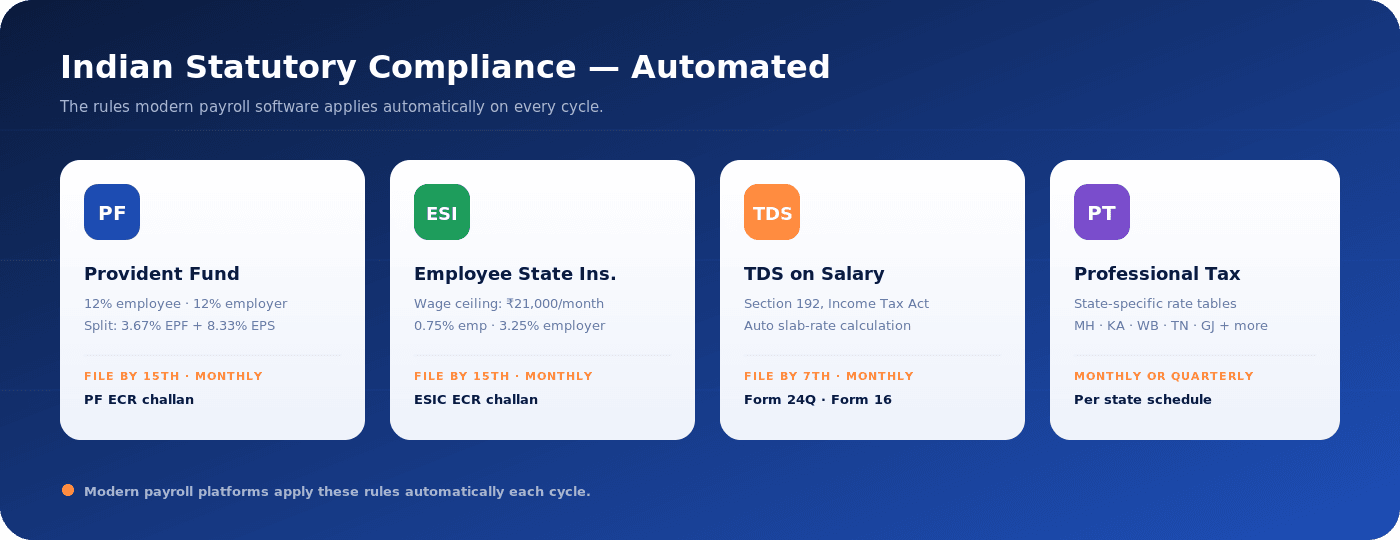
Provident Fund (PF). Every employee earning more than ₹15,000 in basic + DA must contribute 12% to EPF, with the employer matching. The employer's contribution splits — 3.67% to EPF and 8.33% to the Employees' Pension Scheme. Modern platforms calculate this automatically, generate the monthly ECR, and flag the 15th-of-the-month deadline.
Employee State Insurance (ESI). Mandatory for organisations with 10 or more employees in most states. ESI applies to staff earning up to ₹21,000 per month in gross wages — 0.75% employee, 3.25% employer. Modern software validates eligibility on every salary change and generates the ECR for submission.
TDS on salary (Section 192). Tax Deducted at Source under Section 192 follows progressive slab rates and depends on each employee's investment declarations (Section 80C, 80D, HRA exemption, LTA). Quality platforms let employees submit declarations through a portal, validate them, and compute TDS dynamically each month. Form 24Q is filed quarterly; Form 16 is issued annually.
Professional Tax (PT). State-specific — Maharashtra, Karnataka, West Bengal, Tamil Nadu, Andhra Pradesh, Telangana, Gujarat, and others levy it. The best tools handle multi-state PT for distributed teams.
On the Labour Codes. Several payroll platforms are already preparing for Labour Code wage-definition updates expected to impact PF calculations once the codes are fully notified. The four consolidated Labour Codes (Wages, Industrial Relations, Social Security, Occupational Safety) were passed by Parliament in 2019–2020 and have been progressing through phased state-level implementation since. For SMEs, the practical step is to keep your payroll software current and check with a tax advisor before making structural compensation changes. For authoritative updates, see the Ministry of Labour & Employment.
Statutory reference points: EPFO, ESIC, Income Tax Department.
Free resource - Indian Payroll Compliance Calendar 2026
We've put together a free downloadable PDF calendar of every monthly, quarterly, and annual payroll deadline an Indian SME needs to track in 2026 - PF (15th), ESI (15th), TDS (7th), quarterly Form 24Q, Form 16 issue, PT state schedules, and the year-end financial-year-close checklist. Pin it to your office wall or to the calendar in your accounting system. (Available as a downloadable asset alongside this guide - coming soon.)
Manual Payroll vs Automated Software: When Does the Switch Pay Off?
A common founder question: should we just hire someone to do payroll instead?
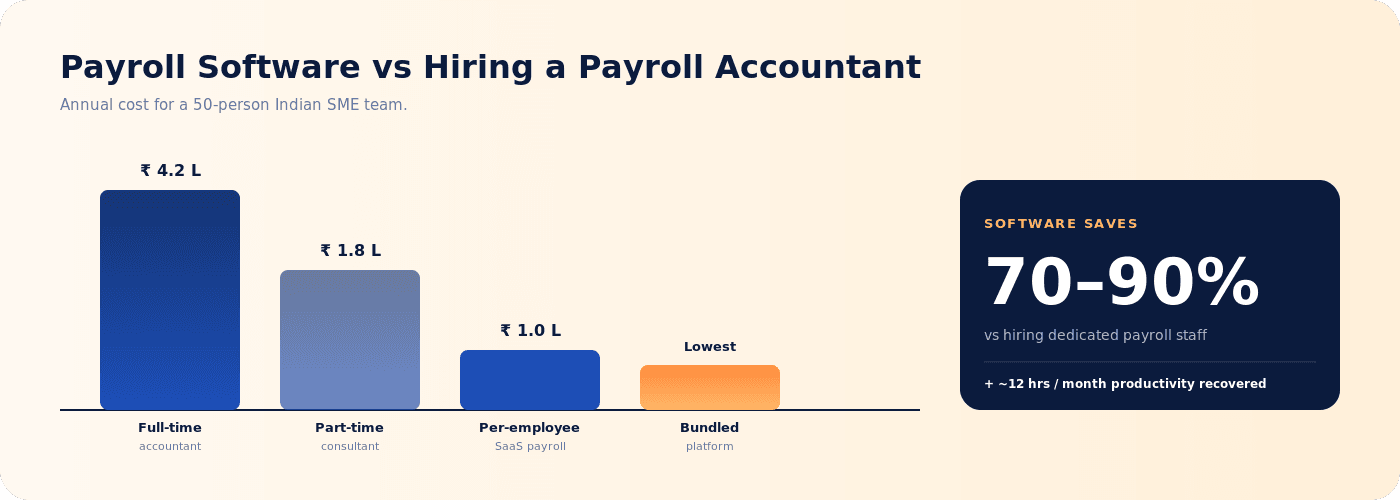
| Approach | Annual cost (50-person team) | Notes |
|---|---|---|
| Full-time payroll accountant | ₹1.8L–₹4.2L | ₹15,000–₹35,000/month |
| Part-time payroll consultant | ₹60K–₹1.8L | ₹5,000–₹15,000/month |
| Cloud payroll software (per-emp) | ₹25,000–₹1L | ₹500–₹2,000/employee/year |
| All-in-one platform (bundled) | Variable | Replaces multiple point tools |
Cloud payroll software is typically 70–90% cheaper than hiring dedicated staff, with no leave, no attrition, no training cost, and no compounding salary increases as your team scales. The qualitative difference matters too: software gives you audit-ready records every cycle, where staff turnover can create handoff gaps.
That said, the right answer for very small teams (under 10 employees) may still be a fractional consultant — software has a setup overhead that needs to amortise.
Payroll Outsourcing vs Payroll Software: Which Makes Sense for Your SME?
A second strategic question Indian SMEs face: should you outsource payroll to a CA firm or HR consultancy, or run it in-house on a software platform? Both work, the answer depends on company stage and how much real-time visibility you need.
The case for outsourcing. Outsourcing makes sense for very small teams (under 10–15 employees) where a CA already handles your books and adding payroll to their scope is cheap, or for companies in highly regulated industries where the CA's professional indemnity gives an additional liability shield. Typical outsourced payroll cost: ₹5,000–₹15,000 per month for a small team, scaling with headcount and complexity.
The case for software. Software makes sense the moment your team starts asking questions the CA can't answer in real time "Why is my HRA different this month?", "When do I get my Form 16?", "Can I download last year's payslip?" Software gives employees self-service. It also gives the founder a live dashboard rather than a monthly email from the CA.
The most common pattern in 2026. A hybrid model: payroll software runs the cycle, and a CA firm reviews quarterly returns and year-end TDS. This combines automation with professional oversight without paying for both at full scope. The CA becomes an advisor on the edges (audit, year-end, complex compensation events) rather than a bottleneck on every cycle.
Where the maths actually changes. Once you cross roughly 30 employees, the per-employee cost of outsourced payroll typically exceeds software pricing. Once you cross roughly 50 employees, the operational risk of single-point-of-failure outsourcing CA on leave, document delays, response times usually tips the decision toward software.
A quick honesty test if you're currently outsourced: ask your CA firm whether they themselves use payroll software internally to deliver your account. Most do. The question is whether that software should sit with them or with you.
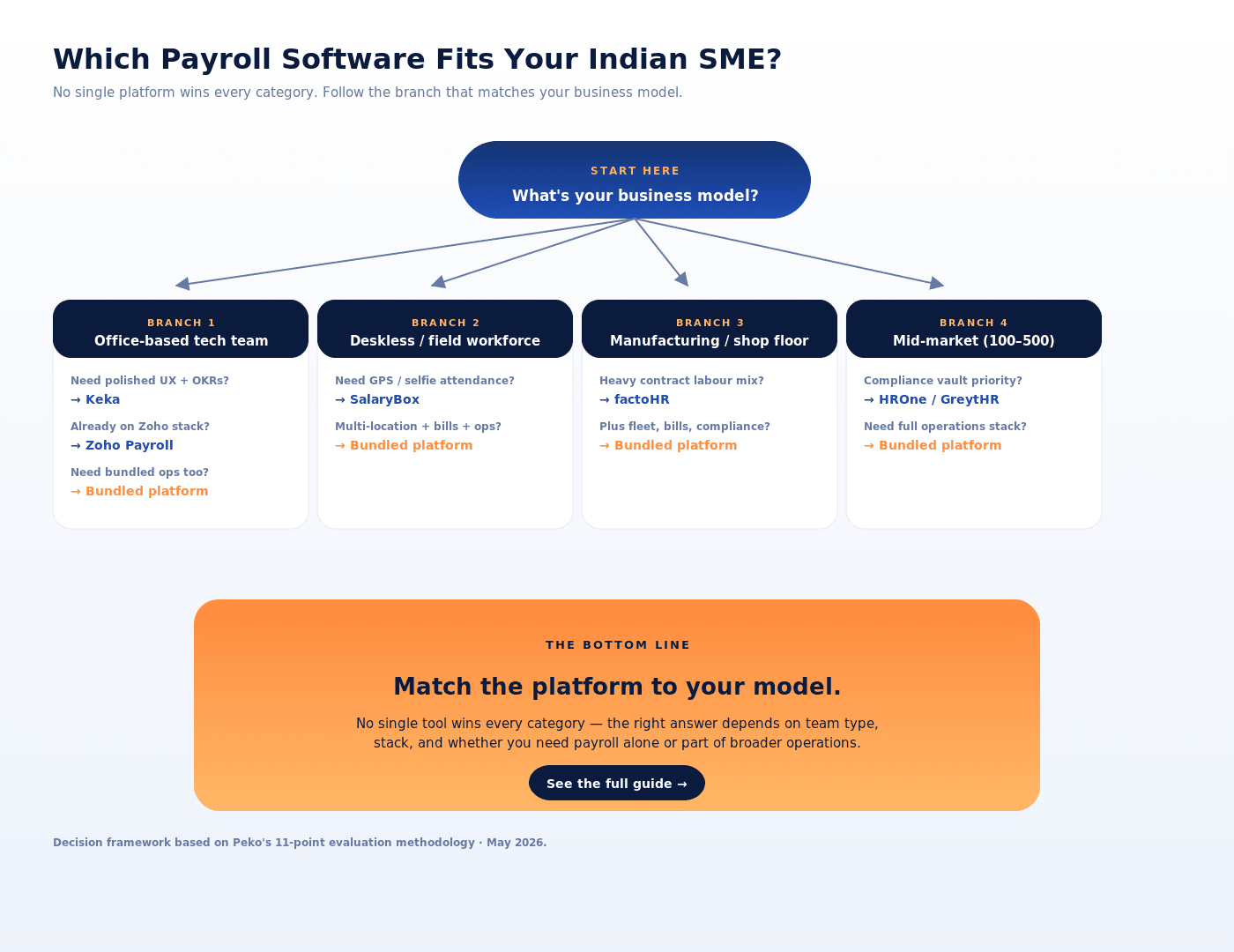
How to Choose: A Decision Framework
Step 1 — Map your business model.
- Office-based tech team? → Keka.
- Deskless or field workforce? → SalaryBox.
- Manufacturing with contract labour? → factoHR.
- Already on Zoho? → Zoho Payroll.
- Already on Razorpay? → RazorpayX Payroll.
- Want payroll alongside payments, bills, travel, and operations on one platform? → Peko A Bundled Platform.
Step 2: Count your active subscriptions. If you already pay for four or more separate tools across payroll, attendance, expenses, and payments, do the blended-cost maths against a bundled platform. The break-even often surprises founders.
Step 3: Check compliance coverage. Verify the platform handles multi-state Professional Tax (if you have distributed teams) and contract-labour rules (if you employ them). Ask specifically about Labour Code readiness in your operating states.
Step 4: Test the employee experience. A great back-end doesn't matter if employees can't access payslips or submit declarations. Pilot the mobile app and self-service portal before signing.
Step 5: Negotiate. Most Indian payroll vendors discount 10–25% on annual contracts. Bundled platforms can sometimes deliver effective savings that beat any single-tool discount.
Real-World Payroll Pain Points: What Indian HR Leaders Actually Tell Us
Patterns we hear from HR leads and SME founders across India:
"We didn't realise we needed ESI until we crossed 10 employees mid-quarter." A common scenario for fast-growing services and tech teams. The wage threshold catches them mid-cycle and the back-liability calculation is unpleasant. Tools that auto-flag eligibility transitions prevent this.
"My payroll person quit and took six years of context with her." Single-person dependency is the most under-discussed payroll risk in Indian SMEs. The fix isn't a better employee, it's externalising the institutional knowledge into a system that survives staff turnover.
"The Diwali bonus cycle broke our spreadsheet." Festival bonuses, exit settlements, and joining bonuses all sit outside standard salary structures. Excel handles them poorly. Most modern platforms have separate workflows for off-cycle payments and pro-rata calculations.
"We got an EPFO notice and the founder found out from the postman." Compliance notices land at the registered office, not on the HR lead's inbox. Founders end up firefighting payroll issues they had no visibility into. Platforms with role-based audit dashboards solve the visibility gap.
"Our employees can't get Form 16 in time for ITR filing." Annual Form 16 generation is a perennial bottleneck. Automated platforms generate Form 16 once the financial year closes and TDS reconciliation is complete, usually within two weeks of 31 March.
None of these are catastrophic individually. They're cumulative. The cost of manual payroll isn't a single failure; it's a slow, recurring tax on the company's attention.
Migrating from Manual or Spreadsheet Payroll
Migration is the moment most SMEs hesitate. It's straightforward if you sequence it well:
- Export current data → employee master, salary history, leave balances, statutory IDs (PF UAN, ESI IP number, PAN, Aadhaar).
- Import into the new platform → most vendors offer a guided import template.
- Validate → randomly sample 10 –15 employees and reconcile against the last manual payslip.
- Run a parallel cycle → process one month on both systems and compare line-by-line.
- Cut over → once parallel is clean, run the next cycle only on the new platform.
- Train your team → managers on approvals, employees on self-service.
For teams under 100 employees, this usually takes 1–2 weeks. Larger teams take 3–4 weeks because of historical data reconciliation.
Further Reading
If payroll is part of a broader business-setup or operations question for you, these adjacent guides may be useful:
- Peko Payroll & HR product overview → features, supported banks, and how the platform handles the statutory stack.
- Peko Bill Payments / BBPS → utility bill payments via the Bharat Bill Payment System.
- Peko Corporate Travel → flights, hotels, eSIM, and expense capture for business trips.
- Peko Compliance → broader compliance workflows beyond payroll.
- Peko India homepage → full platform overview.
A Final Note on Trust and Methodology
This guide is opinionated, every comparison piece is. We've tried to be honest about where each competitor is genuinely strong, including categories where they outperform us. Pricing data and feature sets are based on publicly available information as of May 2026; per-employee pricing and product capabilities change frequently, so always verify with the vendor before signing. The internal benchmark data is drawn from observed customer payroll cycles and your own numbers will vary based on team complexity, industry, and data hygiene.
If you spot anything in this guide that's out of date or that you think we've got wrong, email us at reach@peko.one. We update this page regularly.
Sources & references:
Employees' Provident Fund Organisation (EPFO) · Employees' State Insurance Corporation (ESIC) · Income Tax Department of India · Ministry of Labour & Employment · Press Information Bureau · CII Survey on SME Payroll Practices (2024) · Peko internal customer benchmarks (2025–2026).