- Blogs
- Accounting
- Best Accounting Software UAE 2026: Peko vs Top Providers
Jul 27, 2026
Best Accounting Software UAE 2026: Peko vs Top Providers
Share this article
- How Peko's AI Accounting Service Compares to the Top Providers
- What "AI Accounting" Actually Means for UAE SMEs Right Now
- How We Compared the Best Accounting Software in the UAE
- Peko's Accounting Service: What You Actually Get
- Peko vs the Top Accounting Software and Services in the UAE
- Where AI Genuinely Helps and Where UAE SMEs Still Need a Human
- E-Invoicing and Corporate Tax Changes Every UAE SME Needs to Track in 2026-2027
- Which Industries and Business Types This Applies To
- Frequently asked Questions About AI Accounting
- Final Thoughts
How Peko's AI Accounting Service Compares to the Top Providers
TL;DR
- The UAE now runs on AI faster than almost anywhere else on earth, and accounting is one of the first back-office jobs feeling it: automated categorisation, VAT-ready data capture and early fraud flags are standard on most platforms by 2026.
- Pure accounting software (Zoho Books, QuickBooks, Xero, Wafeq, Tally, Sage) still needs someone in-house to run it. AI-native services such as Peko, Paci.ai and Kitaab.ai bundle a dedicated accountant into the subscription instead.
- Peko's accounting service starts at AED 499 a month and pairs AI bookkeeping with a real accountant, VAT and corporate tax filing support, and fractional CFO access, inside the same platform that already runs invoicing, payroll and corporate cards.
- Two 2026-2027 deadlines matter more than any feature comparison this year: the phased e-invoicing mandate starting July 2026, and the Small Business Relief election window closing 31 December 2026.
Search for the best accounting software UAE has to offer and you will land on a dozen near-identical top-10 listicles, most of them ranking the same six software brands in a different order. That is not what a UAE SME actually needs to decide right now. The real question is whether you want a tool you (or someone you hire) has to operate, or a service that hands you the finished books, filings and a person to call when the Federal Tax Authority sends a letter. This piece compares Peko's AI accounting service against the software and firms UAE businesses actually shortlist, including where AI genuinely changes the math and where it does not.
What "AI Accounting" Actually Means for UAE SMEs Right Now
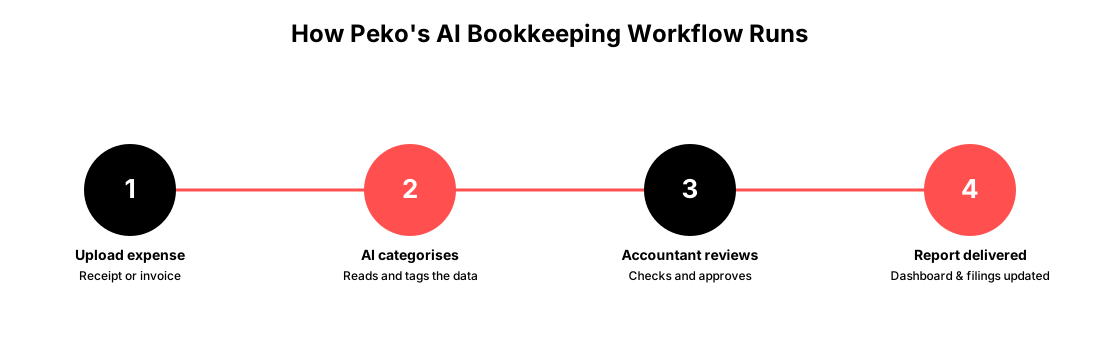
Strip away the marketing and AI accounting in the UAE, in 2026, boils down to three concrete jobs: reading receipts and invoices well enough to categorise them without a human typing anything, matching bank transactions to the right ledger entry automatically, and flagging anomalies before they become a filing problem. None of it replaces the accountant. It removes the typing.
That distinction matters because UAE adoption of AI tools, broadly, is not hype. The UAE recorded a 70.1 percent AI usage rate among its working-age population in the first quarter of 2026, roughly four times the 17.8 percent global average, according to Microsoft's AI Diffusion Report as covered by Khaleej Times. Finance teams are part of that wave. Vendors serving the local market report meaningful cuts to manual data entry and reconciliation time once AI categorisation is switched on, though the exact percentage varies by how messy a company's existing books are, so treat any single vendor's efficiency number as directional rather than gospel.
Two forces are pushing UAE SMEs toward AI-assisted books faster than pure curiosity would. Corporate tax has been live since 2023 and most small businesses are past their first or second filing cycle, which exposes how much manual reconciliation actually costs. And the FTA's e-invoicing mandate, covered in detail further down, requires structured, machine-readable invoice data that manual bookkeeping was never built to produce cleanly.
How We Compared the Best Accounting Software in the UAE
Every provider below was measured against the same six questions, not a feature checklist a vendor wrote about itself: how much of the actual bookkeeping does the AI automate versus just display, does a qualified UAE accountant review and sign off the numbers, is there direct support for VAT and corporate tax filing, is the platform ready for PINT-AE e-invoicing, is pricing transparent with no setup fees buried in a sales call, and does it work for a business with zero in-house finance headcount.
That last filter matters more than most comparison posts admit. A tool can score well on AI depth and still be the wrong pick for a ten-person agency with nobody who wants to learn accounting software. That is the gap this comparison is built to expose.
Peko's Accounting Service: What You Actually Get
Peko treats accounting as a managed service rather than a spreadsheet with an AI layer bolted on. Subscribers get AI-powered bookkeeping that automates routine categorisation, a dedicated accountant who reviews the books and handles VAT and corporate tax filing support, fractional CFO access for cash-flow guidance without a full-time hire, and an interactive tax dashboard, all inside the same account that already runs invoicing, payroll and corporate cards for a UAE SME.
| Plan | Price (AED/month) | Best for | Included |
|---|---|---|---|
| Starter | 499 | Testing core accounting essentials | Up to 50 invoices, dedicated accountant, 4 accountant meetings, monthly reconciliation, financial dashboard, weekly summary |
| Growth | 999 | Freelancers and small teams | Up to 100 invoices, up to 200 expenses, 12 accountant meetings, weekly reconciliation, VAT registration and filing |
| Enterprise | 1,999 | Larger or fast-growing companies | Unlimited expenses and meetings, daily reconciliation on request, customised reporting, free Zoho or Wafeq integration on the standard plan |
The bundling is the point. A business paying AED 999 a month for Xero or QuickBooks still needs to pay a bookkeeper or accountant on top, which typically runs another AED 1,500 to 3,000 a month for a small UAE company according to outsourced-accounting quotes in the market. Peko's Growth plan covers software and the accountant for less than most businesses pay for either one alone. For a company already running invoicing or payroll through Peko, accounting slots into the same login instead of adding a fourth or fifth app to reconcile against.
Peko vs the Top Accounting Software and Services in the UAE
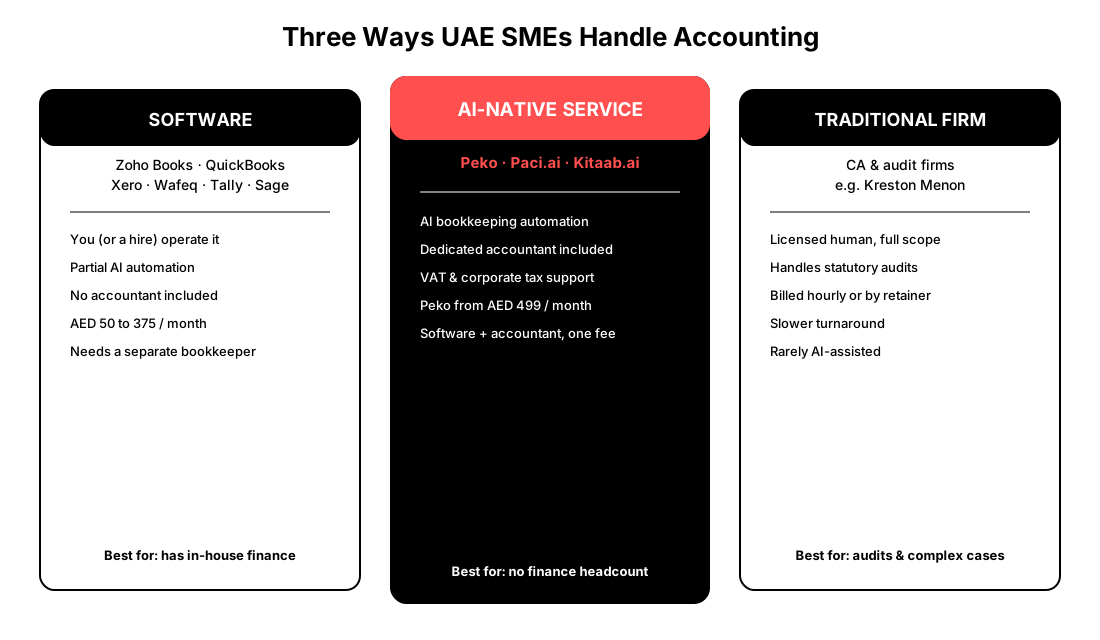
Line up every option a UAE business actually shortlists and the market splits into three tiers: dedicated software you or a hire has to operate, AI-native services that bundle a human accountant into the subscription, and traditional accounting or audit firms that bill by the hour or by engagement. Which tier wins depends almost entirely on whether the business already has someone in-house who can run accounting software competently.
Pure Software: Zoho Books, QuickBooks, Xero, Wafeq, Tally and Sage
Zoho Books carries formal FTA accreditation and a strong built-in UAE VAT module, with UAE pricing running roughly AED 55 to 220 a month depending on the tier, and a free plan for single-user setups. It suits businesses already inside the Zoho ecosystem. QuickBooks Online is the fastest to set up for a founder with no accounting background, with plans from around AED 50 a month up to roughly AED 375 for the Plus tier, though its UAE-specific VAT and corporate tax localisation is thinner than Zoho's or Wafeq's. Xero is the strongest pick for multi-currency reconciliation and accountant collaboration, priced from roughly AED 60 to 175 a month, which explains why it shows up so often in accountant-recommended stacks rather than founder-chosen ones. Wafeq and Tally lean hardest into UAE and GCC-specific tax logic, with Wafeq starting around fifteen to nineteen US dollars a month and marketing itself directly at e-invoicing readiness, while Sage sits at the enterprise end of the same category. None of these six count as a service. Every one of them assumes a person on the other side of the screen who already knows what a chart of accounts is.
AI-Native Accounting Services: Peko, Paci.ai and Kitaab.ai
This is Peko's actual competitive set, and it is newer and thinner than the software category above. Paci.ai pairs AI-driven reconciliation and receipt processing with a team of UAE tax specialists, serving reportedly over a thousand startups and SMEs, and covers accounting, tax and books cleanup end to end. Kitaab.ai runs a similar model it calls "software with a service," where AI extracts data from uploaded documents and a personal accountant reviews and approves it before the books update. Peko's differentiation inside this group is the platform breadth: accounting sits alongside corporate cards, payroll, invoicing and bill payments rather than standing alone, and Peko's pricing structure (flat AED 499 to 1,999 tiers) is more transparent upfront than the "book a call for pricing" pattern common among newer AI-accounting startups.
Traditional Accounting and Audit Firms
Established firms such as Kreston Menon and similar Dubai-based practices still lead search results for pure "accounting firm" queries, and for good reason: statutory audits, complex multi-entity structures and disputes with the FTA still need a licensed human professional with signing authority, something no AI-native platform claims to replace. The trade-off is cost and turnaround. Hourly or retainer billing from a mid-size firm commonly runs well above the flat monthly fee of any AI-native service, and response times move at the firm's schedule, not a dashboard's.
| Provider | Type | AI bookkeeping | Dedicated human accountant | VAT/CT filing support | E-invoicing readiness | Starting price (AED/month, approx.) |
|---|---|---|---|---|---|---|
| Peko | AI-native service | Yes, automated categorisation | Yes, included at every tier | Yes, included from Growth tier | Integrates with FTA-accredited providers | 499 |
| Paci.ai | AI-native service | Yes | Yes, expert team | Yes | Positioned as e-invoicing ready | Custom quote |
| Kitaab.ai | AI-native service | Yes | Yes, personal accountant | Yes | Positioned as e-invoicing ready | Custom quote |
| Zoho Books | Software | Partial automation | No, self-managed | VAT yes, CT partial | FTA accredited, needs ASP for PINT-AE transmission | approx. 55 |
| QuickBooks | Software | Partial automation | No, self-managed | Basic VAT support | Requires third-party ASP integration | approx. 50 |
| Xero | Software | Partial automation | No, self-managed | VAT yes, multi-currency strength | Requires third-party ASP integration | approx. 60 |
| Wafeq | Software | Partial automation | No, self-managed | Strong UAE/GCC VAT logic | Markets itself as e-invoicing certified | approx. 55 (USD 15) |
| Traditional CA firm | Professional service | Rare | Yes, licensed accountant | Yes, full scope including audit | Varies by firm | No flat rate, billed by engagement |
Where AI Genuinely Helps and Where UAE SMEs Still Need a Human
AI earns its place in three narrow but real jobs: catching a duplicate or clearly anomalous transaction before month-end close, auto-populating VAT return line items from correctly tagged transactions so filing is less of a scramble, and giving a founder same-day visibility into cash position instead of waiting for a monthly close. UAE banks and larger financial institutions already run comparable fraud-detection models, and that same pattern-matching approach is filtering down into SME-grade accounting tools.
What AI still cannot do, in the UAE or anywhere else, is interpret ambiguous transactions with business context, defend a position to the FTA during a query, make the EmaraTax election for Small Business Relief on your behalf, or take legal responsibility for a filing. The firms and services performing best in this market right now, from Peko to Kitaab.ai to the traditional CA firms, all keep a licensed human in the approval loop for exactly that reason. Anyone selling "fully autonomous accounting" for a UAE SME in 2026 is selling ahead of both the technology and the compliance reality.
E-Invoicing and Corporate Tax Changes Every UAE SME Needs to Track in 2026-2027
Two dates on the calendar will affect a UAE SME's accounting choice more than any AI feature list this year. The e-invoicing mandate rolls out in phases starting with a pilot from 1 July 2026. Large businesses with revenue above AED 50 million must appoint an FTA-accredited service provider by 30 October 2026 and go live on 1 January 2027. Every remaining business must appoint an ASP by 31 March 2027 and go live by 1 July 2027, with government entities following on 1 October 2027. Invoices under the mandate must be issued in the PINT-AE structured XML format and transmitted through an accredited provider on the Peppol network, per the Federal Tax Authority's e-invoicing programme.
Separately, Small Business Relief lets a UAE resident business with revenue at or below AED 3 million elect to be treated as having zero taxable income for corporate tax purposes, but only for tax periods ending on or before 31 December 2026, and only if the election is actively made on EmaraTax when filing, per the FTA's Small Business Relief guidance. Miss the election and the relief is forfeited for that period even for an otherwise fully eligible business. Peko's own business finance tips pillar walks through the Emara-Tax election steps in more detail, and the platform's invoicing tools are being built toward PINT-AE compliance ahead of the SME go-live window.
None of this is legal or tax advice. Deadlines, thresholds and eligibility rules shift, and a UAE SME should confirm its specific position with a qualified tax advisor or directly with the Federal Tax Authority before making an EmaraTax election or choosing an accredited service provider.
Which Industries and Business Types This Applies To
E-commerce sellers reconciling payouts across three or four marketplaces need automated matching more than almost anyone, since manually tracing a Shopify or Amazon payout back to individual orders is exactly the kind of repetitive task AI categorisation is built for. Free zone startups that formed a company but never hired a finance person are the other obvious fit: the accounting problem does not disappear because there is no headcount for it, it just gets pushed onto a founder who would rather be selling. Agencies and consultancies invoicing five or more clients a month benefit from the same automated reconciliation, since late payments and partial payments across multiple clients are where manual books usually break down first. Restaurants, retail outlets and any business with high daily transaction volume need the reconciliation speed an AI layer provides, because a weekly manual reconciliation on hundreds of small transactions a day falls behind fast. Growing SMEs approaching the AED 3 million Small Business Relief threshold, or the 2027 e-invoicing go-live, need accurate books now specifically because both of those deadlines require clean historical data to act on correctly. And solo founders or freelancers who cannot justify a full-time accountant but still face VAT and corporate tax obligations are, in practice, the exact customer AI-native services like Peko were built for.
Frequently asked Questions About AI Accounting
What is AI accounting and how does it help UAE SMEs?
AI accounting uses machine learning to automatically categorise transactions, extract data from receipts and invoices, and flag unusual activity, cutting the manual data entry that used to consume hours of a UAE SME's week. It works alongside a human accountant rather than replacing the review and sign-off a business still needs for VAT, corporate tax and audit purposes.
Which is the best accounting software in the UAE for a small business with no in-house finance team?
For a business with zero finance headcount, an AI-native service that bundles a dedicated accountant, such as Peko, Paci.ai or Kitaab.ai, tends to fit better than standalone software like Zoho Books, QuickBooks or Xero, all of which still require someone in-house to operate them and interpret the output.
Is Peko's AI accounting service better than Zoho Books or QuickBooks for a UAE SME?
It depends on whether the business already has someone who can run accounting software competently. Zoho Books and QuickBooks are strong, affordable tools for a business with an internal bookkeeper. Peko is built for businesses that would rather pay one flat fee for software, AI automation and a dedicated accountant together, without hiring or managing a separate bookkeeper.
Can AI accounting software handle UAE VAT and corporate tax filing on its own?
No current platform files VAT or corporate tax returns fully unattended in the UAE. AI can auto-populate return line items from correctly categorised transactions, but a qualified accountant still needs to review the filing, make elections such as Small Business Relief on Emara-Tax, and take responsibility for its accuracy.
How much does an AI-powered accounting service cost in the UAE compared to standalone accounting software?
Standalone software like Zoho Books, Xero or Quick-Books runs roughly AED 50 to 375 a month depending on the plan, but still requires a separate bookkeeper or accountant, typically adding AED 1,500 or more a month. AI-native services such as Peko bundle both for a single flat fee starting at AED 499 a month, which often works out cheaper than paying for software and a part-time accountant separately.
Do UAE SMEs still need a human accountant if they use AI accounting software?
Yes. AI reduces manual data entry and speeds up reconciliation, but UAE VAT registration, corporate tax filing, Emara-Tax elections and any FTA correspondence still require a person with the relevant qualification and legal accountability. Every credible accounting service operating in the UAE, AI-native or traditional, keeps a human accountant in that role.
Final Thoughts
The AI accounting story in the UAE is real, but it is not the story most vendors are telling. The winning products in this market are not the ones with the flashiest AI demo. They are the ones that quietly remove the parts of bookkeeping nobody wanted to do in the first place, while keeping a qualified person accountable for the parts that actually carry legal weight. Peko's bet, and the reason it is built into the same platform as invoicing, payroll and corporate cards rather than sold as a standalone tool, is that most UAE SMEs do not want another piece of software to learn. They want the accounting problem handled. If that sounds closer to what your business needs than another dashboard to configure, is worth a direct comparison against whatever you are running today, especially with e-invoicing deadlines now on the calendar.